
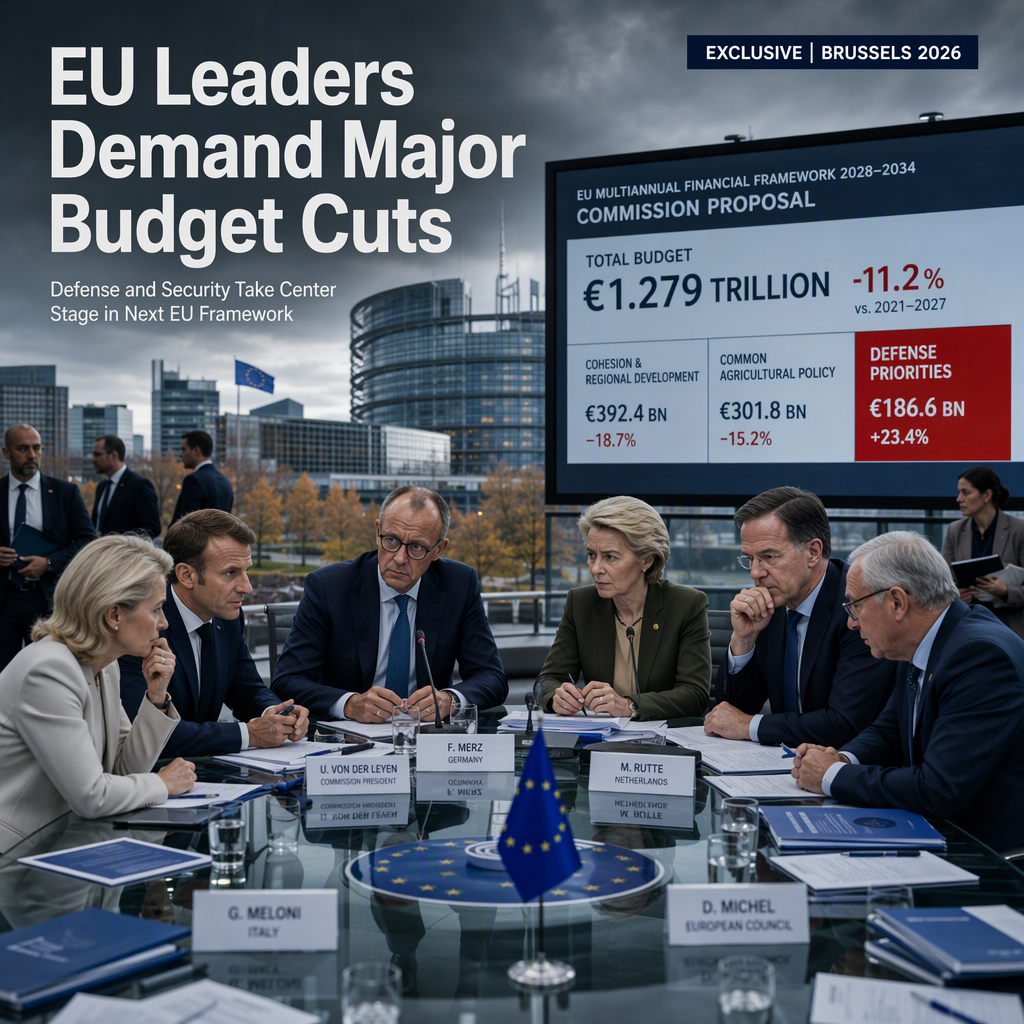
On September 30, 2026, the leaders of Germany, Denmark, the Netherlands, Austria, Finland, and Sweden issued a joint letter to EU officials calling for a drastic reduction in the European Union's next long-term budget, the Multiannual Financial Framework (MFF), which covers the period from 2028 to 2034 [1]. The six leaders, including German Chancellor Friedrich Merz, argued that the current European Commission proposal of almost 2 trillion euros ($2.3 trillion) 'will need to be reduced by several hundred billion euros' to prioritize spending on defense, security, innovation, and addressing irregular migration [1].
The letter, addressed to Irish Taoiseach Micheál Martin and European Council President António Costa, emphasized that the six signatory countries finance almost 40% of all member contributions and shoulder around three quarters of the total financing burden, despite net contributors being in the minority [1]. The leaders stressed that the negotiations are not solely about money but about setting political priorities to achieve 'a strong and sovereign Europe in an uncertain world,' calling for a fundamental reform of the MFF [1].
The push for budget cuts and reallocation comes amid rising government borrowing costs, high inflation, sluggish economic growth, and concerns over increasing budget deficits across the EU [1]. The leaders highlighted the need to focus on defense spending, competitiveness, and the fight against irregular migration, citing increased pressure following Russia's invasion of Ukraine in 2022 and calls from U.S. President Donald Trump for Europe to take greater responsibility for its own defense [1].
NATO members, most of whom are European, have already committed to raising their national defense spending to 5% of GDP by 2035, and the European Commission has proposed a significant increase in regional security funding [1]. The MFF requires unanimous approval from all 27 EU member states, and officials aim to agree on spending priorities and limits by the end of 2026 [1].
CONCLUSION
Germany and five EU allies are demanding substantial cuts to the next EU budget, urging a shift in priorities toward defense and security. With the MFF negotiations set against a backdrop of economic challenges and geopolitical tensions, the outcome will have significant implications for EU fiscal policy and regional stability.