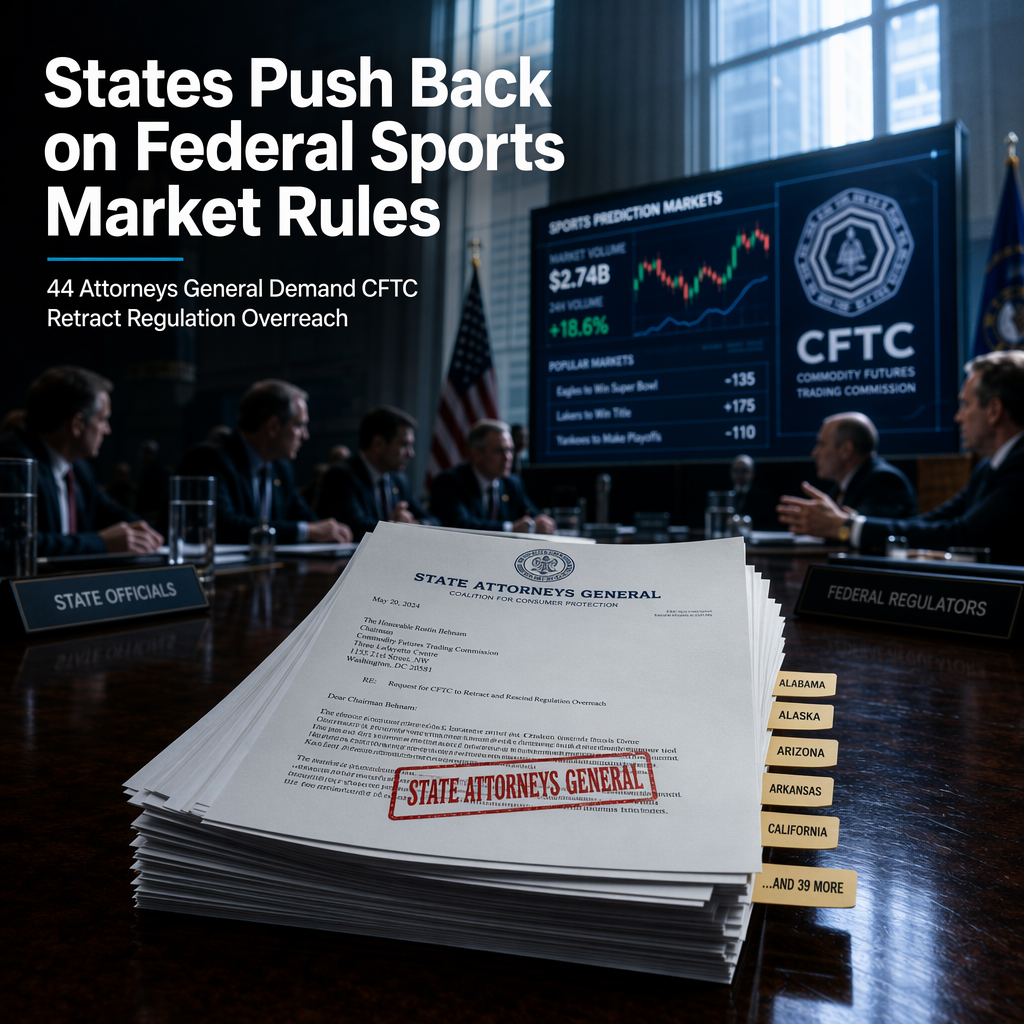
A coalition of 44 state attorneys general, led by Ohio Attorney General Andy Wilson, sent a letter to the Commodity Futures Trading Commission (CFTC) asserting that the agency lacks the authority to regulate sports-related event contracts on prediction market platforms. This letter coincided with the expiration of the public comment period for the CFTC's first proposed rule on prediction market regulation, which primarily targets exchanges' sports offerings [1]. The attorneys general argued that the proposed rule exceeds the CFTC's statutory powers, conflicts with the Constitution, and is arbitrary and capricious in its current form. They urged the CFTC to restart its rulemaking process and clarify that sports bets and gambling should not be traded on designated contract markets, but instead remain under state law jurisdiction [1].
Notably, attorneys general from Florida, Georgia, New Hampshire, Missouri, and Texas did not sign the letter, indicating some divergence among states [1]. The dispute stems from a surge in prediction market exchange volumes, largely driven by the popularity of sports-related contracts during events such as the 2026 FIFA World Cup [1]. The CFTC and prediction market platforms maintain that all event contracts are swaps, a type of derivative regulated by the commission, while states argue that sports-related contracts resemble sports betting, which falls under their regulatory purview [1].
In June, the CFTC released a draft rule focusing on controversial sports-related event contracts and proposed a definition for 'gaming.' The commission defined gaming as an activity done for recreation or entertainment, governed by rules, and based on measurable outcomes determined by skilled activity during the event [1]. CME Group, a major derivatives marketplace, disagreed with this definition, stating that it conflates the sport itself with financial wagering and risks federal preemption of state sports regulations, which CME general counsel Jonathan Marcus called a 'striking overreach' [1].
The CFTC has defended its jurisdiction using federal preemption in court proceedings against states and is currently in litigation with nine states over this issue [1]. CME Group, despite its concerns, acts as sportsbook FanDuel's CFTC-regulated exchange for sports prediction markets [1].
CONCLUSION
The coordinated opposition from 44 states signals significant resistance to federal regulation of sports prediction markets, raising uncertainty for platforms and exchanges. The ongoing jurisdictional battle and litigation suggest continued volatility and potential disruption in the market until regulatory clarity is achieved.