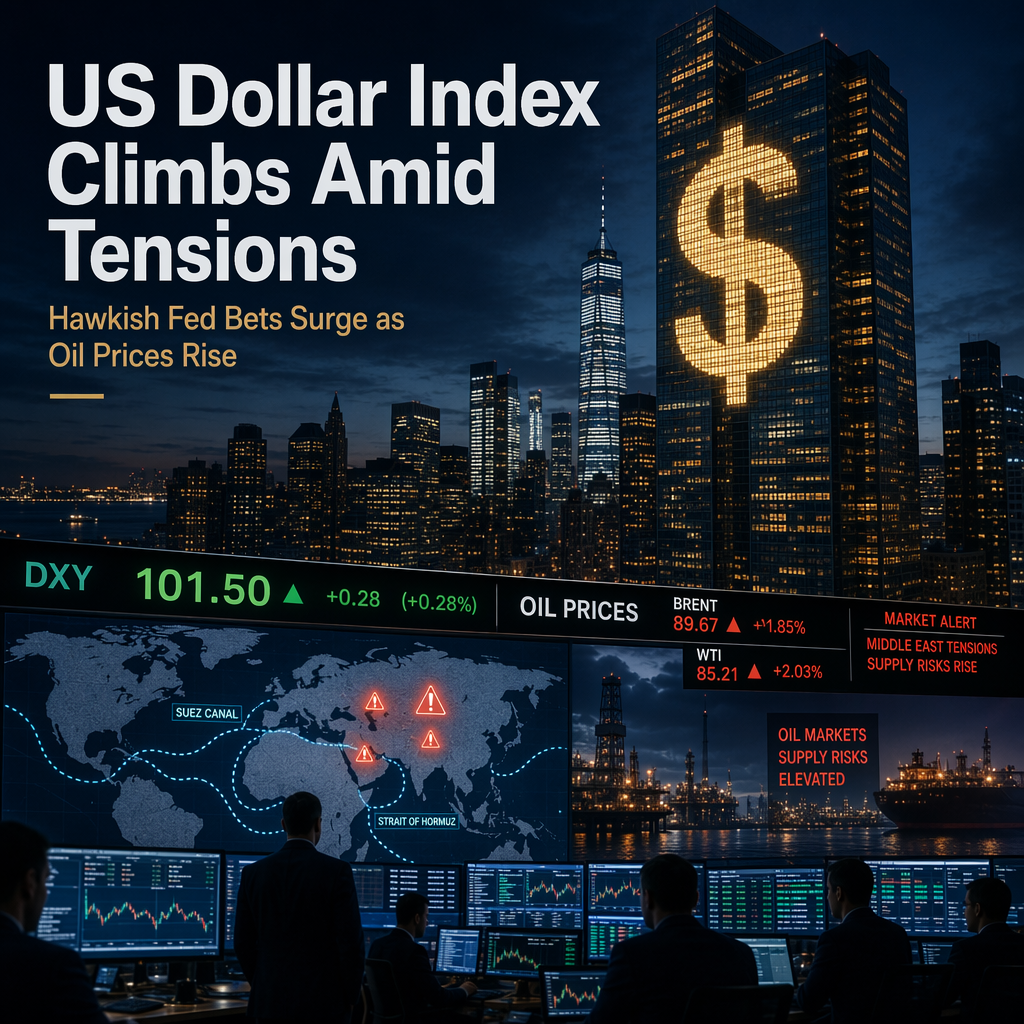
The US Dollar Index (DXY), which measures the Greenback's value against six major currencies, maintained its gains in the Asian session on Friday, trading near a three-week high at 101.50. This strength in the US Dollar is attributed to surging oil prices, driven by intensified risks to Middle East energy supplies, which have in turn revived expectations for a more hawkish stance from the Federal Reserve (Fed) [1].
During the week, the US Dollar was the strongest against the Swiss Franc, appreciating by 1.08%, and also posted notable gains against the British Pound (1.05%), Japanese Yen (0.92%), and Euro (0.43%) [1]. The WTI Oil price, while trading 0.5% lower near $90.60 in Asian trade, remains close to its over six-week high of $92.25 reached on Thursday. The closure of the Bab el-Mandeb Strait and the Strait of Hormuz has disrupted 27% of global energy supply, heightening inflation expectations and discouraging the Fed from adopting looser monetary policy [1].
Geopolitical tensions have escalated, with US President Donald Trump stating that Washington would hold Iran responsible for the actions of Yemen-based Houthis and warning of a forthcoming 'major military punishment' for both Iran and its Houthi allies [1].
Market expectations for a Fed interest rate hike at the upcoming policy meeting have increased sharply, with the CME FedWatch tool indicating a 35.8% probability, up from 11.8% the previous week. These odds had previously eased after softer US Consumer Price Index (CPI) data for June, but have since rebounded amid the current geopolitical and inflationary backdrop [1].
CONCLUSION
The US Dollar Index's resilience near recent highs reflects revived hawkish Fed expectations amid rising oil prices and Middle East supply disruptions. Market participants are now pricing in a higher probability of a Fed rate hike, signaling increased caution and volatility in currency and energy markets.