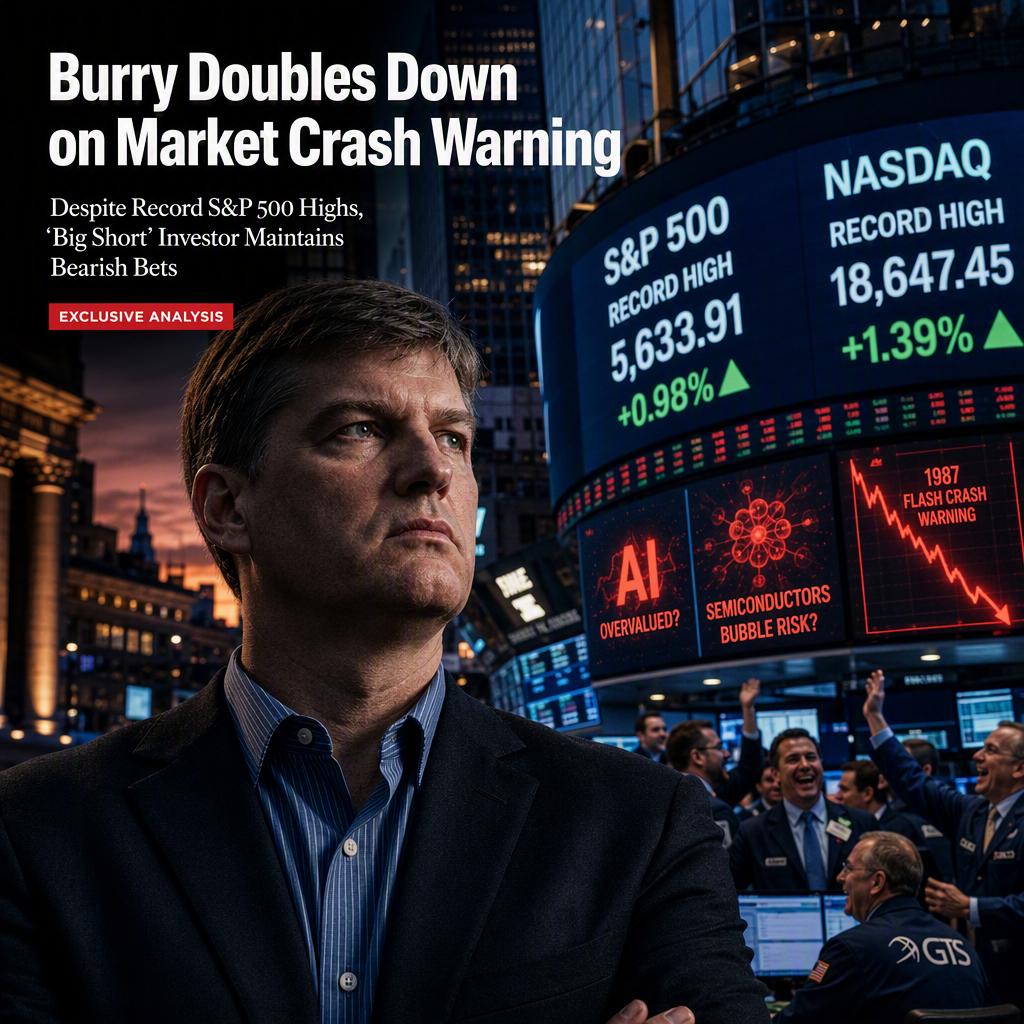
Michael Burry, known for his role in 'The Big Short,' has reiterated his bearish stance on the U.S. stock market even as the S&P 500 surged 1.9% to a record close, its first since June, driven by stronger-than-expected corporate earnings and a decline in oil prices amid optimism about the potential reopening of the Strait of Hormuz to maritime traffic [1]. The Nasdaq Composite also climbed 2.7%, bringing its gain for the first two days of the week to nearly 5% [1].
In a Substack post on Tuesday, Burry warned, 'I continue to believe it is possible we are near a major top, and possible a 1987-type fall, but the S&P 500 making new highs likely will bring new money into the market' [1]. He expressed skepticism about the sustainability of the artificial intelligence boom, arguing that demand for AI infrastructure is being driven by financing arrangements that may not be sustainable [1]. Burry also highlighted that the market's advance is creating a self-reinforcing cycle, with declining volatility encouraging systematic investors to increase exposure, stating, 'the market going up on falling volatility forces vol-targeting funds to leverage up, and brings leverage from other momentum strategies into play' [1].
Despite the ongoing rally, Burry confirmed that he continues to hold short positions in the iShares Semiconductor ETF (SOXX), Micron, Nvidia, Caterpillar, Palantir, Tesla, and Applied Materials [1]. He noted that all of these positions remain profitable except for his bet against Nvidia, and emphasized his confidence in his long-term outlook, though he would cut losses if trades moved decisively against him [1]. Burry cautioned, 'Again, shorting is not for everyone. I must short. Most should not' [1].
CONCLUSION
Michael Burry remains steadfast in his bearish outlook, maintaining short positions against several high-profile stocks and ETFs despite the market's record-setting rally. His warnings of a potential 1987-style crash and skepticism about the AI-driven market advance highlight ongoing concerns about market sustainability. The market, however, continues to attract new investment amid strong earnings and easing geopolitical tensions.