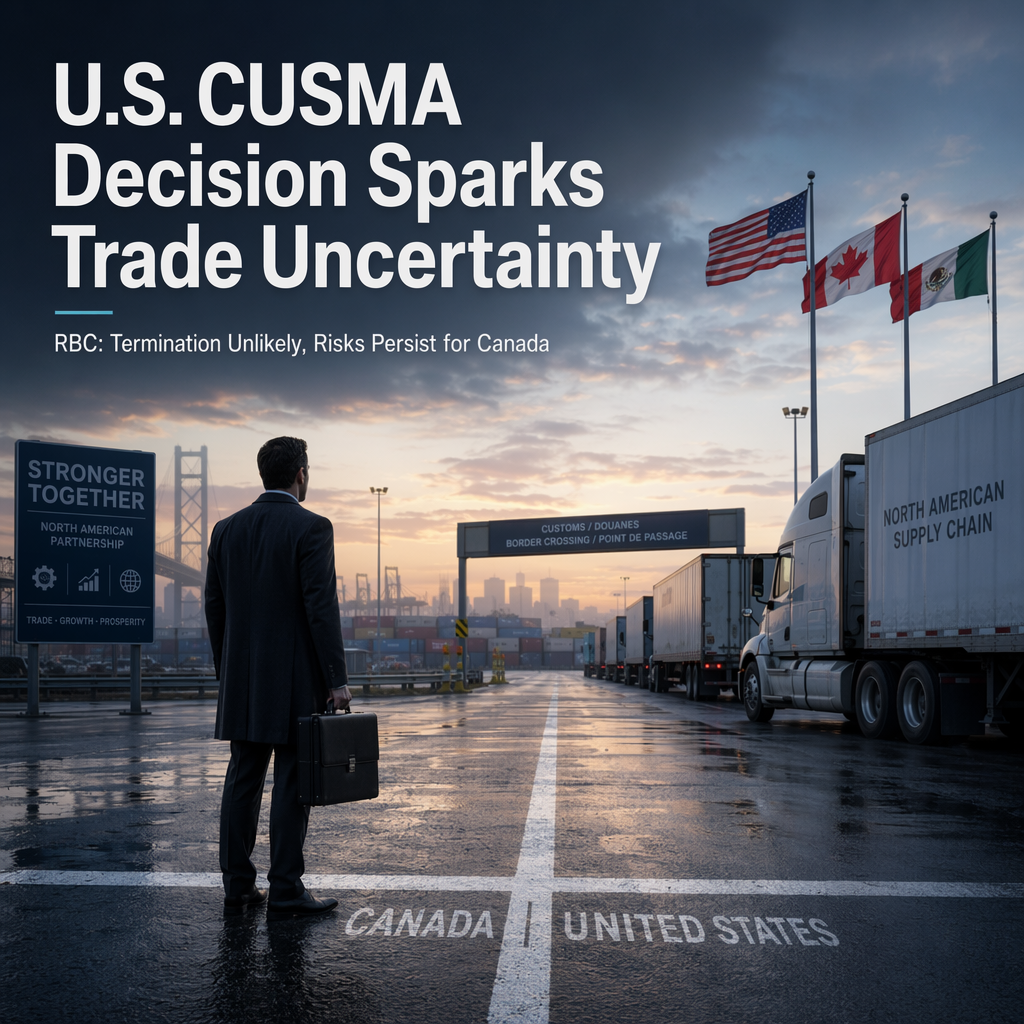
Royal Bank of Canada (RBC) economists Claire Fan and Nathan Janzen analyzed the implications of the U.S. decision on July 1st not to extend the Canada-United States-Mexico Agreement (CUSMA). According to their assessment, this decision does not immediately end the agreement, as CUSMA is set to remain in effect until 2036, with pre-scheduled negotiations over the next decade intended to increase the likelihood of its continuation beyond that date [1].
The economists highlighted that while near-term trade risks for Canada persist, they consider outright termination of CUSMA to be unlikely if economic logic prevails. They noted that, in the unexpected event of CUSMA's failure, the tariff rates that would replace it and the share of exports impacted have both declined, suggesting a somewhat reduced risk profile compared to previous scenarios [1].
RBC expects that the Rules of Origin will be a likely focus in upcoming negotiations, and they emphasize that trade uncertainty is likely to persist regardless of the outcome of these talks [1]. No specific market reactions or analyst forecasts beyond these points were provided in the source.
CONCLUSION
The U.S. decision not to extend CUSMA introduces ongoing trade uncertainty for Canada, but RBC economists believe outright termination of the agreement is unlikely. While some trade risks remain, the potential impact of a CUSMA failure has lessened, and negotiations are expected to focus on Rules of Origin.