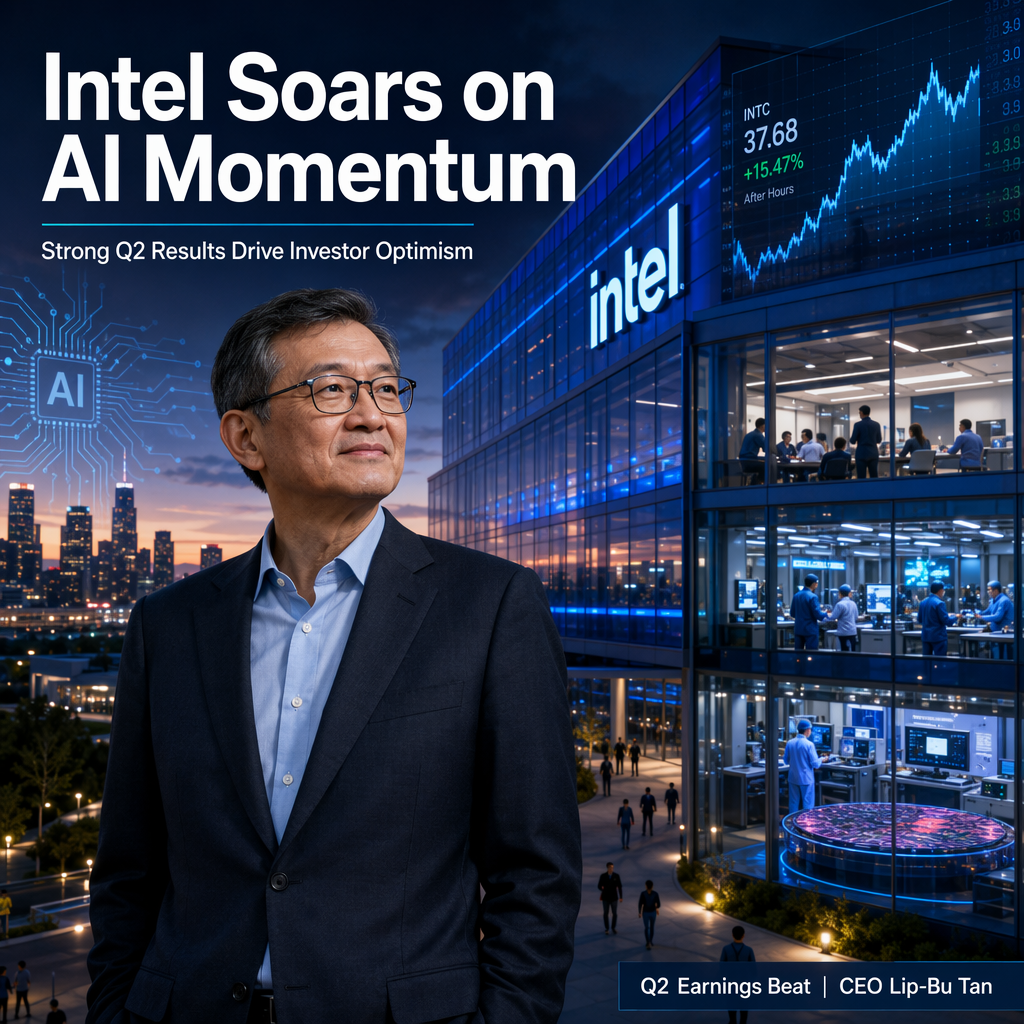
Intel reported a robust second quarter, with revenue rising 25% year over year to $16.1 billion, surpassing the LSEG-compiled consensus estimate of $14.42 billion [1]. Non-GAAP earnings per share (EPS) swung to a 42-cent profit from a 10-cent loss in the same period last year, beating the LSEG estimate of 21 cents [1]. The company also exceeded its own revenue guidance by $1.8 billion and more than doubled its own Non-GAAP EPS forecast, reporting $0.42 versus the company's $0.20 outlook [1].
Shares of Intel rose approximately 4% in after-hours trading, reaching around $104 per share and trading as high as $113 in reaction to the results [1]. The positive momentum is attributed to strong demand for AI infrastructure, particularly Intel's x86 CPUs used for agentic AI tasks, and the strategic importance of its advanced packaging and foundry businesses [1]. The foundry business allows Intel to produce its own AI CPUs without relying on industry leader Taiwan Semiconductor Manufacturing Company (TSMC) [1].
Despite the strong quarter, the company did not announce any major customers for its foundry business, though there have been rumors of partnerships with big names such as Apple. No formal deals have been confirmed as of this report [1]. Intel's capital expenditures are expected to exceed $20 billion in 2026, up roughly $3 billion from prior expectations, with significant increases projected for 2027 as the company invests across its U.S. network [1].
Analysts note that while increased capex can be a concern for tech investors due to uncertainty about returns, these investments are seen as wise given the strong demand and the desire for more U.S.-made chips to reduce geopolitical risk [1]. Based on the strong quarterly performance and positive outlook, the source reiterates a '1' rating and a $140 price target for Intel [1].
CONCLUSION
Intel's strong Q2 results and upbeat outlook under CEO Lip-Bu Tan have boosted investor confidence, driving shares higher. The company's focus on AI infrastructure and U.S.-based manufacturing positions it well for future growth, despite concerns about rising capital expenditures. Analysts remain optimistic, maintaining a positive rating and a higher price target for the stock.