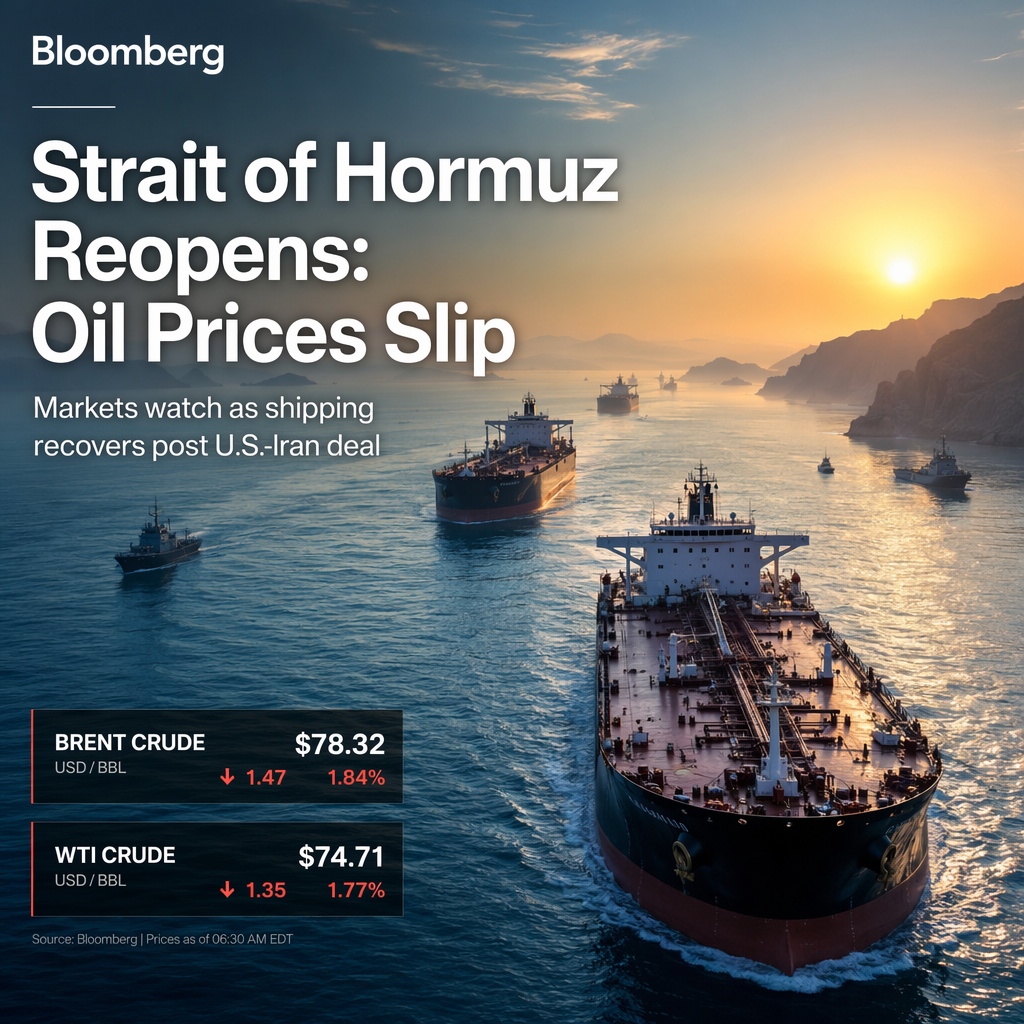
Oil prices experienced choppy trading on Friday as markets responded to the interim U.S.-Iran deal and the subsequent recovery in shipping activity through the Strait of Hormuz [1]. Brent crude futures for August delivery fell 0.45% to $79.49 per barrel, while U.S. West Texas Intermediate (WTI) futures for July declined 0.31% to $76.36 per barrel [1]. Vice President JD Vance reported that tankers carrying more than 12 million barrels crossed the Strait overnight, noting, "The Iranians, for the second night in a row, did not shoot at any ships in the Strait of Hormuz. So far, they are honoring their end of the commitment" [1].
OPEC Secretary General Haitham Al Ghais, in an exclusive interview, stated that OPEC does not expect oil demand to peak in the foreseeable future and rejected International Energy Agency forecasts predicting an upcoming supply glut [1]. Al Ghais emphasized that OPEC focuses on actual numbers and fundamentals rather than speculative forecasts [1].
Market analyst Tiago Lacerda from Axi suggested that oil prices are likely to trade between $75 and $82 a barrel in the near term, with Brent currently down roughly 36% from its peak during the conflict [1]. Lacerda also highlighted ongoing market caution, noting that major shipping lines have yet to resume transits and insurance rates remain elevated, indicating uncertainty about the speed of normalization in the region [1].
The market's attention is now shifting to whether the physical reopening of the Strait will be sustained, as stakeholders monitor the pace at which shipping and insurance conditions return to pre-conflict levels [1].
CONCLUSION
Oil prices edged lower as the reopening of the Strait of Hormuz signaled a tentative recovery in shipping activity following the U.S.-Iran deal. However, market sentiment remains cautious due to elevated insurance rates and the slow resumption of major shipping lines. OPEC maintains a positive demand outlook, countering forecasts of a supply glut.