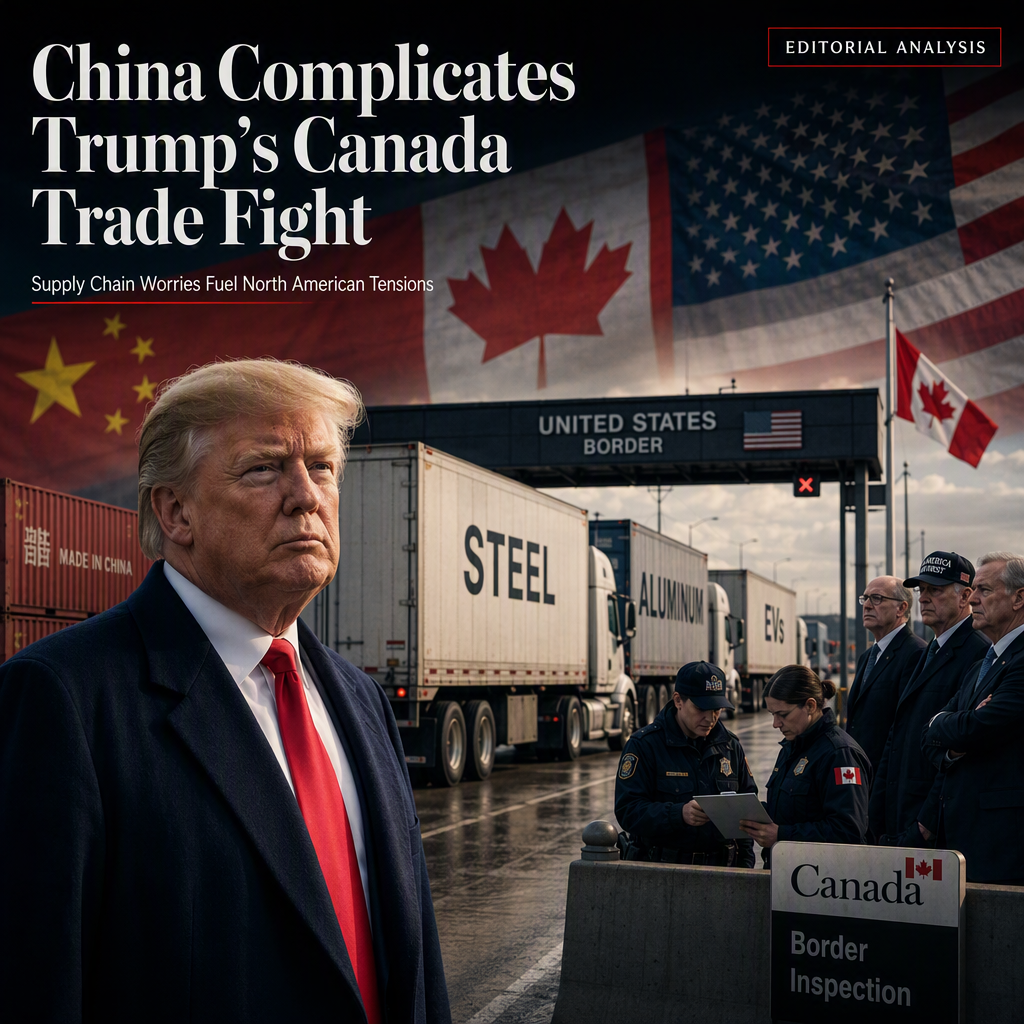
President Donald Trump's latest trade dispute with Canada is being shaped by China's involvement in North American supply chains, particularly concerning steel, aluminum, and other goods. The U.S. is urging Canada to implement stricter measures to prevent Chinese products from entering the U.S. market through transshipment, a process where goods are routed through an intermediary country with minimal processing before reaching their final destination. U.S. officials are concerned that steel and aluminum produced in China could be processed in Canada or Mexico and then enter the U.S. as regional content, circumventing trade restrictions [1].
In 2019, the U.S. and Canada issued a joint statement to resolve a previous steel-and-aluminum tariff dispute, agreeing to prevent transshipment of steel and aluminum made outside their borders and to distinguish between North American and foreign steel. However, U.S. trade hawks now argue that Canada should accept tougher safeguards to further limit China's role in critical manufacturing supply chains [1].
Canada asserts it is already taking steps to restrict foreign steel imports, including imposing limits on imports from countries without a free-trade agreement, such as China, and applying a 50% surcharge once those limits are exceeded. Despite these measures, Canada has recently moved to strengthen economic ties with Beijing. In March, China reopened its market to several Canadian farm and seafood exports, including canola, peas, lobster, and crab. Additionally, Canada established a 49,000-vehicle annual quota for Chinese electric vehicles at the 6.1% most-favored-nation tariff rate, removing a previous 100% surtax. Canada also extended tariff relief for certain Chinese steel and aluminum products deemed in short supply, as part of its broader effort to diversify trade relationships. China is now Canada's second-largest merchandise trading partner [1].
These developments have sparked criticism in Washington, with officials arguing that Canada is moving away from the Trump administration's goal of creating a China-resistant North American trading bloc. The central question for Trump is whether Canada will align with the U.S. approach or whether its efforts to expand trade with Beijing will further strain the already tense relationship [1].
CONCLUSION
China's growing role in Canada's trade policy is complicating President Trump's efforts to limit Chinese influence in North American supply chains. While Canada claims to be taking steps to restrict foreign steel and aluminum, its renewed economic ties with Beijing have raised concerns in Washington. The outcome of this dispute could impact the future direction of North American trade relations.