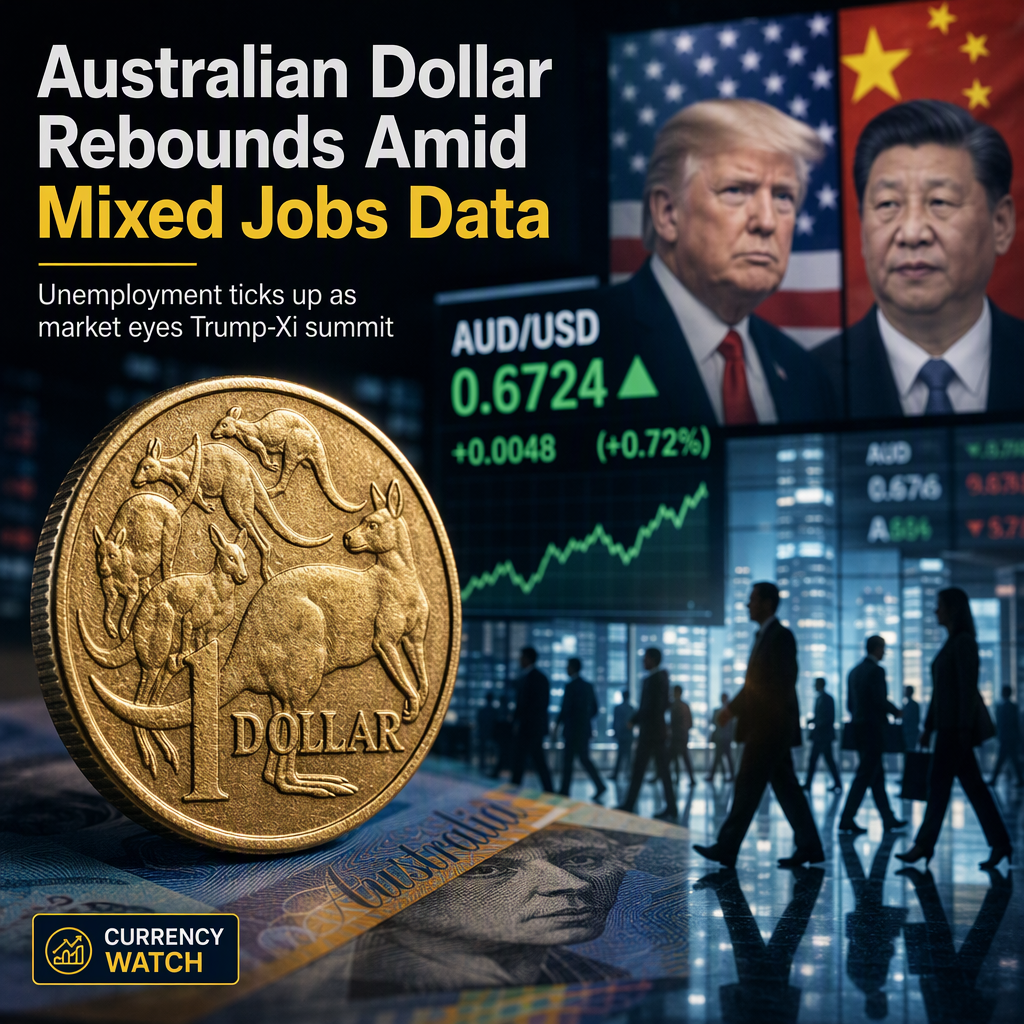
The Australian Dollar (AUD) regained most of its early losses against the US Dollar (USD) on Thursday, trading near 0.7035 during the early European session. This recovery followed the release of Australia's August employment data, which showed the economy added 39.5K jobs, significantly surpassing the consensus estimate of 20K and reversing the previous month's decline of -15.8K. Despite the robust job creation, the unemployment rate unexpectedly rose to 4.6%, compared to expectations for it to remain steady at 4.5% [1].
The upbeat employment data has fueled expectations that the Reserve Bank of Australia (RBA) may consider a near-term interest rate hike. However, the rise in the unemployment rate tempers the overall positive sentiment, suggesting mixed signals for the labor market [1].
Market participants are also closely watching the anticipated meeting between US President Donald Trump and Chinese leader Xi Jinping, where discussions are expected to cover trade, Artificial Intelligence (AI), technology, Taiwan, and Middle East energy supply. This meeting is seen as a potential catalyst for further market movement [1].
On the US side, surging Treasury yields have bolstered the US Dollar's outlook, with the 10-year yield reaching 5.13%, the highest in 19 years. The US Dollar Index (DXY) is trading near its eight-week high of 101.23, adding pressure to the AUD/USD pair [1].
Technically, AUD/USD remains in a bearish near-term bias, trading below key moving averages and Fibonacci retracement levels. The pair is currently beneath the 20-period EMA at 0.7120 and the 50.0% Fibonacci retracement at 0.7053. The Relative Strength Index (RSI) at 35 indicates fading momentum and proximity to oversold territory, suggesting a corrective tone rather than a full reversal. Key support levels are identified at 0.7009, 0.6947, and 0.6867, while resistance lies at 0.7053, 0.7097, and 0.7120 [1].
CONCLUSION
Australia's strong job creation in August has provided some support for the AUD, but the unexpected rise in unemployment and a strong US Dollar are limiting gains. Market attention is now focused on the Trump-Xi meeting, which could further influence currency movements. Technical indicators suggest the AUD/USD pair remains under pressure, with key support and resistance levels in play.