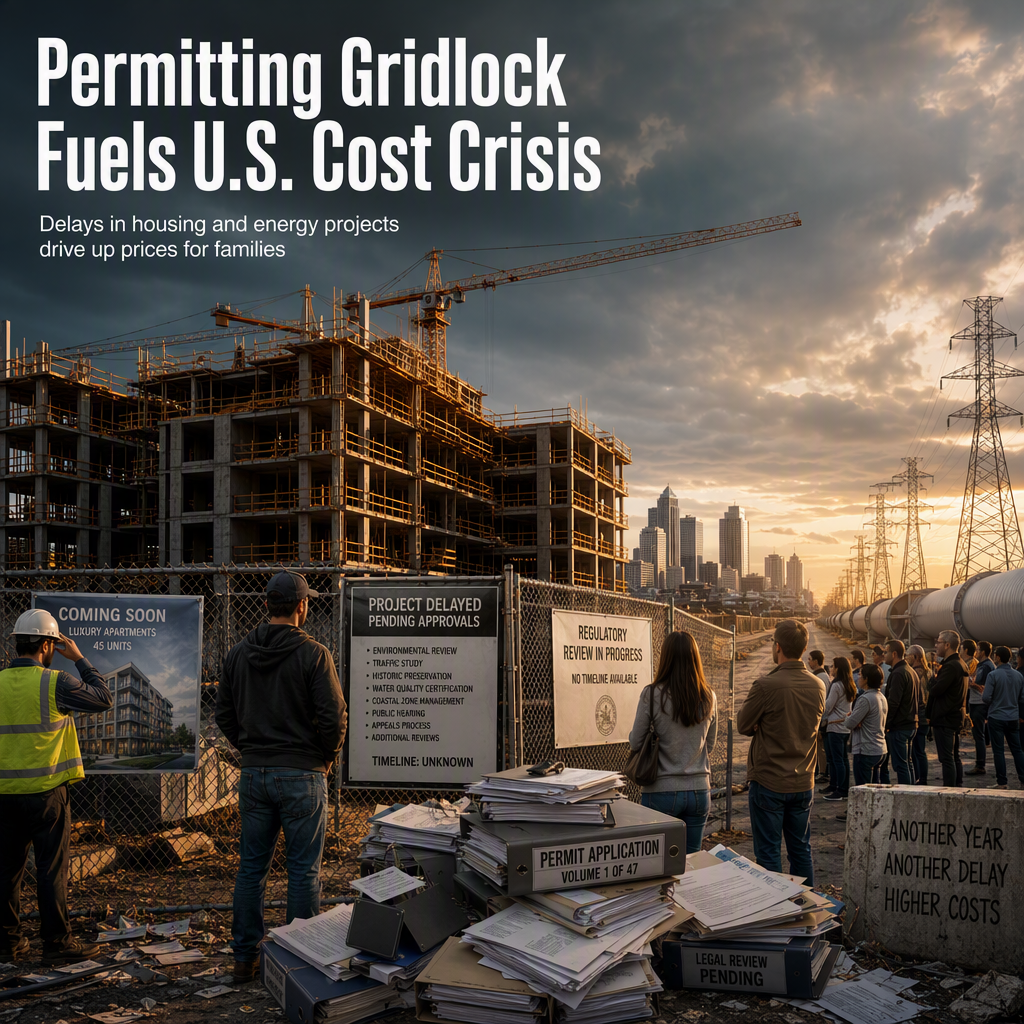
According to an opinion piece by Pat Toomey, America's permitting system is significantly contributing to higher costs of living by delaying the supply of housing, energy, and manufactured goods [1]. The article asserts that while the U.S. has no shortage of entrepreneurs, workers, or capital, the permitting process is plagued by overlapping federal reviews, duplicative agency requirements, and prolonged litigation, which collectively result in years of delays for major projects [1]. These delays increase financing and construction costs, discourage investment, and ultimately lead to higher rents, home prices, utility bills, and goods for consumers [1].
The article specifically cites the National Environmental Policy Act (NEPA), enacted in 1970, as a major source of procedural complexity. Over time, NEPA has evolved into what the author describes as a 'procedural maze,' causing endless paperwork, overlapping reviews, and years of litigation, often without improving environmental outcomes [1]. The Mountain Valley Pipeline is highlighted as a case study: first proposed in 2014, it took nearly a decade to become operational due to repeated litigation under NEPA, the Endangered Species Act, and the Clean Water Act, with completion only achieved after Congressional intervention [1].
Housing development faces similar challenges. The article references the Mare Island Naval Shipyard in California, closed in 1996, where plans for a mixed-use community with thousands of homes have been delayed for decades due to environmental remediation and overlapping federal oversight, resulting in fewer homes and higher housing costs [1].
The cumulative effect of these permitting delays, according to the article, is higher costs for American families and a drag on supply across multiple sectors [1]. The author argues that permitting reform is essential not just for energy or environmental reasons, but as a key affordability issue for the U.S. economy [1].
CONCLUSION
The article contends that America's complex permitting system is a significant driver of higher living costs, particularly in housing and energy. It calls for permitting reform as a necessary step to increase supply and reduce costs for American families.