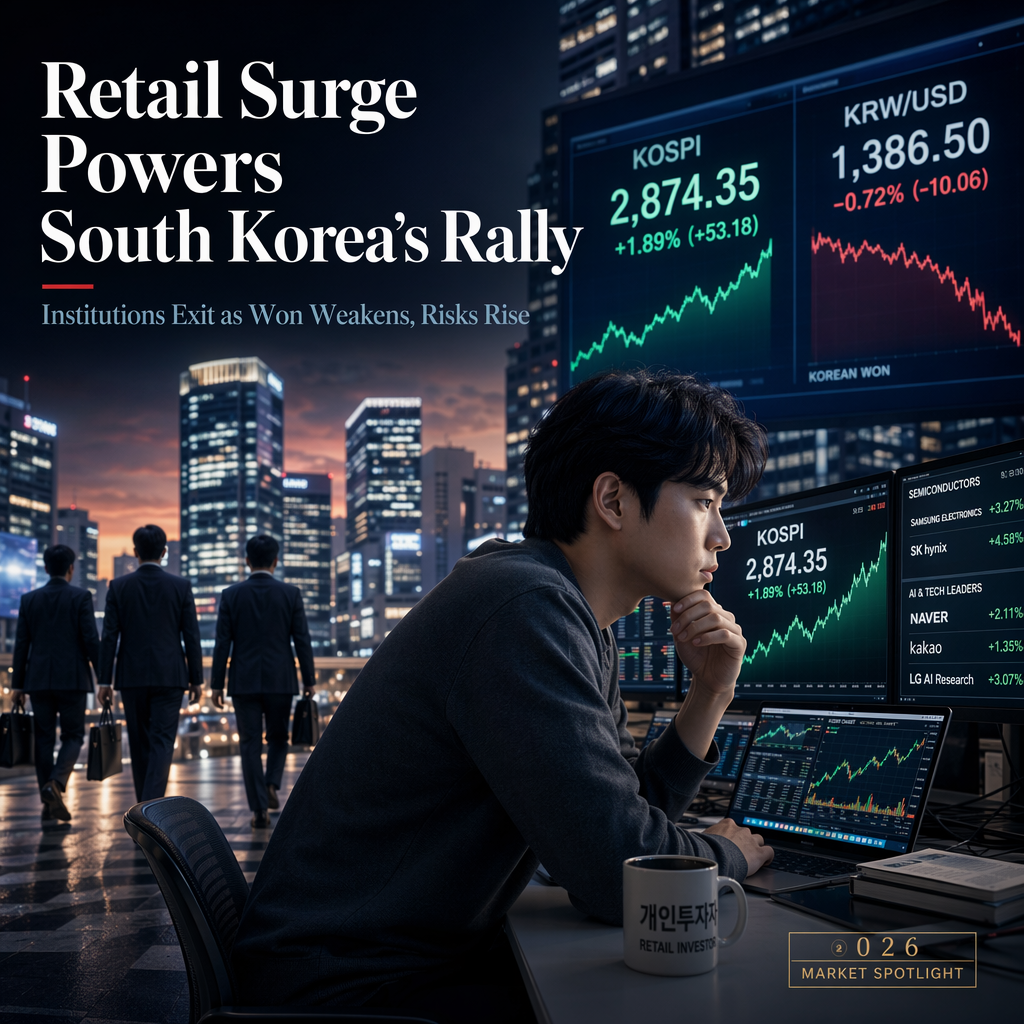
South Korean equities have experienced exceptional returns in 2026, with the KOSPI index rising more than 110% year to date through June, according to BNY's Geoff Yu. Despite this rally, institutional investors, particularly from the Americas, have been net sellers, resulting in $17.25 billion of net institutional outflows. U.S. institutions accounted for 72% of all South Korean equity sales globally, driving $15.65 billion of net selling, nearly the entire global total. Retail investors have emerged as the key marginal buyers, focusing on AI and semiconductor stocks, and are not constrained by ownership caps or benchmarks. This shift has increased concentration and regulatory risk in the market [1].
Cross-asset activity reveals elevated KRW FX volumes, averaging 1.23 times normal levels year to date, with nine surge days above the 2.05x threshold—almost 8% of all trading sessions. June saw the highest KRW activity at 1.90x normal volume, even though the KOSPI returned just 3.6% for the month. Despite the equity rally, the Korean won weakened by about 6% against the U.S. dollar, indicating hedging and profit-taking rather than fresh inflows. The divergence between strong equity performance and weak currency suggests that retail-driven momentum may be unsustainable, especially as signs emerge that retail flow impulse is fading. The June 23 correction, when the KOSPI dropped 10% in a single day, alongside broader weakness in global tech, is likely to increase scrutiny of leveraged retail participation [1].
No specific forward-looking statements or analyst opinions regarding future market direction were provided in the sources. However, the elevated regulatory risk and fading retail momentum imply potential volatility ahead for South Korean equities [1].
CONCLUSION
South Korean equities have surged in 2026, driven by retail investors amid significant institutional outflows and a weakening won. Elevated FX volumes and a sharp correction in late June highlight rising regulatory and concentration risks. The sustainability of the retail-driven rally is uncertain, with market participants likely to monitor leveraged retail activity closely.