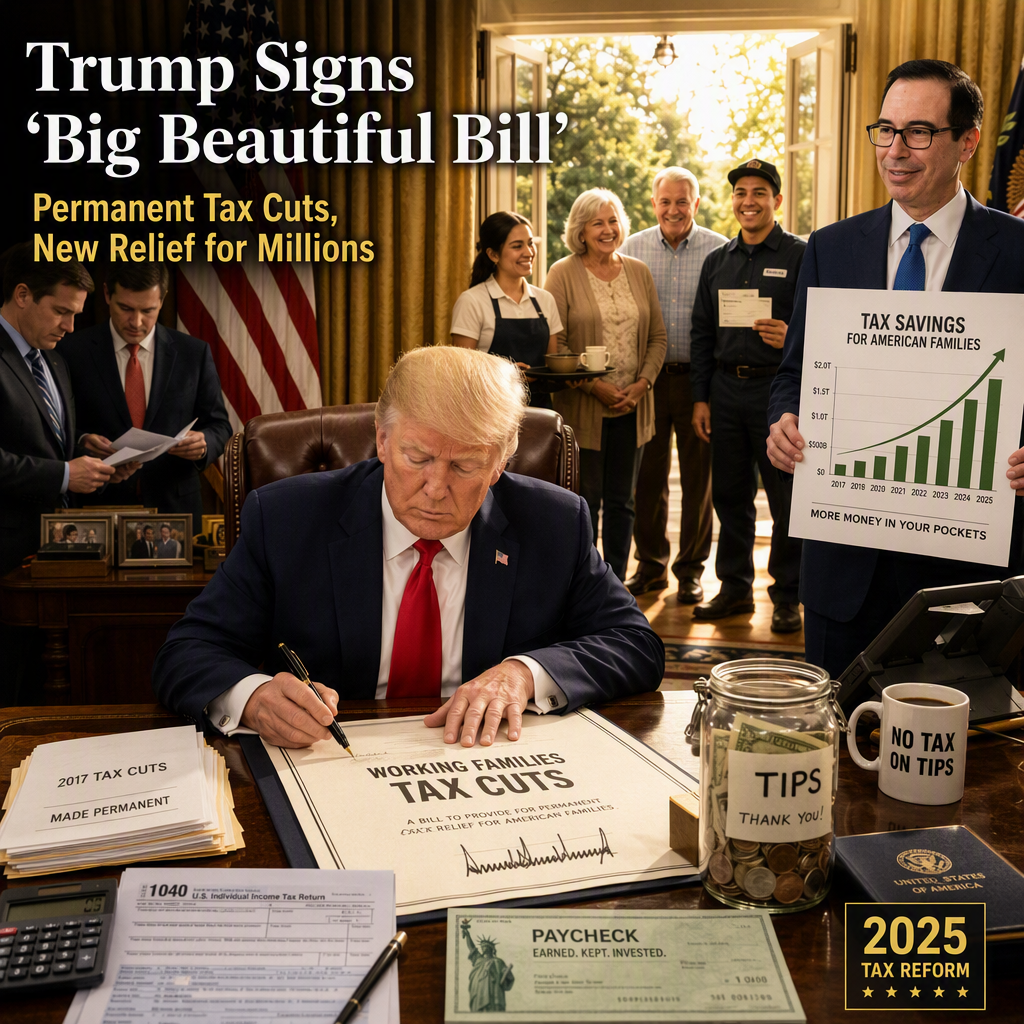
President Donald Trump signed the 'One Big Beautiful Bill Act,' also known as the 'Working Families Tax Cuts,' into law on July 4, 2025, making permanent the tax changes from the 2017 Tax Cuts and Jobs Act while introducing new deductions for tip income, overtime earnings, seniors, and auto loan interest, among others [1]. The legislation also raised the federal deduction limit for state and local taxes (SALT) for itemizing filers [1].
According to Treasury Secretary Scott Bessent, more than 64 million tax returns claimed at least one of the new signature tax cuts, including deductions for tips, overtime, auto loan interest, or the enhanced senior deduction [1]. Bessent stated before the House Committee on Financial Services that the legislation delivered tax relief 'directly to millions of low- and middle-income Americans' [1]. White House spokesman Kush Desai echoed this, noting that 'tens of millions of Americans have taken advantage of at least one of these signature provisions' [1].
Policy experts cited in the article emphasized that the benefits of the tax cuts varied depending on individual household circumstances [1]. Joseph Rosenberg, a senior fellow at the Urban-Brookings Tax Policy Center, explained that these provisions 'hit households differently,' meaning the impact was not uniform across all Americans [1].
The permanence of the 2017 tax cuts was highlighted as the primary source of benefit, with the Tax Foundation estimating that, without the extensions, approximately 62% of Americans would have faced tax increases in 2026 when the original provisions were set to expire [1]. The tax cuts have become a central theme for Republicans as they campaign to maintain their slim majorities in Congress ahead of the midterm elections [1].
CONCLUSION
Trump's 'Big Beautiful Bill' has delivered significant tax relief to millions of Americans, particularly by making the 2017 tax cuts permanent and introducing new deductions. While the benefits are widespread, their impact varies by household. The legislation is a key talking point for Republicans as they approach the midterm elections.