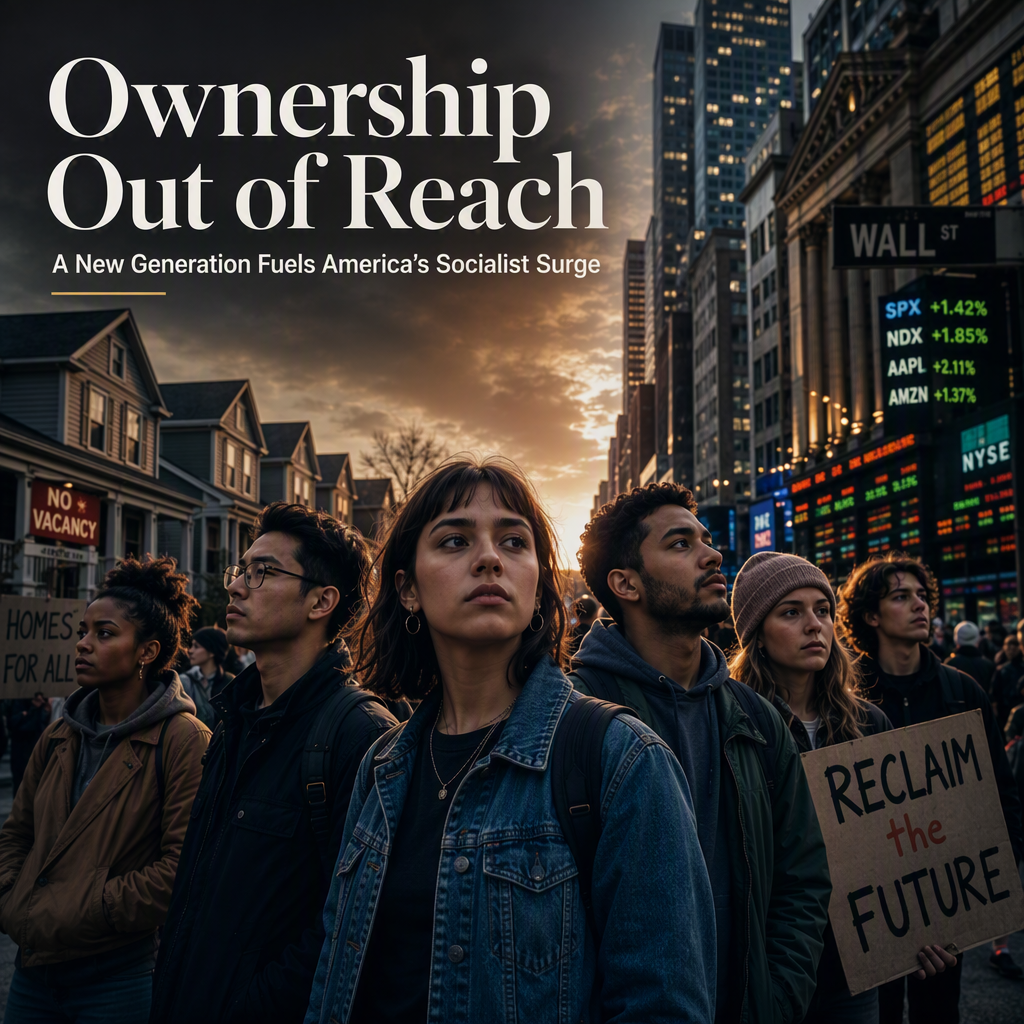
Recent political developments in the United States highlight a growing surge in support for socialist candidates and policies, as evidenced by Bernie Sanders-backed Abdul El-Sayed's victory in the Michigan Democratic Senate primary and Francesca Hong's near-win in Wisconsin's gubernatorial primary, where she came within 3,000 votes of securing the nomination. Additionally, Zohran Mamdani, described as a Democratic Socialists of America (DSA) favorite, currently serves as the mayor of America's largest city [1].
The article attributes this trend to declining rates of ownership among Americans. The national homeownership rate is currently 65%, down from a peak of 69.2% in 2004 and below the 25-year average. Among Americans under 35, the rate has dropped to 35.2%, more than a percentage point lower than a year ago. The generational gap is notable: only 57% of Americans in their mid-30s own homes today, compared to 64% of their parents' generation at the same age. The 30-year mortgage rate has recently climbed to 6.69%, suggesting that homeownership rates are unlikely to improve in the near future [1].
A similar pattern is observed in financial markets. While 62% of Americans own stock, ownership is much lower among certain groups: only 28% of households earning under $50,000, 42% of those with a high school education or less, and 44% of those aged 18 to 29 own any stock. The article argues that these declining ownership rates create fertile ground for socialist policies, as individuals without property may be more receptive to government intervention and redistribution [1].
Specific policies mentioned include Mamdani's rent freeze in New York and Sanders' proposal for the government to take a 50% stake in AI companies. The article contends that such measures address symptoms rather than root causes, potentially worsening underlying issues by reducing housing supply and failing to provide individuals with actual ownership in high-growth companies [1].
No explicit market reactions or analyst opinions are provided, but the article implies that these trends could have significant implications for the future of capitalism and property rights in the United States [1].
CONCLUSION
The article links the rise in socialist political success to declining rates of home and stock ownership among Americans, particularly younger and lower-income groups. While no immediate market reaction is discussed, the analysis suggests that these trends could have medium-term implications for U.S. economic policy and investor sentiment.