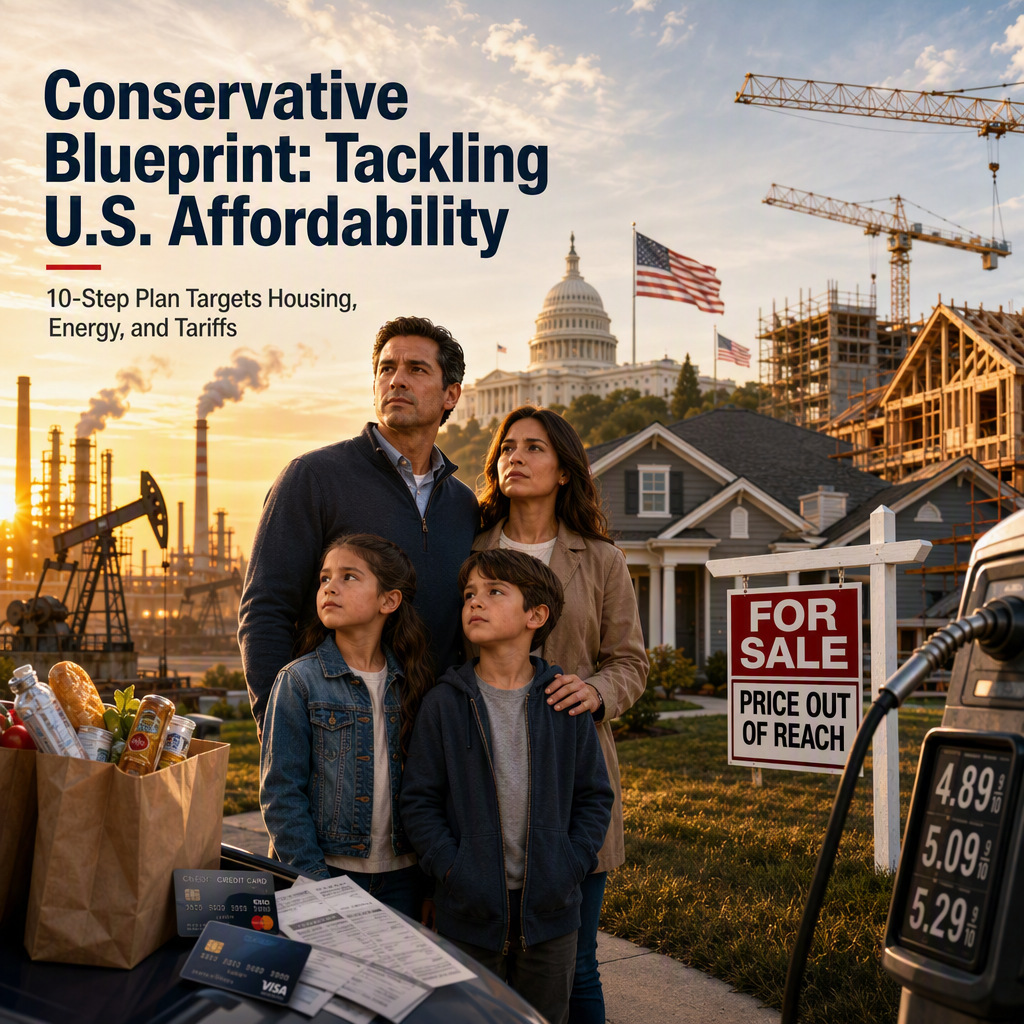
A new report from Advancing American Freedom (AAF), a conservative group founded by former Vice President Mike Pence, has outlined 10 proposals aimed at reducing the cost of living for Americans by cutting government regulations and boosting production across the economy [1]. The report, titled '10 Ways to Improve Affordability Now Across 10 Levels of the Economy,' identifies affordability as the 'No. 1 issue facing the American people' and targets costs associated with housing, energy, and business, among other sectors [1].
Key recommendations include easing zoning restrictions, expanding oil and gas access, and overhauling Social Security and SNAP eligibility. The report notably diverges from former President Donald Trump’s agenda on tariffs and credit card interest rates. Specifically, the AAF report criticizes Trump’s tariffs, stating they have raised prices for consumers, strained U.S. alliances, and resulted in nearly 900,000 fewer jobs than expected. The authors advocate for shifting more tariff authority back to Congress [1]. Despite these negative impacts, tariffs generated $30.4 billion in duties in January, a 242% increase from $8.9 billion a year earlier, according to Treasury data [1].
On housing, the report blames zoning restrictions for increasing costs and making homeownership more difficult, especially for younger Americans. The National Association of Home Builders estimates that government regulations account for about 26% of the price of a new single-family home. The report suggests limiting local zoning restrictions, streamlining project approvals, and tying approximately $50 billion in annual federal housing aid to zoning reform [1].
In the energy sector, the proposal calls for increased oil and gas leasing and the rejection of state fracking bans. Richard Stern, vice president of the Plymouth Institute for Free Enterprise at AAF, argued that greater domestic energy production could lower costs throughout the economy, as energy impacts every good and service [1]. Stern also warned that economic frustration could lead to social division, emphasizing that businesses and entrepreneurs are not to blame for the affordability crisis [1].
CONCLUSION
The AAF report presents a conservative blueprint for addressing America's affordability crisis, focusing on deregulation, increased energy production, and tariff reform. While the proposals highlight significant regulatory and policy changes, the market impact remains medium as the recommendations are not yet enacted. The report underscores the ongoing debate over the best approach to lowering costs for American families.