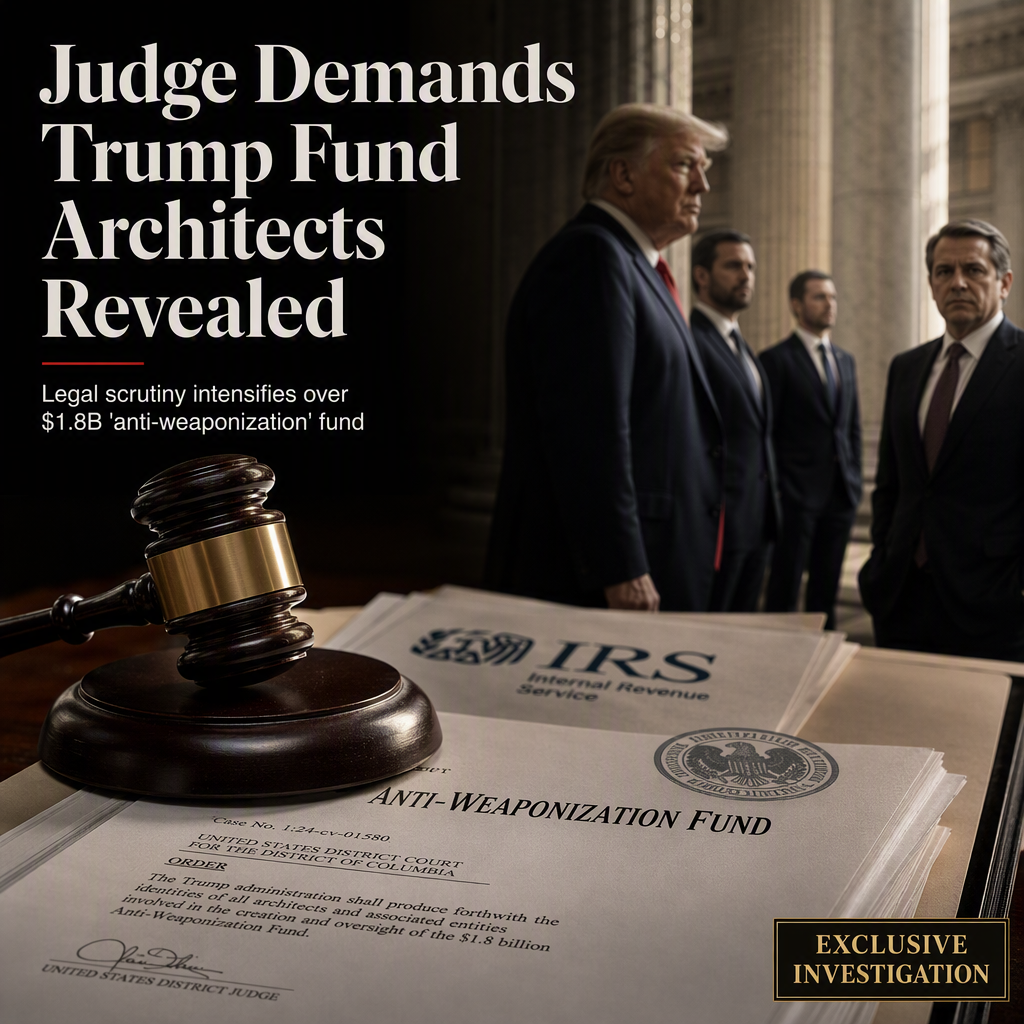
A federal judge has ordered the Trump administration to disclose the names of individuals responsible for structuring the nearly $1.8 billion 'anti-weaponization fund,' which Attorney General Todd Blanche has declared 'dead' [1]. U.S. Magistrate Judge Ivan D. Davis of the Eastern District of Virginia granted part of a motion from plaintiffs to compel discovery from the federal government, specifically requiring the release of the fund's architects' identities [1]. Aman George, senior counsel at Democracy Forward, described the order as a 'significant step' toward uncovering the origins of what he called a 'slush fund,' and emphasized ongoing legal efforts to ensure the fund is permanently halted [1].
The fund was established as part of a settlement agreement between President Donald Trump, his two sons, his company, and the Internal Revenue Service, with the intention of allocating approximately $1.8 billion in taxpayer money as payouts for those who 'suffered weaponization and lawfare.' This provision could potentially extend to Jan. 6 rioters convicted and later pardoned by Trump for violent crimes [1]. The fund was temporarily blocked in May by a federal judge after a lawsuit was filed by a fired Jan. 6 prosecutor, a law professor previously sued by the Trump administration, and career IRS workers who opposed the Trump-IRS agreement that granted immunity from IRS audits to the president and several family members [1].
The 'anti-weaponization' fund has faced bipartisan criticism in Washington, jeopardizing Blanche's nomination as attorney general. Blanche subsequently stated in writing that the fund 'is rescinded' and 'there is no fund.' However, a legal loophole remains because the rescinding document did not include the original agreement's signatories, leaving open the possibility that the fund and related IRS immunity could be revived [1]. Trump has refused to denounce the fund, stating at a Cabinet meeting that the fund 'is dead, but you know, I wish it weren’t,' and reiterating his belief that 'people were horribly treated' [1].
This week, Treniss Evans III, a Jan. 6 defendant seeking a $1 million payout from the government, posted a photo of himself in Blanche’s office. However, a source familiar with the matter clarified that Evans did not meet with the attorney general [1]. The Justice Department has not responded to requests for comment regarding the judge's order [1].
CONCLUSION
The judge's order to disclose the architects of the $1.8 billion 'anti-weaponization' fund marks a pivotal moment in ongoing legal scrutiny of the Trump-IRS settlement. Despite Blanche's written rescission, unresolved legal loopholes and continued controversy suggest the issue may persist, with potential implications for government accountability and political dynamics.