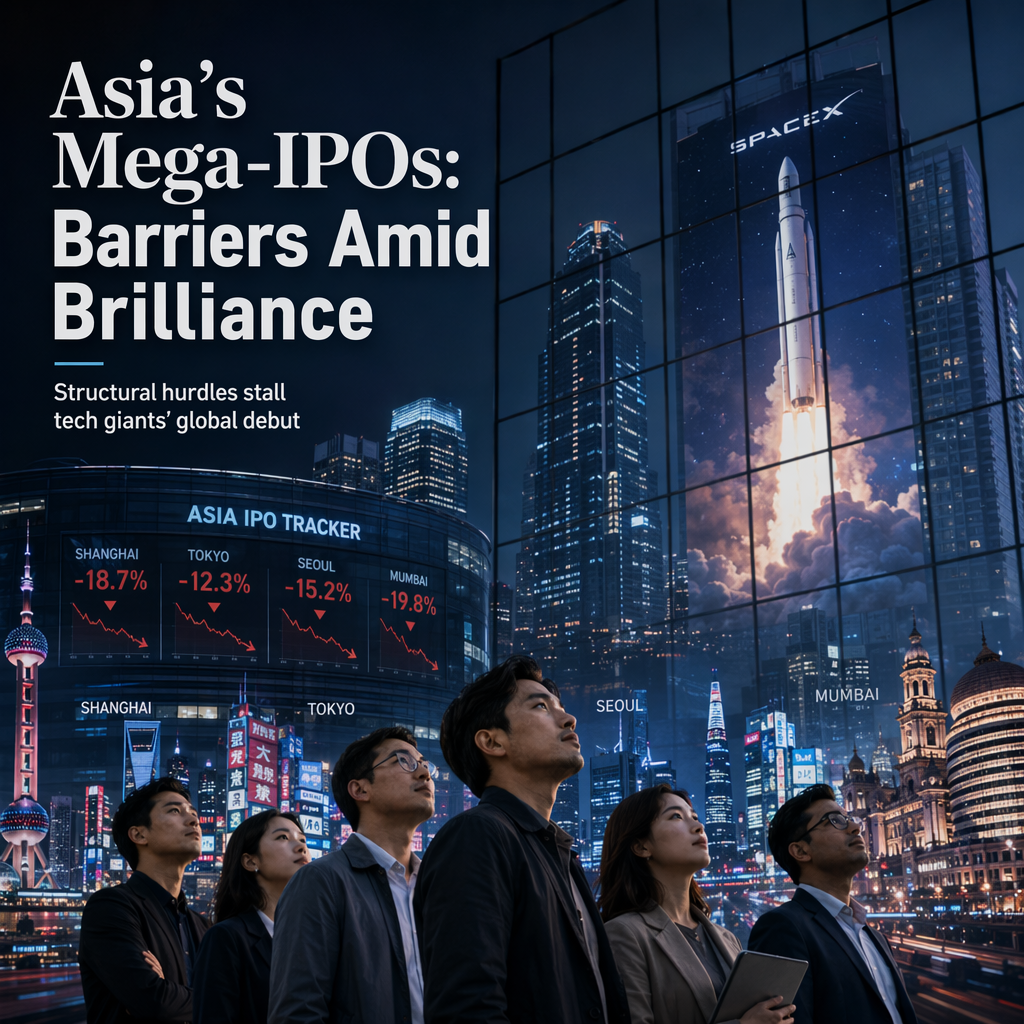
Asia continues to lag behind the United States in producing blockbuster initial public offerings (IPOs) on the scale of companies like SpaceX, despite having world-class industries and a strong base of entrepreneurs and engineers [1]. The region's technological capability is not in question, with companies in China, India, South Korea, and Japan dominating sectors such as semiconductors, electric vehicles, robotics, and advanced manufacturing [1]. However, analysts and industry experts point to structural and behavioral constraints in Asian capital markets as the primary barriers to nurturing firms into mega-cap public companies [1].
Recent examples highlight the disparity in IPO scale: ChangXin Memory Technologies (CXMT) is planning a Shanghai IPO expected to raise at least 29.5 billion yuan ($4.3 billion), which could be China's largest since 2022, and Indian telecom giant Jio Platforms is seeking a valuation of about $120 billion in its planned IPO [1]. In stark contrast, SpaceX debuted at a valuation of $1.77 trillion, surpassing $2 trillion in its earliest days of trading [1]. This valuation gap has historically driven major Asian technology firms, such as Alibaba and JD.com, to list in New York to access deeper pools of international capital before later pursuing secondary listings in Hong Kong [1].
Experts cite several factors contributing to Asia's challenges: less patient private capital, stricter listing requirements, and lower valuation multiples compared to the U.S. market [1]. John Fildes, partner at Bain & Co., emphasized that the abundance of private capital in the U.S. allows firms to reach the market with much higher valuations [1]. Additionally, U.S. exchanges continue to reward technology companies with higher valuation multiples than their Asian counterparts, according to analysts [1].
In China, the industrial base and innovation are not seen as constraints. Instead, the financial ecosystem is viewed as the bottleneck, with China's venture capital industry operating on shorter investment horizons and facing more restricted cross-border capital and less institutional capital compared to the U.S. [1]. Wenjie Ding, investment strategist at China Asset Management, noted that China has the industrial capabilities, market scale, and talent pool to create mega-sized companies, but the financial infrastructure remains a limiting factor [1].
CONCLUSION
Despite Asia's technological prowess and large domestic markets, structural limitations in capital markets and financial ecosystems continue to hinder the creation of mega-IPOs comparable to those in the U.S. The region's companies face challenges such as less patient private capital, stricter listing requirements, and lower valuation multiples, prompting some to seek listings abroad. Without significant changes to market structures, Asia may continue to trail the U.S. in producing the world's largest public technology companies.