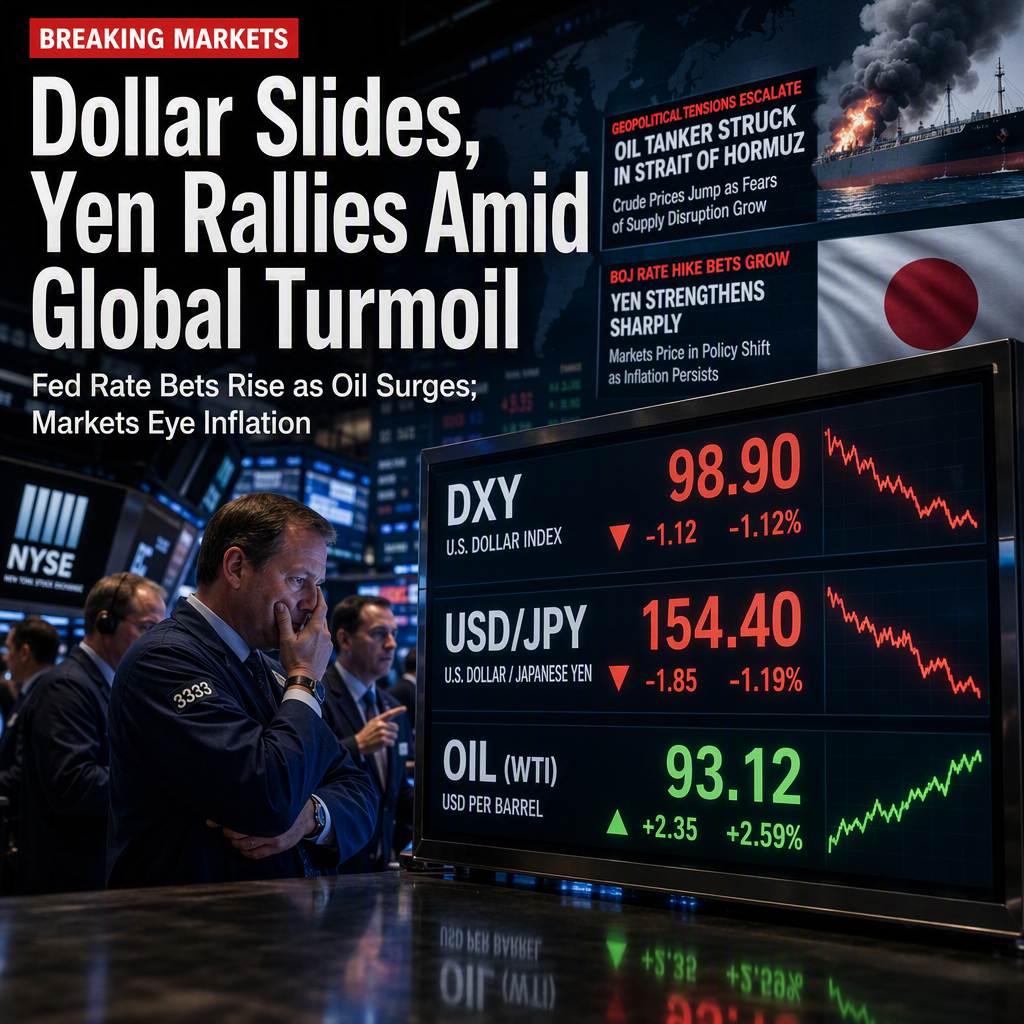
The US Dollar Index (DXY), which measures the Greenback against a basket of six major currencies, extended its decline on Monday, trading around 98.90 and down 0.26% on the day, marking two-week lows [1]. This weakness was primarily driven by a sharp rally in the Japanese Yen (JPY), with USD/JPY falling to a six-and-a-half-month low near 154.40, supported by hawkish Bank of Japan (BoJ) expectations, capital repatriation, and the unwinding of Yen-funded carry trades [1]. Source 2 corroborates this, noting that further repricing of additional tightening by the BoJ has boosted the Yen, sending USD/JPY to new seven-month lows near 154.00 [2].
The Dollar's decline comes despite elevated geopolitical tensions and expectations for a Federal Reserve (Fed) interest rate hike. Traders increased bets on a rate hike at the Fed’s September 15-16 meeting following Friday’s robust employment report, with the CME FedWatch Tool indicating a 58% chance of a rate increase next week [1]. Friday’s Nonfarm Payrolls printed 162K against a 53K consensus, causing EUR/USD to fall roughly 40 pips before rebounding [3]. Market attention is now turning to upcoming US inflation data, with the Producer Price Index (PPI) due Thursday and the Consumer Price Index (CPI) scheduled for Friday [1][2].
Geopolitical risks have also contributed to market volatility. Over the weekend, the US military struck three Iranian crude oil tankers in response to Iran firing ballistic missiles at two US Navy ships, and Saudi Aramco’s Jazan refinery was hit by a fresh strike on Monday [1]. Oil prices have surged, with WTI confronting three-month tops above $93.00 per barrel amid increasing tensions in the US-Iran conflict [2]. Elevated oil prices are adding to inflation risks and reinforcing expectations of tighter monetary policy [1][2].
In the broader currency market, EUR/USD held above 1.1600 after a brief spike on Monday, supported by a Eurozone Q2 GDP revision to 0.6% from a 0.4% consensus and a jump in the Sentix investor survey to 5.1 from 0.9 [3]. Both the ECB and Fed are expected to raise rates this month in response to the same energy shock, but the rate gap has not moved the currency significantly [3]. The ECB is expected to lift the deposit rate to 2.5% and the main refinancing rate to 2.65% on Thursday, with consensus among economists that this will mark the end of the journey to neutral [3]. Interest rate futures price a third increase to 2.75%, but economists do not expect it, highlighting a discrepancy between market pricing and forecasts [3].
Analysts at HSBC noted that Fed Chairman Warsh’s Jackson Hole speech restored confidence in the Fed’s commitment to fight inflation, helping reduce the risk that weak policy credibility would become a lasting drag on the dollar [1]. However, persistent inflation concerns, policy credibility questions, and political risks continue to weigh on the Greenback [1].
CONCLUSION
The US Dollar Index has come under pressure as the Japanese Yen strengthens on BoJ tightening expectations and geopolitical tensions drive oil prices higher. Despite increased Fed rate hike bets and robust US employment data, the Greenback remains weak, with upcoming US inflation figures and central bank decisions poised to influence market direction. The market impact is high, with currency and commodity volatility reflecting ongoing uncertainty.