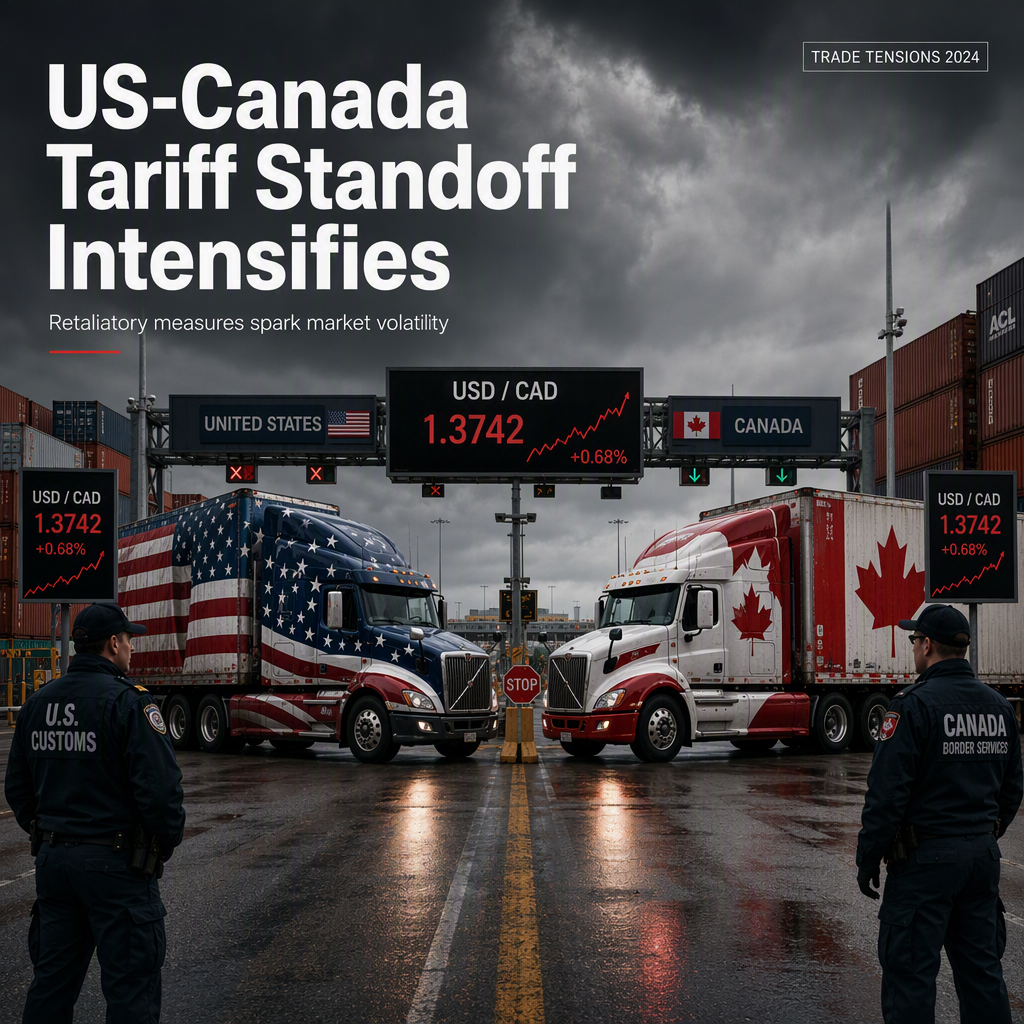
The United States imposed 50% tariffs on certain Canadian products on Saturday following the collapse of trade negotiations between the two countries on Friday [1]. In response, Canadian Prime Minister Mark Carney announced that Canada will implement its own retaliatory tariffs starting September 8, as reported by CNBC [1]. US Trade Representative Jamieson Greer stated that 'Canada declined to finalize the trade deal under the terms agreed earlier this week' [1]. Carney, in a statement released Friday, explained that despite efforts toward a deal, 'that progress has not been enough to meet our objectives for Canadians,' and criticized the 'last-minute changes in the U.S. proposed terms' as 'unfair, uneconomic, and called into question the reliability of any deal' [1].
The market reacted to these developments, with the USD/CAD currency pair rising 0.22% on the day to 1.3787 at the time of writing [1]. The article notes that tariffs are used as protectionist tools to support domestic industries but can also lead to higher prices and the risk of a trade war through retaliatory measures [1].
The article also highlights that US President Donald Trump has made tariffs a central part of his economic strategy ahead of the November 2024 presidential election, targeting major trading partners such as Mexico, China, and Canada, which together accounted for 42% of total US imports in 2024 [1]. Trump intends to use tariff revenue to lower personal income taxes [1].
No forward-looking analyst opinions are provided in the article, but the escalation of tariffs between the US and Canada signals heightened trade tensions and potential for further market volatility [1].
CONCLUSION
The imposition of 50% US tariffs on Canadian goods and Canada's planned retaliatory tariffs mark a significant escalation in trade tensions between the two countries. The immediate market reaction saw the USD/CAD rise, reflecting investor concern. The situation underscores the risk of a broader trade conflict with potential economic repercussions.