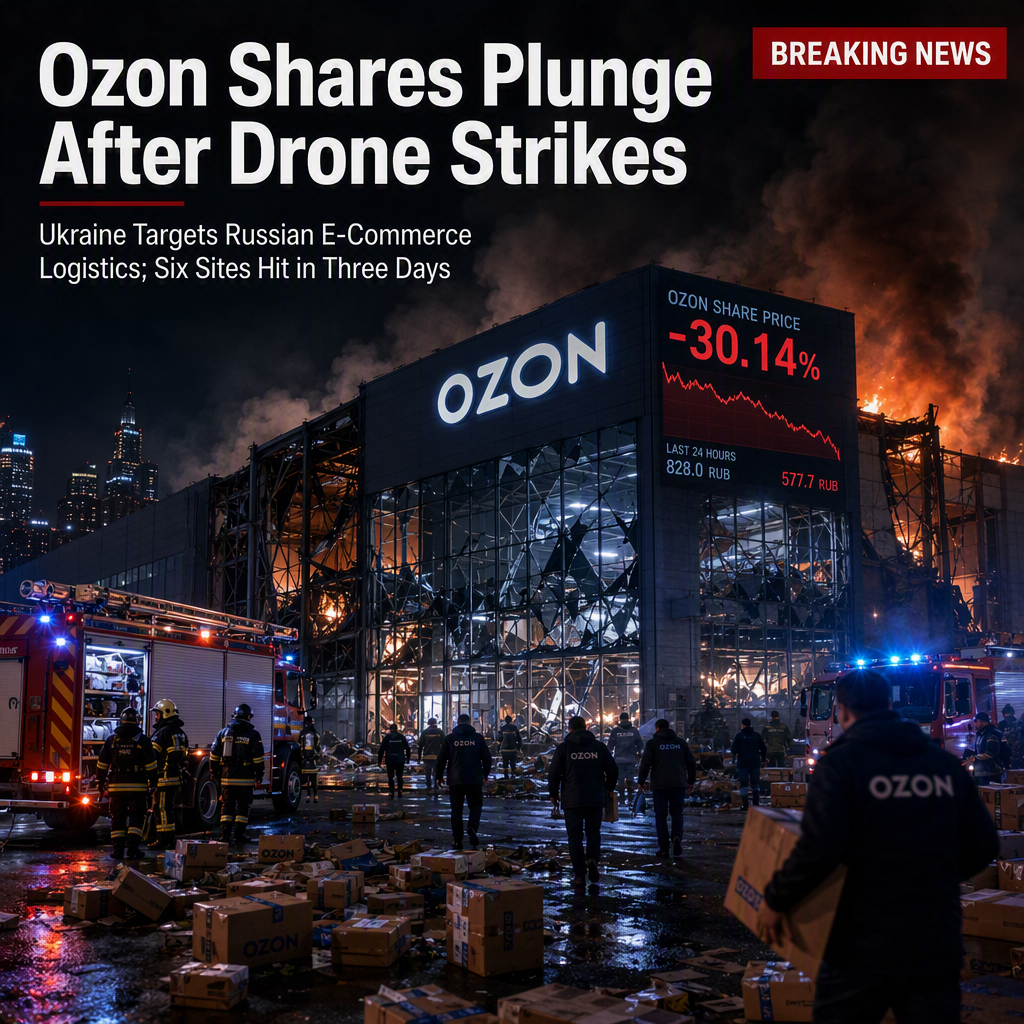
Ukraine has intensified its drone campaign against Russia's e-commerce sector, expanding its focus from Wildberries to Ozon, Russia's second-largest online retailer, in an effort to disrupt commercial supply chains and increase financial pressure on Russian banks and businesses [1]. On Monday, Ozon's shares plummeted nearly 30% on the Moscow Exchange following reports of drone strikes on its logistics facilities in southern Russia, bringing the total number of targeted sites to six within three days [1].
Recent attacks have been reported at logistics hubs in Makhachkala (Dagestan) and Enem (near Krasnodar), while operations at an Ozon logistics center in the Samara region were halted after a drone strike caused a warehouse fire and prompted the evacuation of over 500 employees [1]. The Institute for the Study of War noted that Ukrainian forces have shifted their focus to Ozon warehouses since Saturday, following a series of attacks on Wildberries logistics centers that began in mid-July [1].
Ukraine's Ministry of Defense stated that systematic strikes on storage centers holding dual-use goods are disrupting Russian logistics and negatively impacting the broader economy. The ministry highlighted that after targeting 15 of Wildberries' largest logistics hubs, Ozon has now become the primary target [1]. Ukrainian President Volodymyr Zelenskyy has previously justified such attacks by alleging that the targeted warehouses were involved in supplying Russian forces with drone components and other military equipment [1].
In response, Russian President Vladimir Putin accused Ukraine of opening a "Pandora's box" with these strikes on economic targets and vowed to retaliate against Ukraine's "most sensitive economic sectors" [1]. The combined revenue of Russia's top three e-commerce players—Wildberries, Ozon, and Yandex Market—was approximately $140.3 billion by the end of last year, representing over 5% of Russia's GDP, according to the Ukrainian Security and Cooperation Center citing Russia's Chamber of Commerce and Industry [1]. Analysts have suggested that these attacks are exposing vulnerabilities in Russia's wartime economy, which has otherwise broadly defied expectations during the conflict [1].
CONCLUSION
Ukraine's targeted drone strikes on Ozon's logistics infrastructure have led to a sharp decline in the company's share price and heightened concerns about the resilience of Russia's wartime economy. The attacks mark a significant escalation in Ukraine's efforts to disrupt Russian supply chains, with both sides signaling potential for further economic retaliation.