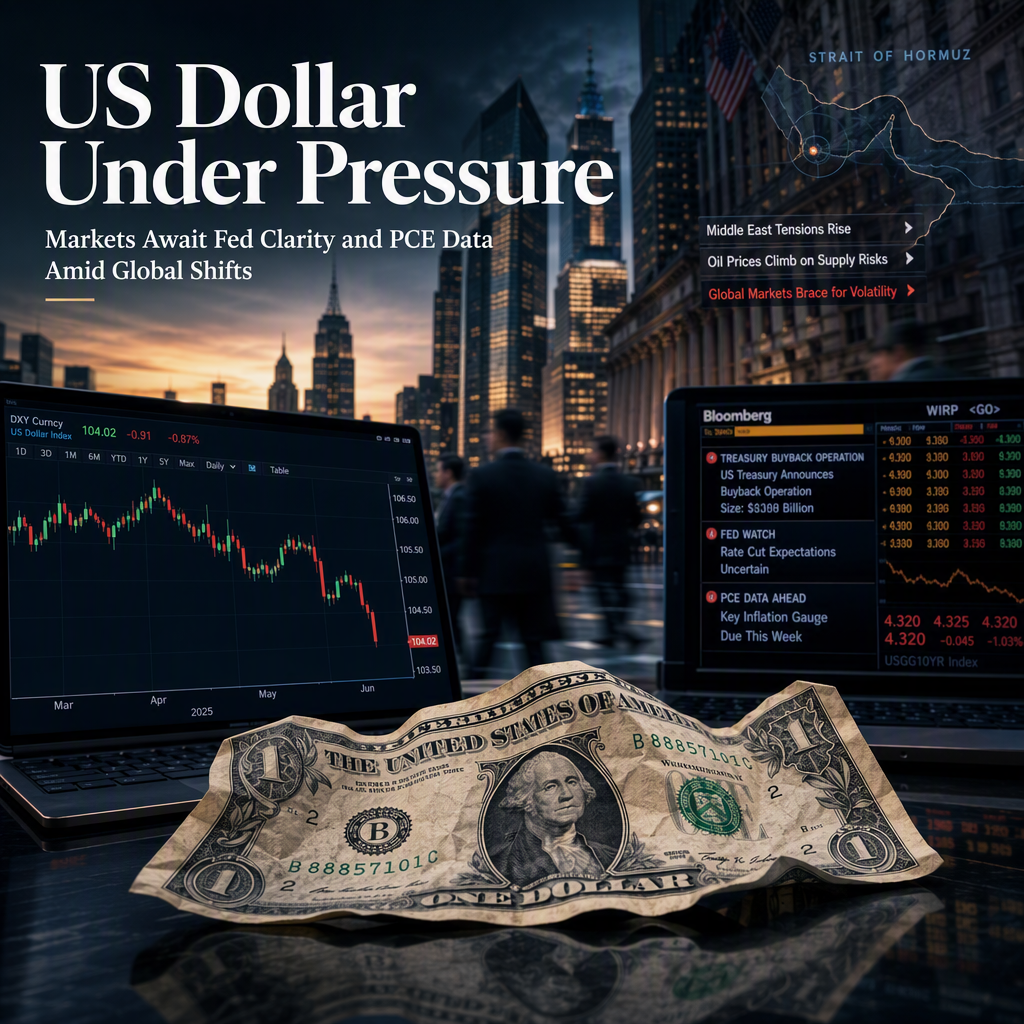
The US Dollar is experiencing a period of heightened volatility and uncertainty as markets await the release of the US Personal Consumption Expenditures (PCE) Price Index and a pivotal speech by Federal Reserve Chair Kevin Warsh at the Jackson Hole Symposium on Friday [1][2][3]. The Dollar Index (DXY) has recovered to near 99.00 in early European trading on Wednesday, but remains under pressure due to a confluence of domestic and international factors [2].
A key development is the US Treasury's decision to double its bond buyback operations to at least $4 billion per operation, up from the previous $2 billion, in an attempt to stabilize surging long-term borrowing costs as national debt surpasses $40 trillion [2]. Two senior officials indicated that the Treasury could use its nearly $1 trillion General Account to fund these buybacks [3]. However, strategists at Scotiabank and DBS Bank caution that the Dollar's recent stabilization is fragile, with Scotiabank noting that 'investors will want clear signals from US policymakers on the promised fiscal consolidation plan from Bessent and on the Fed’s reaction function from Warsh at Jackson Hole or the dollar is liable to come under renewed pressure' [2]. DBS Bank’s Philip Wee highlights a critical communication gap at the Fed, stating that the lack of clear guidance is undermining confidence in the Dollar [3].
Market expectations for a Federal Reserve rate hike in September have diminished, with the probability of a 25 basis point increase dropping to 38.4% from 67% earlier in the month, according to the CME FedWatch tool [2]. Tamer US inflation data and a sluggish labor market have contributed to this shift, while easing inflationary fears due to a fall in crude oil prices have led to a further decline in US bond yields, undermining the USD [3].
Geopolitical developments are also influencing market sentiment. The US has expanded secondary sanctions on entities and countries maintaining business ties with Iran, which could boost safe-haven flows to the Dollar [2]. However, reports that Iran and Oman are discussing the establishment of a temporary joint maritime corridor in the Strait of Hormuz, and that the US has offered Iran sanctions relief and an end to the naval blockade in exchange for reopening the Strait, have eased market tensions and dragged crude oil prices to a two-week low [1][3]. This has further dented the Greenback's reserve currency status and warrants caution before placing aggressive bearish bets on the GBP/USD pair [3].
Technical analysis across the articles points to a bearish near-term bias for the Dollar. The DXY remains below key moving averages, with the Relative Strength Index at 34.60, just above oversold territory [2]. The USD/IDR pair trades around 17,760, with the Rupiah subdued amid market caution and external headwinds, while the GBP/USD pair holds below the 1.3660-1.3665 supply zone but retains an upside bias if this barrier is cleared [1][3].
CONCLUSION
The US Dollar is under significant pressure from a combination of domestic policy uncertainty, shifting Federal Reserve expectations, and easing geopolitical tensions. Markets are closely watching upcoming US PCE data and Fed Chair Warsh's Jackson Hole speech for clearer policy direction. Until then, the Dollar remains vulnerable to renewed downside, with technical indicators and market sentiment skewed bearish.