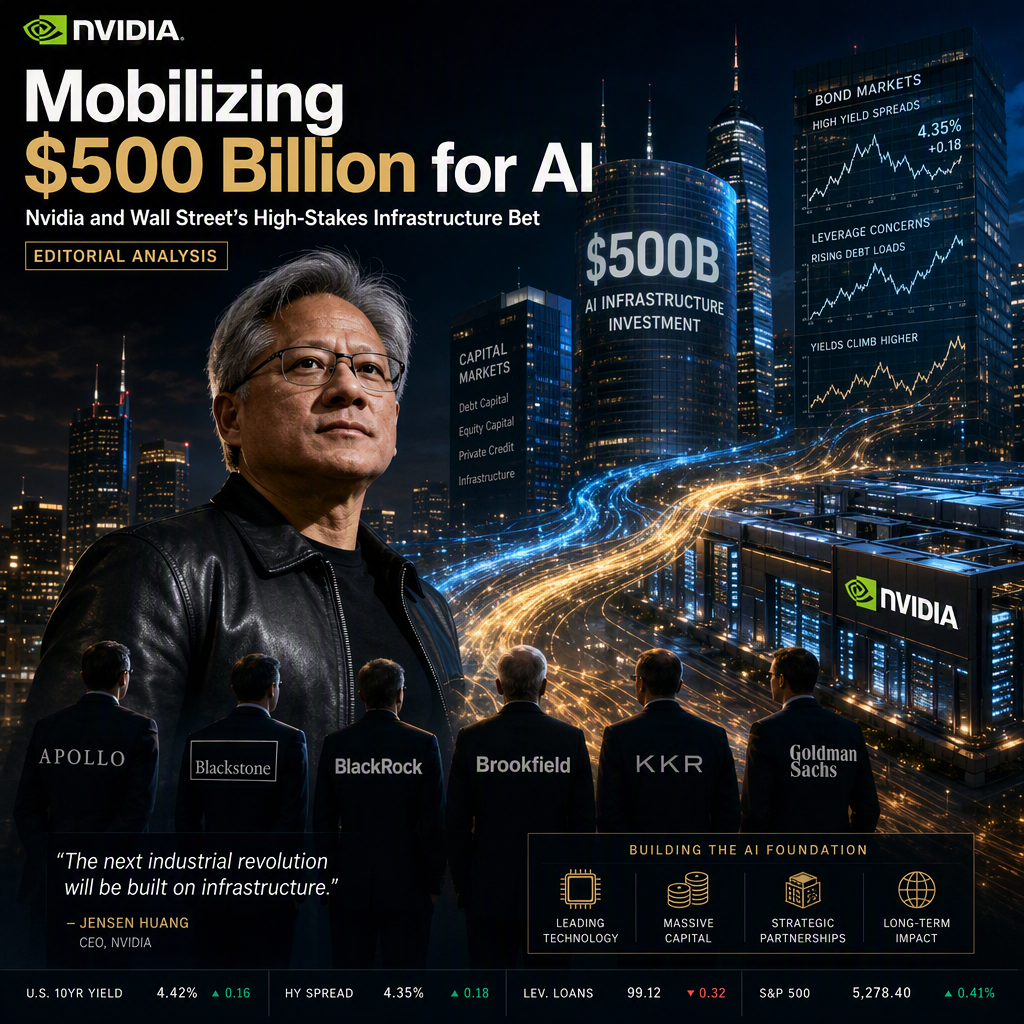
Nvidia has announced plans to partner with major Wall Street firms, including Apollo, Blackstone, BlackRock, Brookfield, KKR, and Goldman Sachs, to mobilize more than $500 billion of third-party capital for AI infrastructure investments. Nvidia CEO Jensen Huang described Nvidia's chips as an 'investable infrastructure asset,' signaling a shift toward treating AI infrastructure as a new asset class for investors [1].
The financing of this AI boom is becoming increasingly complex, with hyperscalers and their financial backers utilizing bond markets, joint ventures, leases, and other structures to fund unprecedented infrastructure buildouts. Some tech giants are using joint ventures and leasing vehicles to borrow money for AI data center spending, with the debt not appearing on their balance sheets until the leases commence [1].
Goldman Sachs analysts estimate that hyperscalers have combined lease commitments for data centers, R&D facilities, offices, and equipment totaling $1.5 trillion, a significant increase from about $200 billion five years ago. This figure includes approximately $1 trillion of 'uncommenced' lease commitments, which are not yet reflected in financial statements but will require future payments. Goldman analysts warn that this can understate leverage and future liquidity needs as these obligations are eventually recognized and contractual payments come due [1].
The recent unravelling of the AI-focused hedge fund Situational Awareness, following losses on leveraged equity bets, has heightened concerns about the scale and visibility of borrowing in the sector. Market watchers are debating whether the anticipated revenues from AI infrastructure can justify the vast sums being spent. Lotfi Karoui, a multi-asset credit strategist at PIMCO, noted that the AI capex cycle, adjusted for inflation, is on track to be the largest investment cycle since the 19th-century railway construction, though the ultimate scale of the buildout remains 'deeply uncertain' [1].
Some strategists suggest that earnings expectations, rather than growing leverage, could be a bigger concern for markets at this stage [1].
CONCLUSION
Nvidia's ambitious AI infrastructure funding push, backed by major Wall Street firms, is driving a surge in complex and often less-visible leverage across the sector. While the scale of investment is unprecedented, analysts warn of potential risks related to future liquidity needs and the uncertainty of returns. Market participants remain focused on whether earnings will ultimately justify the massive capital commitments.