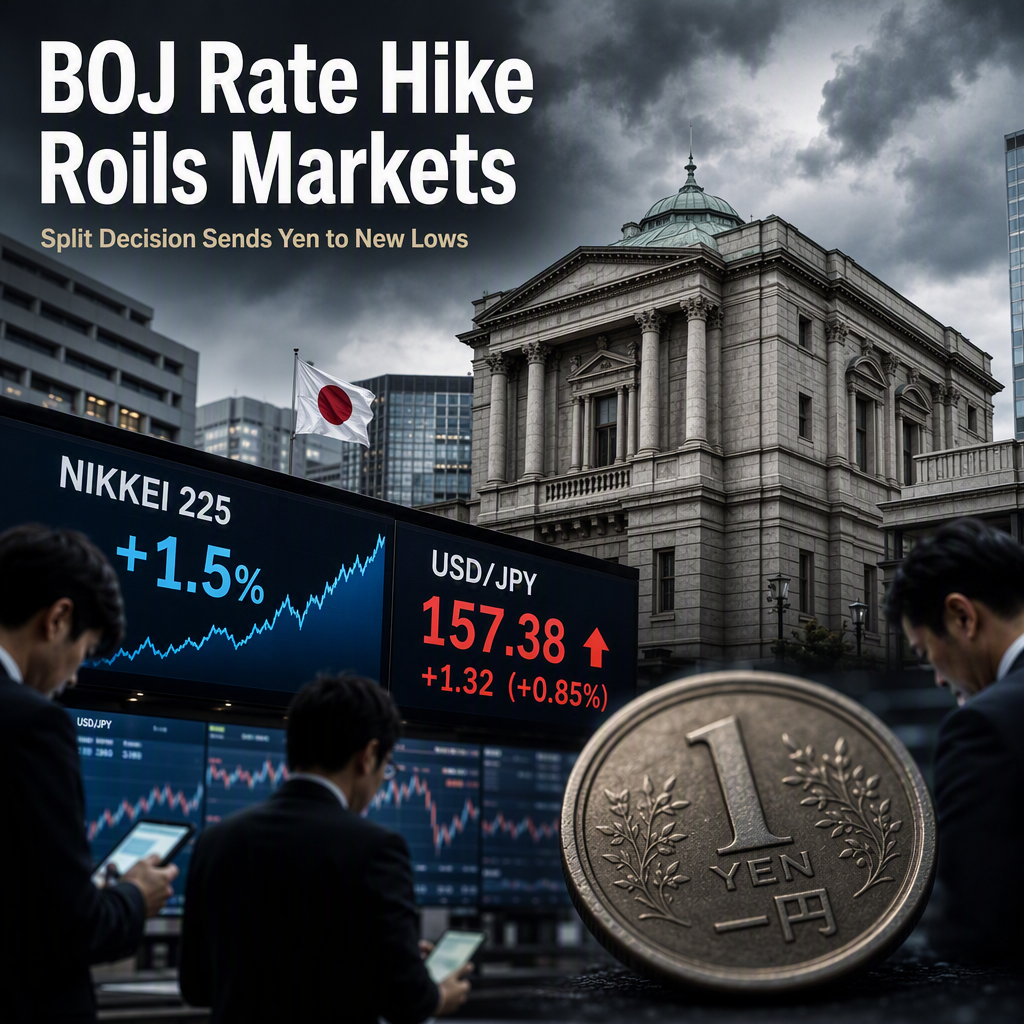
The Bank of Japan (BOJ) raised its benchmark interest rate by 25 basis points to 1.25%, marking its highest level since 1995 and coming just three months after the previous hike [1][6]. The decision was made in a split vote, with board members Toichiro Asada and Ayano Sato dissenting, citing concerns that core inflation, which stood at 1.7% in August (down from 1.8% in July), remained below the BOJ’s 2% target and that economic conditions did not warrant a hike [6]. Governor Kazuo Ueda stated that monetary policy had entered a new phase and signaled that rate hikes are on the table at every meeting going forward [1][2][6]. However, the absence of an updated outlook report and the dovish tone of the statement limited the BOJ's ability to reinforce a hawkish message [6].
Despite the rate hike, the Japanese Yen weakened across major currency pairs. The USD/JPY pair rose above 157, the EUR/JPY traded at 180.85, and GBP/JPY rallied above 210.50, with the Yen dropping to multidecade lows [1][2][3][4][5][6]. The Nikkei 225 stock index gained 1.5% following the announcement, and the yield on the 10-year Japanese Government Bond slipped, contrary to typical market expectations for a rate hike [6]. Analysts attributed this counterintuitive reaction to the split decision and the dovish tone, suggesting that the BOJ may not pursue aggressive tightening [4][6].
Market participants and analysts noted that the two dissenting board members, both appointed by Prime Minister Sanae Takaichi, may act as a brake on further tightening, making it harder for the board to reach consensus on another hike this year [2][4][5][6]. Deutsche Bank analysts described the move as a "more dovish hike than expected," and ING highlighted persistent upside inflation risks but cautioned that the board's divisions could temper the pace of future rate increases [2][4][5]. The BOJ's decision follows similar moves by the European Central Bank and the U.S. Federal Reserve, both of which raised rates earlier in the week, further diminishing the Yen's competitive advantage [1][2][5].
Technical analysis from FXStreet indicates that the Yen remains vulnerable, with upside risks for USD/JPY towards 157–160 in the coming weeks if elevated oil prices persist and the Fed hikes again [4]. Experts believe another BOJ rate hike, likely in December, is possible, with Governor Ueda expected to emphasize that every forthcoming meeting remains "live" [6].
CONCLUSION
The BOJ's rate hike to 1.25% was met with a weaker Yen, rising Japanese equities, and lower bond yields, reflecting market skepticism about further aggressive tightening. The split decision and dovish tone suggest that future rate hikes may face internal resistance, leaving the Yen vulnerable and market participants cautious about the BOJ's policy trajectory. Analysts expect continued volatility, with the possibility of another hike later in the year.