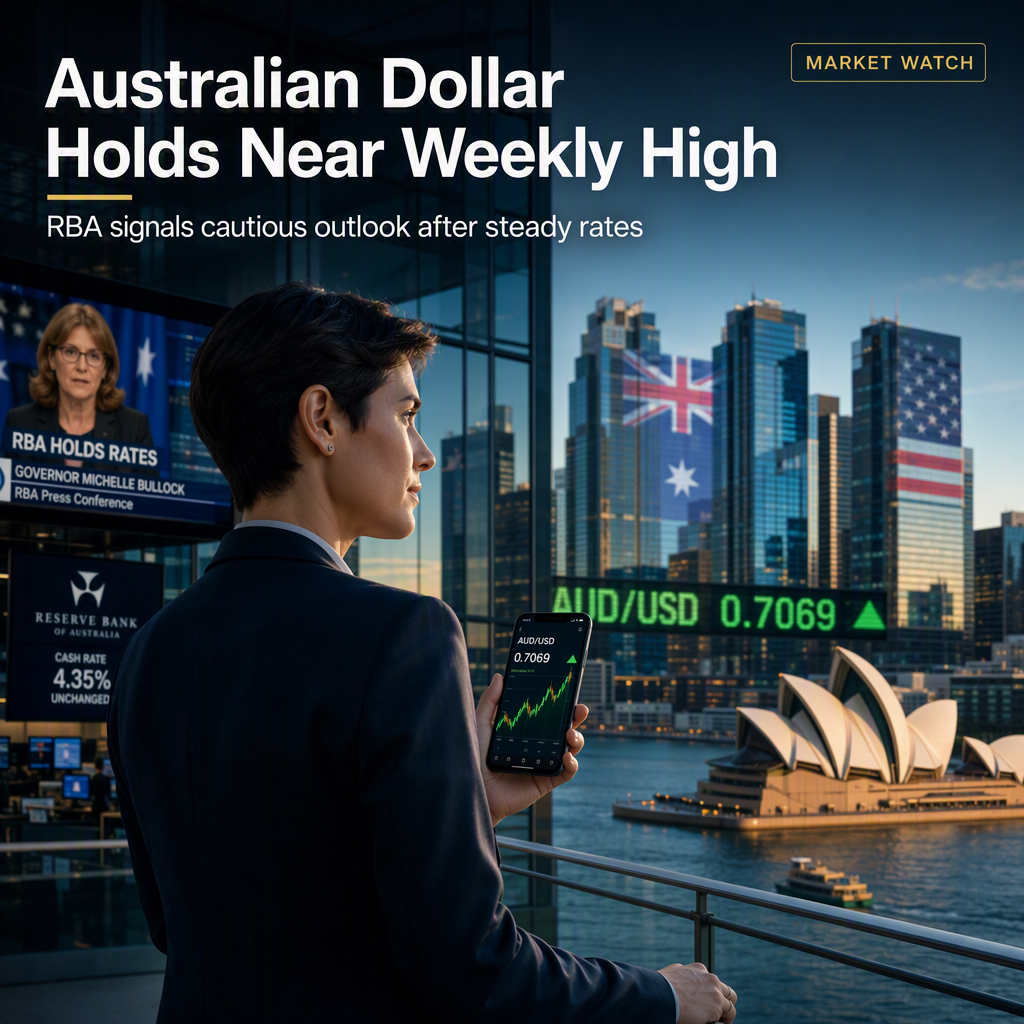
The Australian Dollar (AUD/USD) traded moderately higher above the 0.7060 region following the Reserve Bank of Australia's (RBA) decision to keep interest rates unchanged at 4.35% in a unanimous vote during its August monetary policy meeting [1]. RBA Governor Michelle Bullock stated that the central bank "will raise rates again if needed" and expressed hope for further progress before gaining confidence in the Consumer Price Index (CPI) trajectory [1].
On the US side, the ADP Employment Change 4-week average showed the private sector added 8.25K jobs for the week ending July 25, a decrease from the previously revised figure of 11K. Despite this weaker-than-expected jobs report, the US Dollar Index (DXY) remained flat, with market attention also drawn to geopolitical tensions in the Strait of Hormuz, where US forces reportedly fired on a Panama-flagged ship attempting to breach the American blockade of Iranian ports [1].
Standard Chartered analysts highlighted that the RBA projects a gradual disinflation path, expecting inflation to return to the midpoint of its 2-3% target range only by late 2027. The bank noted that tighter financial conditions are already impacting economic activity, with signs of an easing labor market, cooling housing prices, and slowing consumer spending growth [1]. Their base case anticipates no further RBA rate hikes in the foreseeable future, though they caution that risks remain skewed toward a possible hike in Q4 if demand does not slow or if energy prices rise again [1].
Technical analysis shows AUD/USD trading at 0.7069, maintaining a modest bullish bias above key moving averages, with immediate resistance at 0.7070 and 0.7074. The Relative Strength Index (RSI) near 60 suggests constructive, but not overextended, upside momentum [1].
CONCLUSION
The RBA's decision to hold rates steady and its cautious forward guidance have kept the Australian Dollar near weekly highs, supported by technical strength and a modestly positive market tone. While Standard Chartered expects a prolonged period of steady policy, risks of a rate hike remain if inflationary pressures persist. Market participants are likely to monitor upcoming data and global developments for further direction.