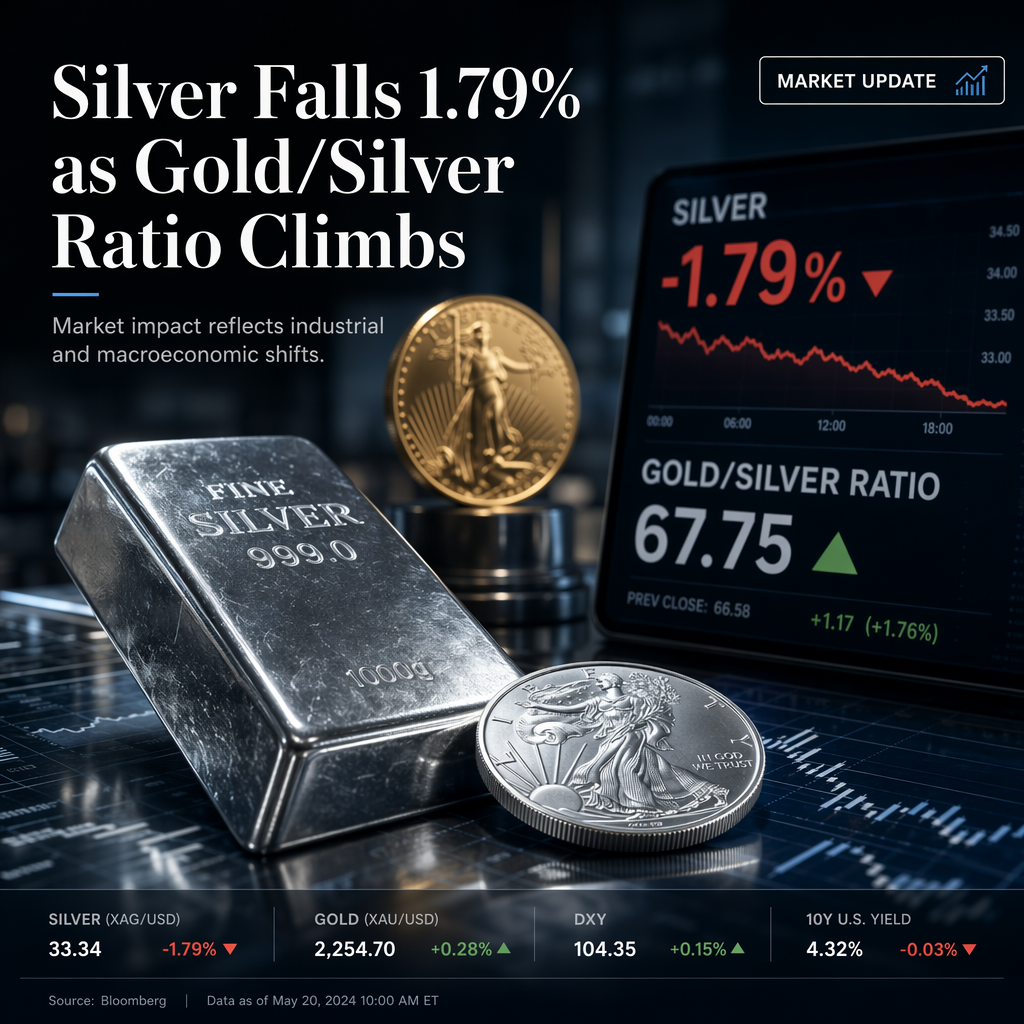
Silver prices (XAG/USD) declined on Tuesday, trading at $60.95 per troy ounce, which represents a 1.79% decrease from Monday's price of $62.06 [1]. Since the beginning of the year, silver prices have fallen by 14.26% [1]. The Gold/Silver ratio increased to 67.75 on Tuesday, up from 67.11 on Monday, indicating that more ounces of silver are needed to equal the value of one ounce of gold [1].
The article notes that silver is a precious metal traded by investors for diversification, intrinsic value, and as a potential hedge during periods of high inflation, though it is less popular than gold [1]. Silver prices are influenced by factors such as geopolitical instability, recession fears, interest rates, and the strength of the US Dollar, as well as investment demand, mining supply, and recycling rates [1]. Industrial demand, particularly from sectors like electronics and solar energy, also plays a significant role in price movements, with economic dynamics in the US, China, and India contributing to price swings [1].
Silver prices often follow gold's movements due to their similar safe-haven status. The Gold/Silver ratio is used by investors to assess the relative valuation between the two metals; a high ratio may suggest silver is undervalued or gold is overvalued, while a low ratio could indicate the opposite [1].
No forward-looking statements or analyst opinions are provided in the article [1].
CONCLUSION
Silver experienced a notable decline, falling 1.79% in a single day and 14.26% year-to-date, with the Gold/Silver ratio rising to 67.75. The market impact is medium, as the drop reflects broader influences such as industrial demand and macroeconomic factors. Investors may monitor the Gold/Silver ratio for potential valuation signals, but no explicit analyst forecasts are given.