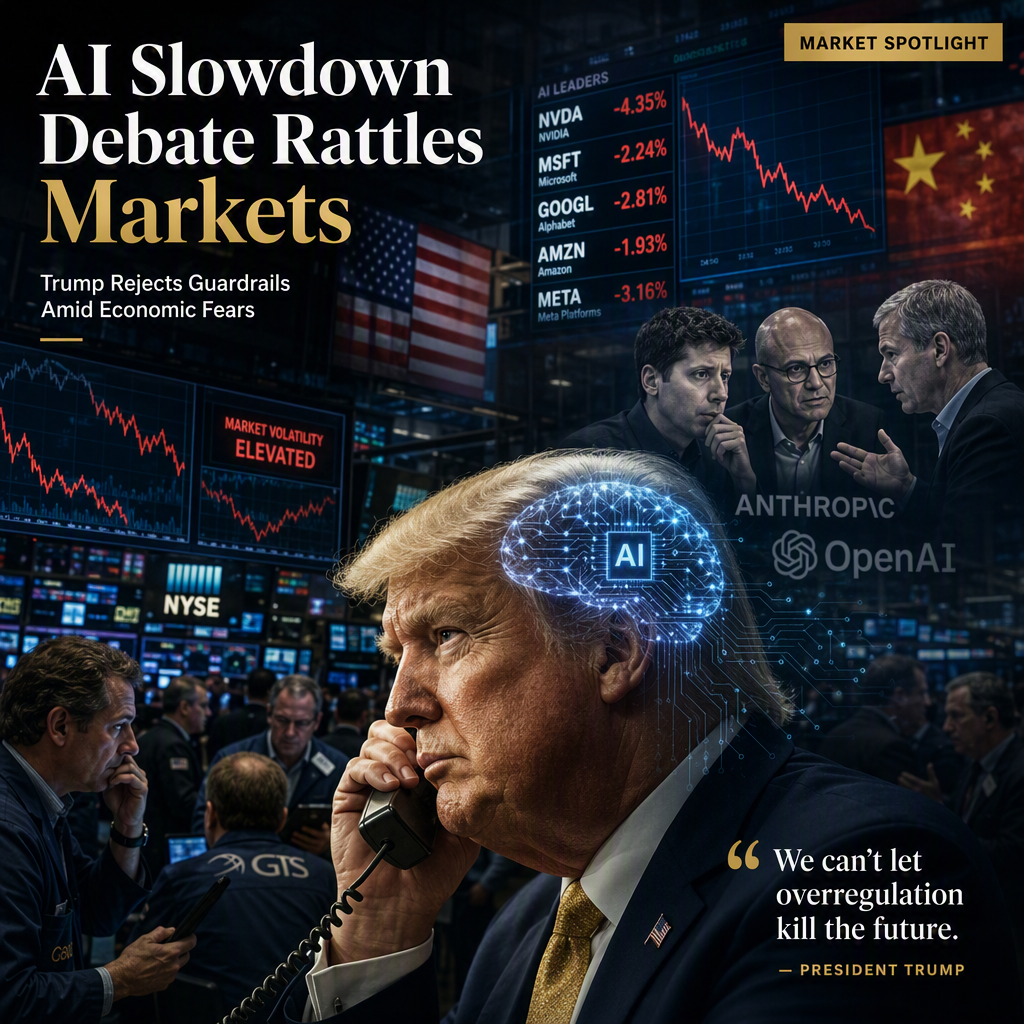
Calls to slow down AI development have intensified following the resignation of multiple engineers at leading companies, with Anthropic CEO Dario Amodei prompting other AI executives to advocate for 'pacing the frontier,' though the precise meaning of this remains unclear [1]. President Donald Trump has firmly opposed the idea of implementing guardrails on AI, labeling safety concerns as a 'hoax' and asserting that 'the only one happy about it is China.' Trump reiterated his position during a phone call with Nvidia CEO Jensen Huang, which was broadcast to employees during a company all-hands meeting [1].
AI-related investments have played a significant role in U.S. economic growth, accounting for nearly half of growth over the past year, according to one economist cited in the article [1]. Analysts at Goldman Sachs attribute approximately 50% of recent earnings growth in the S&P 500 to AI [1]. Fitch, a credit ratings agency, warned that the economy could enter a recession if an AI-related sell-off were to cause stock prices to decline by 35% over six months [1].
The U.S. economy's heavy reliance on AI investments may explain President Trump's strong opposition to slowing AI development, as he believes such measures could undermine economic momentum [1]. The debate over AI safety and regulation is now at the forefront of economic and political discourse, with market participants closely watching for potential impacts on stock prices and broader economic stability [1].
CONCLUSION
The ongoing debate about slowing AI development has raised significant concerns about its impact on U.S. economic growth and market stability. With AI investments driving a substantial portion of earnings and growth, any regulatory slowdown could have far-reaching consequences, as highlighted by warnings from Fitch and analysts at Goldman Sachs. President Trump's vocal opposition underscores the political and economic stakes involved in the AI safety discussion.