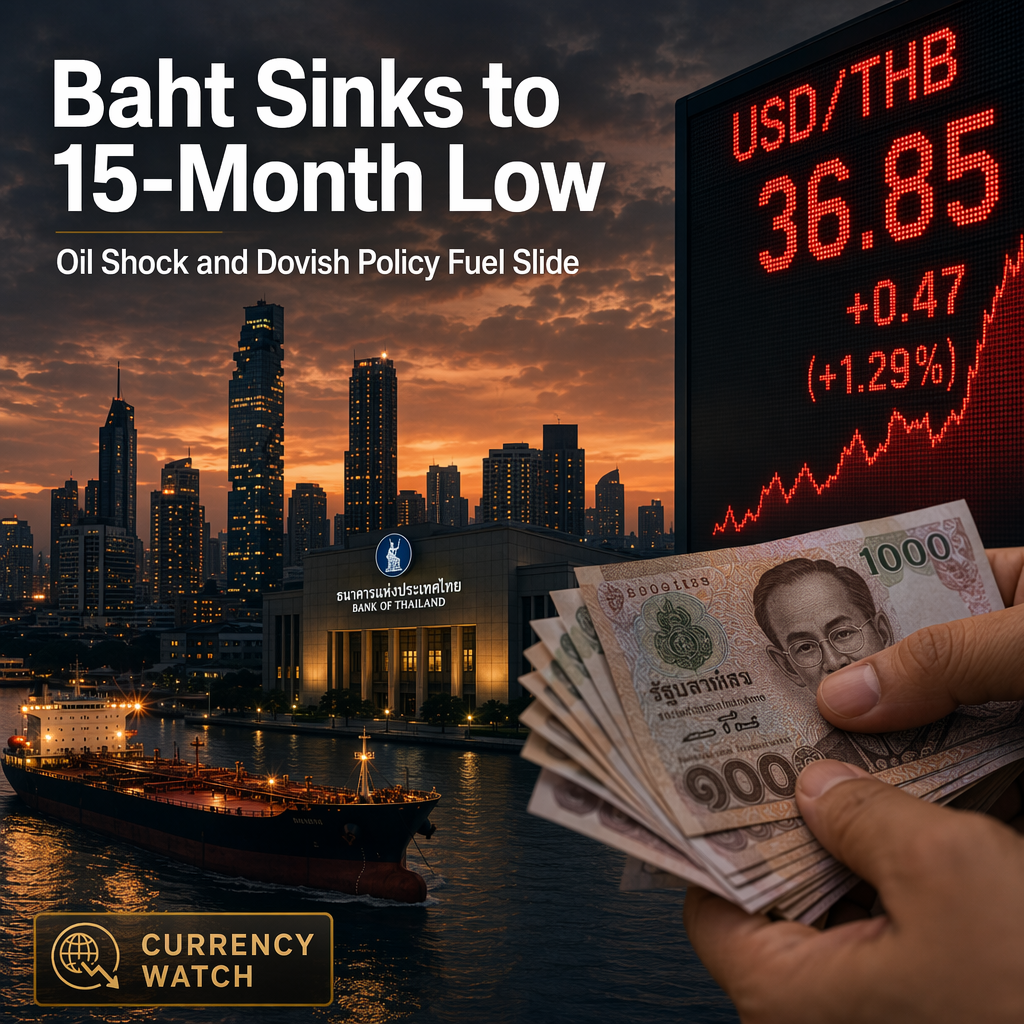
The Thai Baht (THB) is trading near its weakest level in over a year against the US Dollar (USD), pressured by a combination of volatile oil prices, a stronger USD, and higher US yields, according to OCBC analysts Sim Moh Siong and Christopher Wong [1]. The currency's decline has been exacerbated by the Bank of Thailand's (BoT) accommodative policy stance, with the central bank showing tolerance for gradual weakness in the Baht [1].
OCBC notes that the renewed oil shock, alongside a firmer USD and rising US yields, has created a challenging environment for the THB, particularly given Thailand's reliance on imported energy [1]. This situation has heightened inflation concerns and reinforced expectations that US interest rates may remain elevated for an extended period [1].
The BoT's current policy offers little support to the Baht, with Governor Vitai previously signaling no urgency to tighten monetary policy [1]. However, OCBC warns that a sharper depreciation of the THB could test policymakers' tolerance, especially if oil prices remain high and imported inflation continues to build [1].
No specific market reactions, forward-looking statements, or analyst opinions beyond OCBC's warnings and observations are provided in the source [1].
CONCLUSION
The Thai Baht remains under pressure due to high energy costs, a strong US Dollar, and the Bank of Thailand's accommodative stance. While policymakers have so far tolerated gradual weakness, a sustained oil shock and rising inflation could force a reassessment. Market participants should monitor for any policy shifts if depreciation accelerates.