
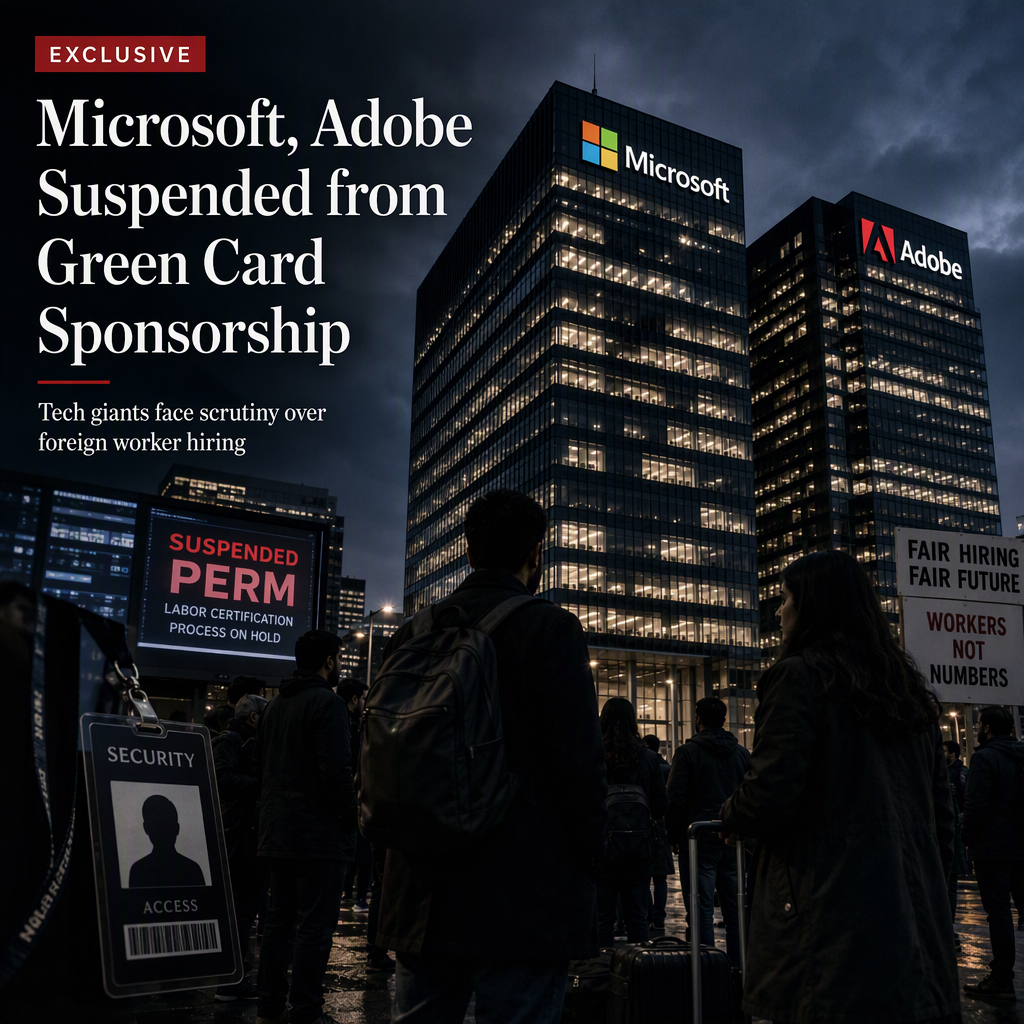
The Trump administration has suspended Microsoft, Adobe, and six IT services firms from the Labor Department's PERM program, which allows employers to sponsor foreign workers for green cards, citing concerns over the replacement of laid-off American workers with foreign hires [1]. Vice President JD Vance specifically accused Microsoft of replacing every laid-off worker with one and a half foreign 'indentured servants,' referencing the company's reliance on foreign labor [1]. The PERM suspension does not affect H-1B visas, which are temporary work permits, but H-1B approval data underscores the tech sector's dependence on foreign workers [1].
According to U.S. Citizenship and Immigration Services' H-1B Employer Data Hub, Amazon and Meta were the top sponsors of H-1B visas in fiscal 2025, with Amazon receiving 19,178 approvals and Meta 6,294. Microsoft was third with 6,258 approvals, having been surpassed by Amazon in 2017 [1]. Vice President Vance claimed Microsoft replaced 6,000 laid-off workers in 2025 with H-1B visa holders, and data confirms Microsoft received over 6,000 H-1B approvals last year. However, two-thirds of these approvals were for individuals already employed at Microsoft, while Amazon brought in nearly four times as many new H-1B workers and was not included in the suspension [1].
All eight suspended companies are among the nation's top 50 H-1B sponsors, with most being IT services and consulting firms. Adobe is the smallest among them, ranked No. 45 [1]. The crackdown also extended beyond the tech sector, as Labor Department Inspector General Anthony D'Esposito announced an investigation into alleged J-1 visa fraud at nine major American universities during the same news conference [1]. Trump supporters argue that such visa programs incentivize employers to hire from abroad, potentially undercutting American workers [1].
CONCLUSION
The suspension of Microsoft, Adobe, and six IT firms from the PERM green card program highlights ongoing scrutiny of foreign worker hiring practices in the tech sector. While H-1B visa approvals remain unaffected, the move signals increased regulatory pressure and could impact future hiring strategies for major technology companies.