
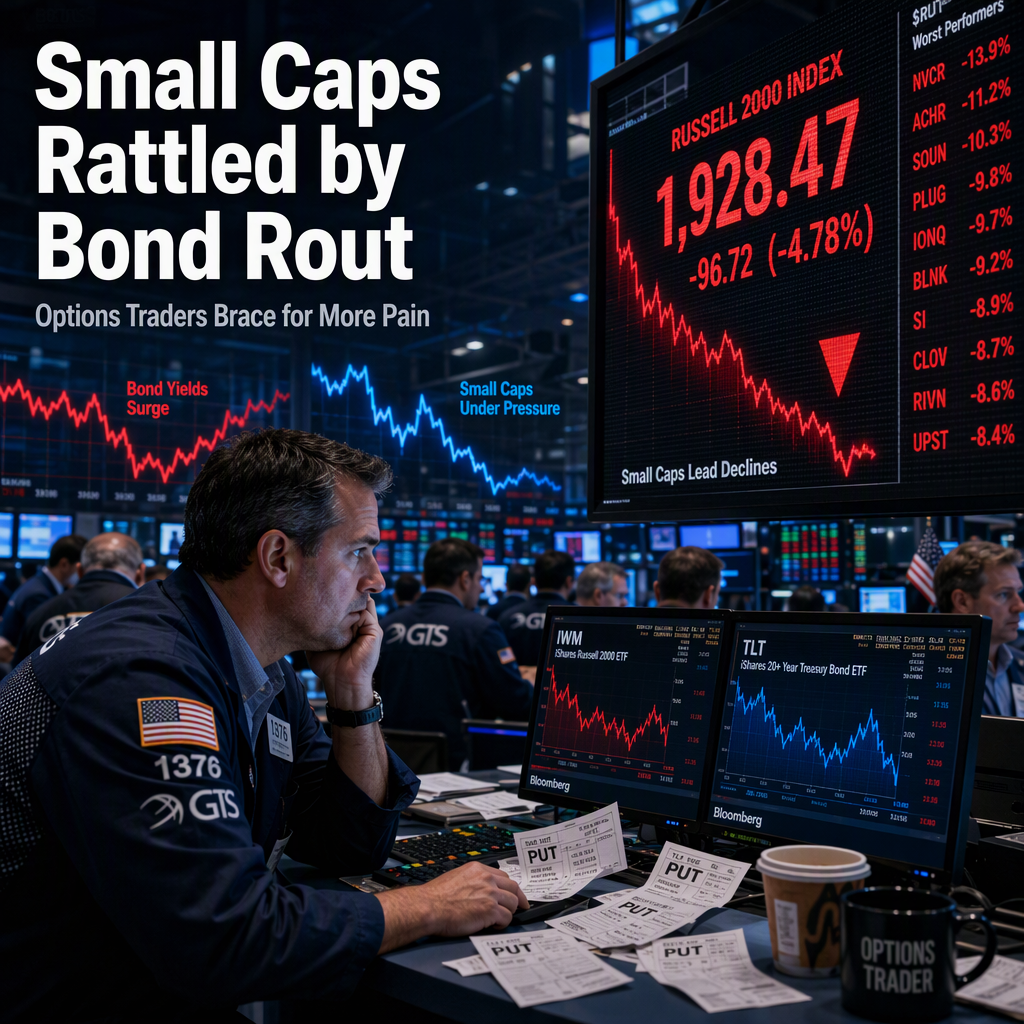
Small-cap stocks in the U.S. have experienced significant underperformance in September, following a strong start to the year. The Russell 2000 index, which was up 20% year to date at the beginning of the month, has now dropped to a 14% gain, lagging behind the S&P 500's 20% and Nasdaq-100's 12% returns for the same period [1]. The primary drivers of this decline are higher interest rates and falling bond prices, with the correlation between the iShares Russell 2000 ETF (IWM) and the 20+ Year Treasury Bond ETF (TLT) currently at 0.51. Notably, last week, the correlation between small caps and the price of the 10-year Treasury note reached a one-year high above 0.97 [1].
According to Kevin Gordon, head of macro research and strategy at the Schwab Center for Financial Research, small caps have struggled more than large caps to adjust to the Federal Reserve's hawkish stance and rising long-term rates. Their negative correlation to the 10-year Treasury yield is twice that of large caps [1]. Options trading activity reflects this bearish sentiment: on Thursday, more puts were traded than calls in IWM, with traders likely buying 480,000 puts versus 371,000 calls. Total open interest in puts is just shy of 7 million contracts, compared to 3 million in calls. Of the $322 million in premium traded in IWM, $100 million was likely spent buying puts, while $50 million went to calls. The top-four most popular trades by volume were all puts, with the 280 and 281-strike puts expiring Thursday accounting for over 120,000 trades. The 269-strike put expiring October 16 requires a 4% selloff to be profitable [1].
Despite the bearish options activity and the expectation of further weakness if rates continue to rise, Gordon notes that some small caps still show strong fundamentals. He points to continued improvement in PMIs, robust U.S. growth data, and solid forward earnings estimates for small caps as reasons not to discount their broader prospects [1].
Market implications are significant, as the rate-driven shift in power rankings among equity indexes appears likely to persist. Options volume in SPY and QQQ was 40% above the 30-day average by midday Thursday, while IWM volume was nearly double, indicating heightened trader activity and concern around small caps [1].
CONCLUSION
Small caps have suffered a sharp setback in September due to rising rates and bond liquidation, with options traders heavily favoring bearish positions. While further weakness is possible if rates continue to climb, some analysts highlight strong fundamentals and earnings prospects for select small-cap stocks. The market impact is high, and traders are closely watching rate movements for future direction.