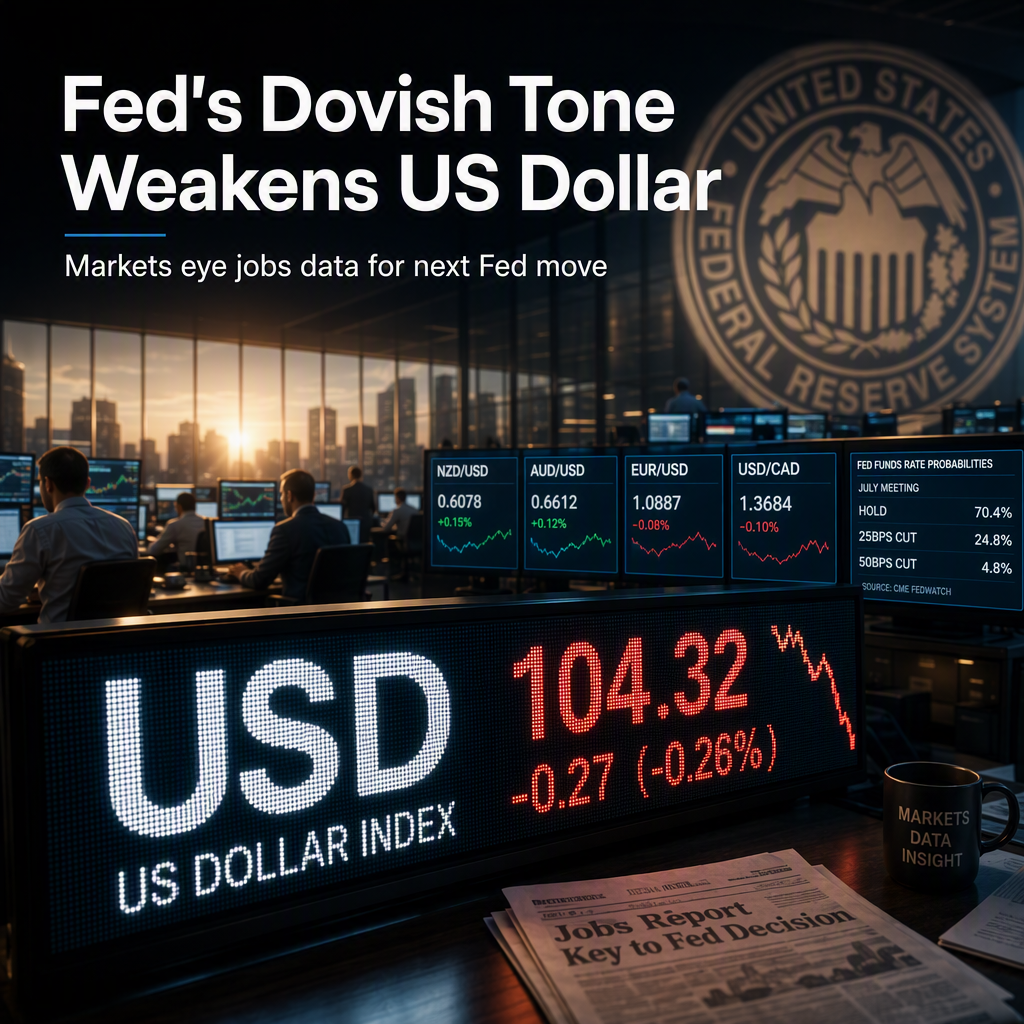
The US Dollar (USD) weakened against major currencies following Federal Reserve (Fed) Governor Christopher Waller's remarks, which signaled a preference for holding interest rates steady at the upcoming September meeting, provided that inflation data does not surprise to the upside [1][2][3][4][5]. Waller's dovish tone contrasted with previous hawkish statements from other Fed officials, notably Chairman Kevin Warsh, and led to a notable shift in market expectations. The CME FedWatch tool showed the probability of a September rate hike dropping to approximately 50% from 63.2% the previous day [1][3][4][5]. The FXS Fed Sentiment Index also reflected a modest pullback in perceived hawkishness, falling by 2.06 points to 125.38, though it remains above the neutral mark, indicating that markets still see some risk of further tightening [3].
Currency markets responded to the Fed's softer stance. The New Zealand Dollar (NZD/USD) advanced for a second day, trading around 0.5900, supported by both the weaker USD and a rebound in New Zealand's trade data, which showed two-way trade rising 16% year-on-year to NZ$64.9bn in the June quarter [1]. The Reserve Bank of New Zealand (RBNZ) recently implemented its second consecutive rate hike but signaled a less aggressive approach going forward, with a December hike nearly fully priced in by markets [1]. The Australian Dollar (AUD/USD) also edged higher, nearing 0.7210, as Australia's Q2 GDP growth of 0.4% quarter-on-quarter beat forecasts and raised the probability of a September rate hike by the Reserve Bank of Australia (RBA) to about 70% [4]. The Canadian Dollar (USD/CAD) traded sideways after a sharp drop in USD/CAD on Thursday, with the pair holding below its 100-day moving average, reflecting a bearish near-term tone for the USD [3]. The Euro (EUR/USD) remained flat above 1.1600, with investors cautious ahead of the US Nonfarm Payrolls (NFP) report and Eurozone retail sales data [5].
Market participants are now focused on the upcoming US August employment report, with consensus estimates projecting Nonfarm Payrolls to expand by 56,000 jobs and the unemployment rate to remain at 4.1% [1][4]. TD Securities expects a stronger NFP rebound to 95,000, but notes that only a strong inflation print following the jobs data would likely push the Fed toward a rate hike [3][5]. Analysts at TD Securities and other sources agree that while a strong payrolls report could give a slight boost to the USD, it is unlikely to shift the Fed's stance unless accompanied by higher inflation data [3][5].
In summary, the Fed's shift toward a more data-dependent and less hawkish stance has led to a pullback in USD strength and repricing of rate hike probabilities across markets. The focus now turns to the US NFP and subsequent inflation data, which will be critical in determining the Fed's next move and the USD's direction.
CONCLUSION
The Federal Reserve's softer tone has tempered expectations for a September rate hike, weakening the US Dollar and boosting rival currencies. Market participants are now awaiting the US Nonfarm Payrolls and inflation data for further guidance on the Fed's policy path. Unless both jobs and inflation data surprise to the upside, the Fed is likely to hold rates steady in September.