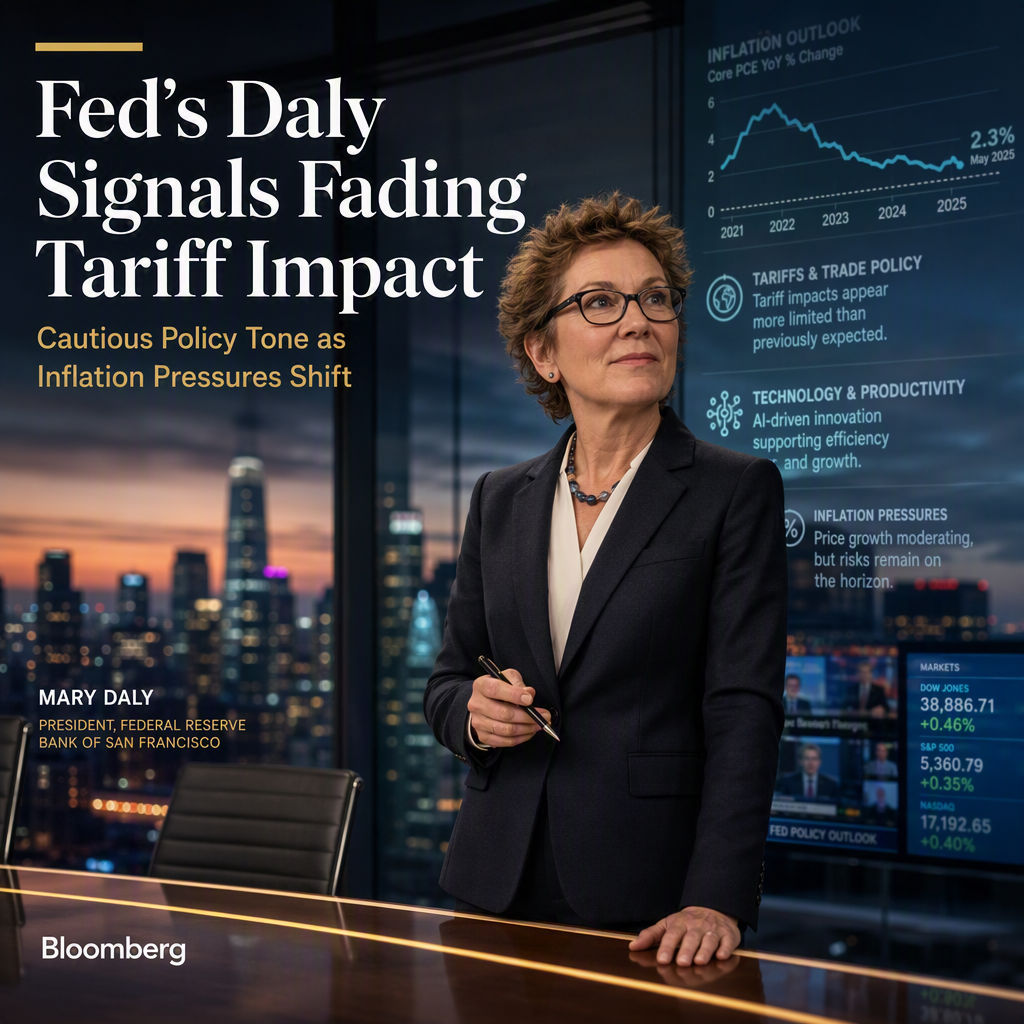
Federal Reserve Bank of San Francisco President Mary Daly stated that tariffs have had a clear impact on inflation, but she is now observing early signs that this effect is beginning to fade [1]. Daly also noted that the end of the Middle East war should help ease inflation pressures, while technology spending is currently pushing inflation higher [1]. She emphasized that many expect supply shocks to trigger a temporary surge in inflation, but there are 'good reasons' to believe these shocks will not cause a lasting impact on inflation [1].
Daly highlighted that the job market is unlikely to spark significant inflation pressure and that longer-term inflation expectations remain firmly anchored, though she cautioned that stable inflation expectations should not be taken for granted [1]. In terms of monetary policy, Daly expressed support for holding rates steady in July and gathering more data, reflecting a cautious and risk-balanced approach [1].
Market reaction to Daly's comments was muted, with the US Dollar Index (DXY) trading 0.02% lower near 99.68 as of the time of reporting [1]. The FXS Speechtracker score for Daly's remarks was 5.4/10, slightly below the historical average of 5.6/10, indicating a modestly less hawkish tone [1]. Additionally, the FXS Fed Sentiment Index fell by 2.23 points to 138.69, signaling a pullback in perceived hawkishness, though the index remains above the neutral 100 mark [1].
Overall, Daly's remarks suggest that current inflationary pressures are largely supply-shock driven and potentially transitory, rather than demand-led. Her comments reinforce a wait-and-see approach to monetary policy, with the Fed remaining in hawkish territory but showing signs of a marginally softer policy tone [1].
CONCLUSION
Fed’s Daly signaled that the inflationary impact of tariffs is beginning to fade, while technology spending remains a concern. Her support for holding rates steady and the modestly softer policy tone suggest the Fed is adopting a cautious, data-dependent stance amid ongoing inflation uncertainties.