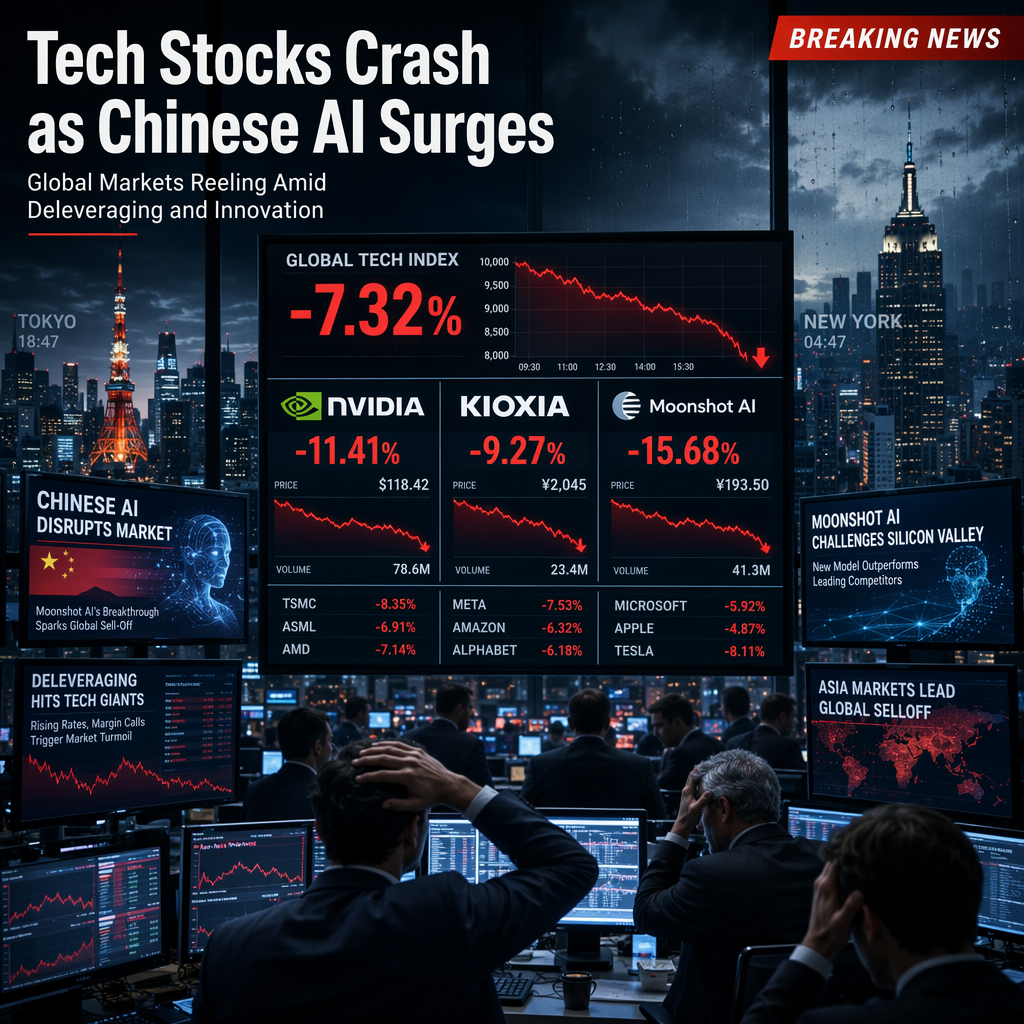
On Friday, technology stocks in both the U.S. and Japan experienced sharp declines, driven by concerns over intensifying competition in artificial intelligence and a wave of deleveraging among investors. In the U.S., shares of Nvidia and other major technology companies tumbled after Chinese startup Moonshot AI unveiled its low-cost Kimi K3 model, which is seen as a significant advance and a potential rival to leading U.S. AI systems [1]. This development revived fears about America's dominance in the AI sector, with investors worried that Chinese developers are narrowing the technology gap while aggressively undercutting on price [1]. Market strategists described the event as a 'wake-up call' for U.S. tech giants, warning that the rapid progress of Chinese AI could force American firms to accelerate development and lower prices, thereby pressuring profit margins [1]. Technical analysts cautioned that a break below recent support levels for Nvidia and other Big Tech stocks could trigger further downside, as market sentiment turned more cautious and investors closely monitored competitive threats from China [1].
Simultaneously, Japanese stocks also plunged, led by a 16% drop in memory maker Kioxia Holdings, as investors unwound leveraged positions in tech stocks amid skepticism over the sustainability of the AI-led rally [2]. The Nikkei average briefly fell by 4,100 points, with semiconductor and technology stocks leading the declines [2]. Market participants attributed the sell-off to rapid deleveraging and growing doubts about the durability of AI-driven gains in Japanese equities [2]. Technical analysts noted that the Nikkei breached several key support levels, raising concerns about further downside risk [2]. A Tokyo-based trader highlighted that the forced selling was especially pronounced in stocks that had benefited most from the AI rally [2].
Across Asian markets, equity benchmarks declined, with volatility in major semiconductor stocks further dampening sentiment [2]. The sharp drop in Kioxia and similar names raised questions about the resilience of Japanese equities if the AI narrative weakens [2]. Analysts warned that failure to hold above key psychological support levels could lead to additional selling pressure, and resistance is now expected at previous support levels [2].
Both articles underscore a shift toward caution and heightened risk aversion among investors, as the competitive threat from Chinese AI innovation and concerns over market leverage prompt a broad reassessment of the outlook for technology shares globally [1][2].
CONCLUSION
The unveiling of Moonshot AI's Kimi K3 model and a wave of deleveraging have triggered significant declines in technology stocks across the U.S. and Japan. Market sentiment has turned cautious, with analysts warning of further downside risk as investors re-evaluate the sustainability of AI-driven gains and the competitive landscape. The events highlight the growing influence of Chinese innovation and the vulnerability of tech-heavy markets to shifts in investor confidence.