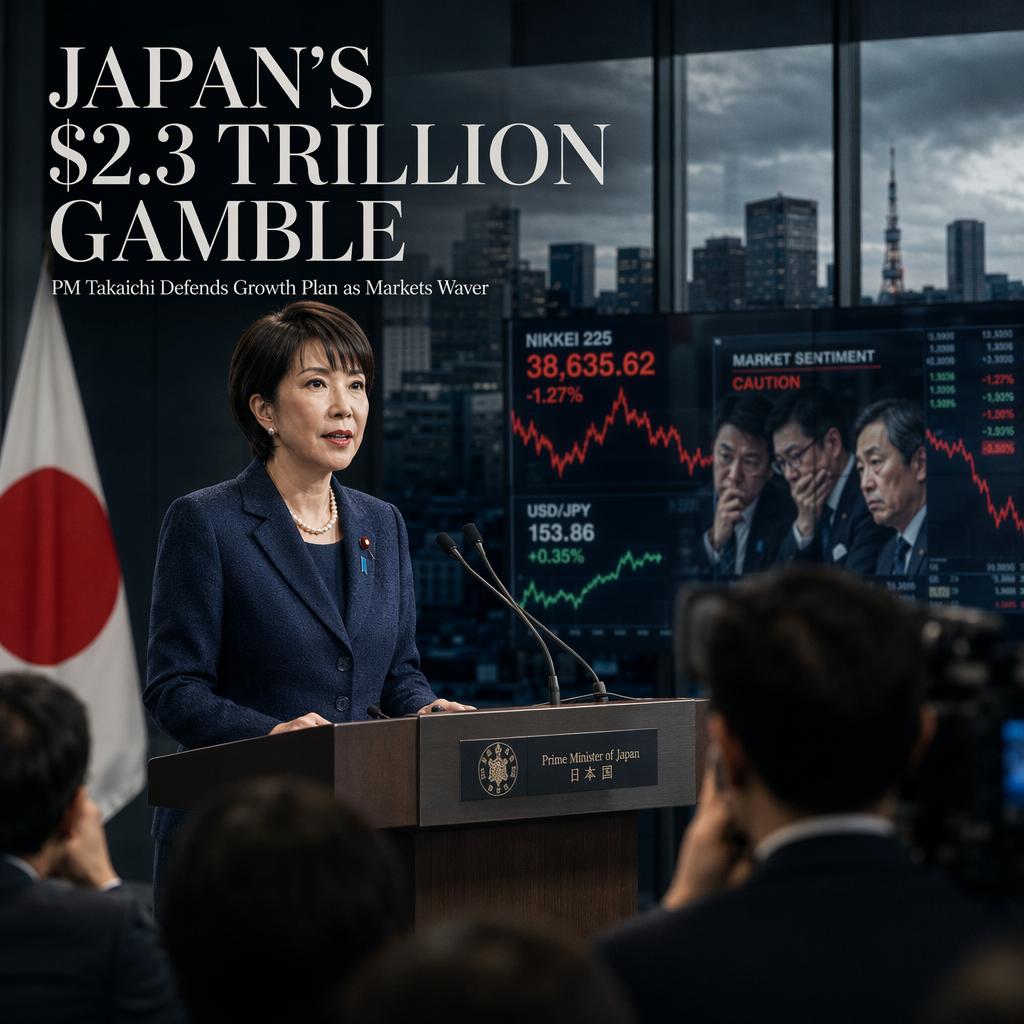
Japanese Prime Minister Sanae Takaichi has publicly defended her administration's 370 trillion yen ($2.3 trillion) economic growth drive, addressing mounting concerns from market participants about the potential risks of such a large-scale stimulus package [1]. During a news conference at the prime minister’s office in Tokyo on July 27, Takaichi emphasized that Japan has not yet 'escaped deflation' despite recent price increases, underscoring the necessity for continued economic stimulus [1].
The initiative, one of the largest in recent Japanese history, is designed to boost economic activity and support recovery in key sectors [1]. However, market participants have expressed unease regarding the plan's scale, with some analysts warning that significant government spending could lead to higher bond yields and a weaker yen [1]. These concerns are heightened as the yen trades near multi-decade lows and yields rise in response to global commodity price increases, particularly oil surpassing $100 per barrel [1].
Takaichi responded to these criticisms by asserting that the growth drive would be implemented through targeted investments and careful fiscal management, aiming to strengthen the economy's foundations without resorting to unchecked fiscal expansion [1]. She stated, "We are focused on strengthening the foundations of the economy without resorting to unchecked fiscal expansion" [1].
Economists remain skeptical about Japan's ability to grow its way out of its sizable national debt, with a recent Nikkei survey highlighting these ongoing concerns [1]. Despite this, Takaichi maintained that the growth drive is essential for securing long-term prosperity and preventing a return to prolonged economic stagnation [1].
CONCLUSION
Prime Minister Takaichi's $2.3 trillion growth plan has sparked significant market debate, with concerns about inflation, bond yields, and the yen's stability. While the administration insists on fiscal discipline and the necessity of stimulus, skepticism remains among economists and market participants regarding Japan's debt trajectory and the plan's long-term effectiveness.