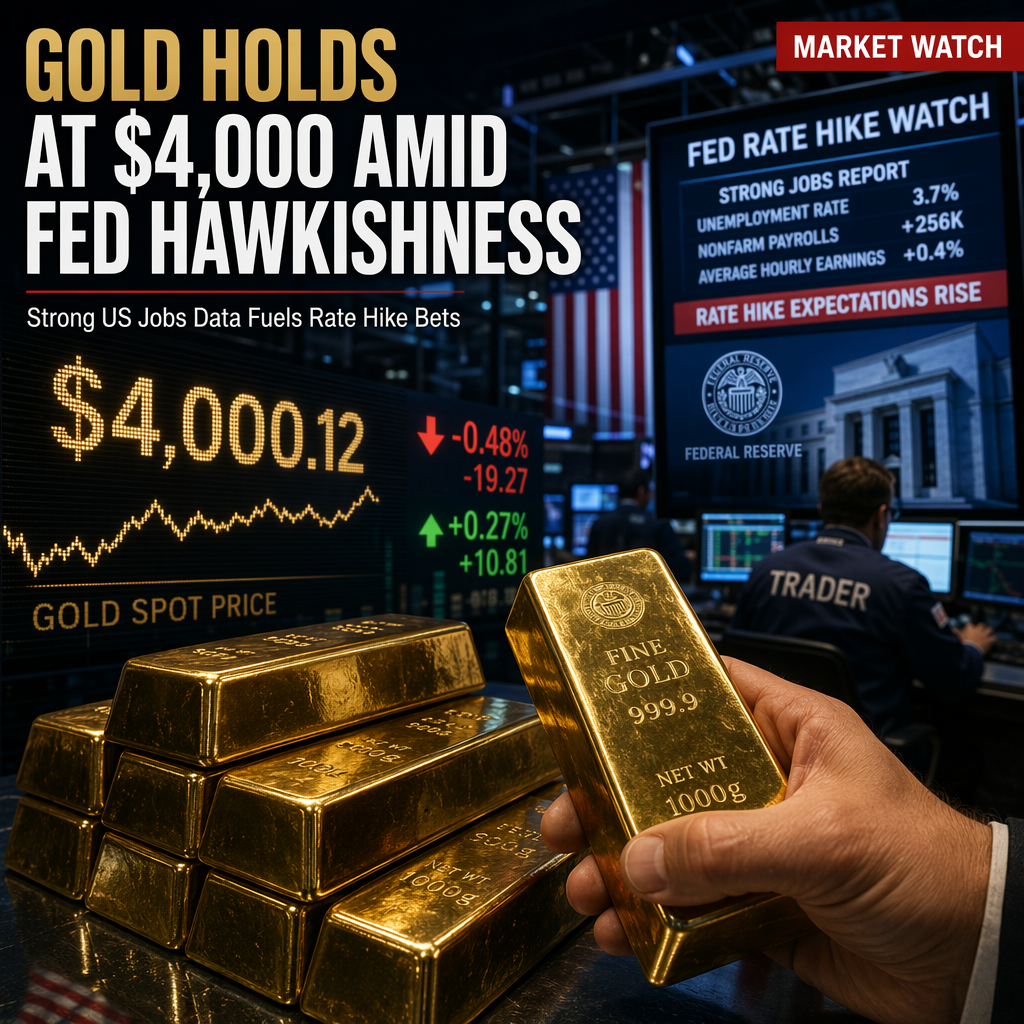
Gold (XAU/USD) is stabilizing just above the $4,000 mark, trading around $4,025 on Wednesday after hitting a seven-month low of $3,941 on Tuesday [1][3]. The precious metal has experienced its steepest quarterly decline since 2013, now trading approximately 28% below its all-time high near $5,600 set in January, following a 67% rally in 2025 [1]. The recent sell-off is primarily attributed to a sharp shift in US interest rate expectations, with traders now pricing in a 67% probability of a Federal Reserve (Fed) rate hike at the September meeting, according to the CME FedWatch Tool [1].
The catalyst for this shift has been robust US labor market data. The Job Openings and Labor Turnover Survey (JOLTS) reported job openings at 7.594 million in May, the highest in two years [2][3]. Additionally, the Challenger Job Cuts report showed a significant decline in job cuts to 45,849 in June from 97,006 in May, a 53% drop [2][4]. Year-to-date, employers have announced 443,604 job cuts, down 40% from the first half of 2025, though this remains the second-highest January-to-June total since 2020 [4]. These data points reinforce the view that the US labor market remains resilient, supporting expectations for a more hawkish Fed policy stance [2][3][4].
Fed officials have echoed this sentiment. In a recent interview, Fed’s Hammack stated that the job market is “right around full employment” and growth “looks good,” but warned that “inflation is still too high” and that rate hikes may need to be considered, emphasizing persistent core and services inflation [4]. Market participants are now awaiting further cues from the ADP Employment Change report and Fed Chair Kevin Warsh’s speech in Sintra, Portugal, later on Wednesday, as well as Thursday’s Nonfarm Payrolls (NFP) report [1][2][3].
Gold’s downside is also pressured by weak physical demand from India, where households sold nearly 50 tonnes of old gold in the April-June quarter, a 43% increase from a year earlier, following a customs duty hike from 6% to 15% in May [1]. Geopolitical uncertainty, particularly slow progress in US-Iran peace talks, is providing some support for safe-haven assets but has not reversed gold’s bearish trend [1][2].
Technically, XAU/USD remains in a bearish near-term tone, trading below key moving averages and showing fading bearish momentum, but no clear signs of a trend reversal [1][3]. A decisive break below $4,000 could expose further downside toward the $3,860–$3,886 area, while resistance is seen near $4,060 and $4,096 [3].
CONCLUSION
Gold prices remain under pressure as strong US labor market data and hawkish Fed expectations boost the US Dollar and Treasury yields. With traders now anticipating a possible rate hike, gold’s outlook stays bearish, especially amid weak physical demand and ongoing geopolitical uncertainty. Upcoming US employment reports and Fed communications will be critical in shaping the next move for gold.