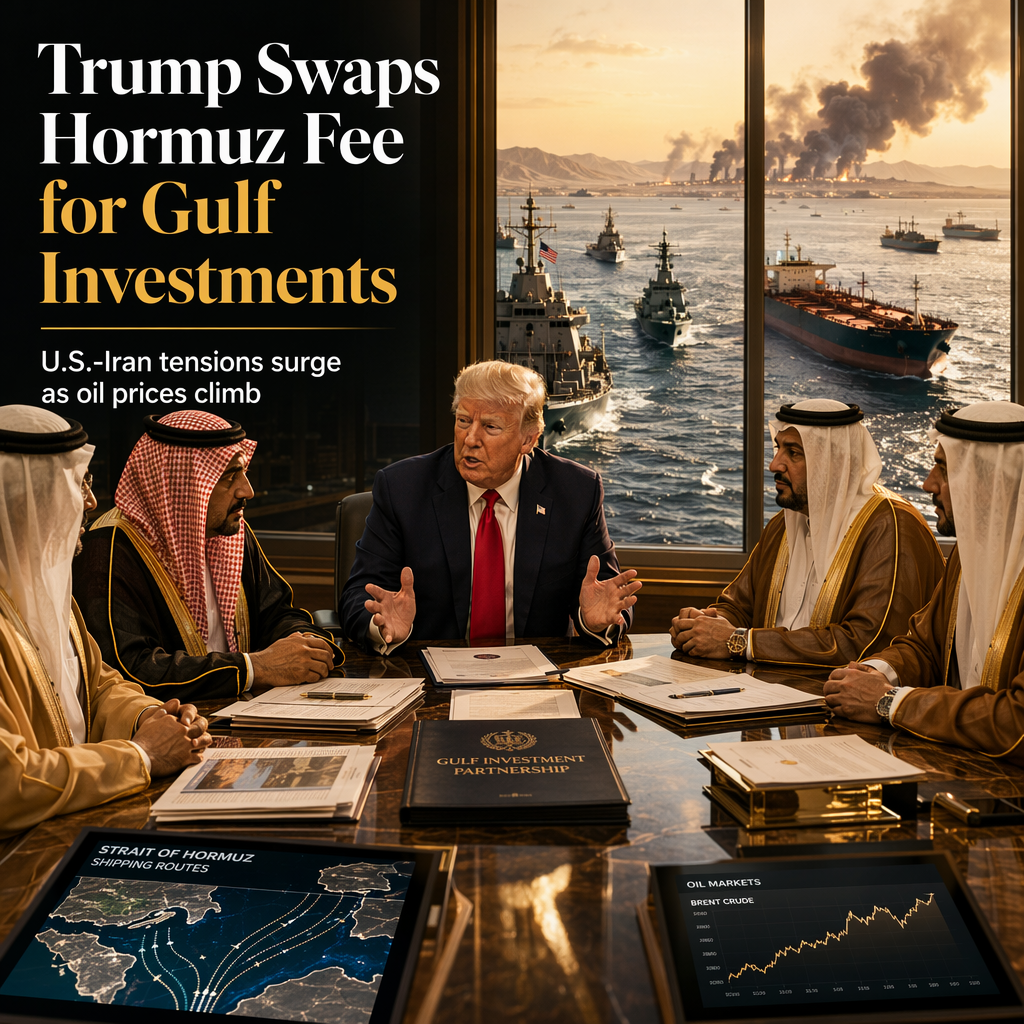
President Donald Trump announced on Tuesday that he will scrap a proposed 20% fee on commercial shipping through the Strait of Hormuz, opting instead for 'Trade and Investment Deals' with Gulf nations investing in the United States [1]. Trump stated that the decision was made following productive conversations with Middle East leadership, who expressed interest in investing in the U.S. 'at record amounts' [1]. He emphasized that the new approach replaces the fee with investments, which he described as a preferable form of compensation for U.S. protection of the strait [1].
The announcement comes as tensions escalate between the U.S. and Iran over control of the Strait of Hormuz, a critical shipping route for oil and natural gas. Trump declared that the strait is open to all ship traffic except for Iran, citing Iranian leadership as the reason for a 'FULL Blockade' on ships to and from Iranian ports or carrying Iranian cargo [1]. Over the weekend, U.S. and Iranian forces exchanged missile and drone attacks, and on Monday, the U.S. launched strikes against Iranian military sites [1]. Trump claimed these actions have 'very much destabilized' Iran and significantly reduced its military capability [1].
Market reactions were notable, with FOX Business reporting surging oil prices tied to Iran's claims over the Strait of Hormuz and the reinstated blockade by President Trump [1]. The ongoing tensions and military exchanges have heightened concerns about the security of oil supplies through the region [1].
During a meeting with Iraqi Prime Minister Ali al-Zaidi, Trump reiterated that Gulf state leaders prefer investment deals over fees and that these investments will be 'massive' and beneficial for the U.S. economy [1]. He also criticized the longstanding practice of the U.S. protecting the strait without adequate compensation, stating that the new investment-focused approach is fairer and more advantageous [1].
CONCLUSION
President Trump's decision to replace the proposed shipping fee with Gulf states' investment deals marks a significant shift in U.S. policy regarding the Strait of Hormuz. The move comes amid heightened U.S.-Iran tensions and has contributed to rising oil prices, reflecting market concerns over regional stability and energy supply security.