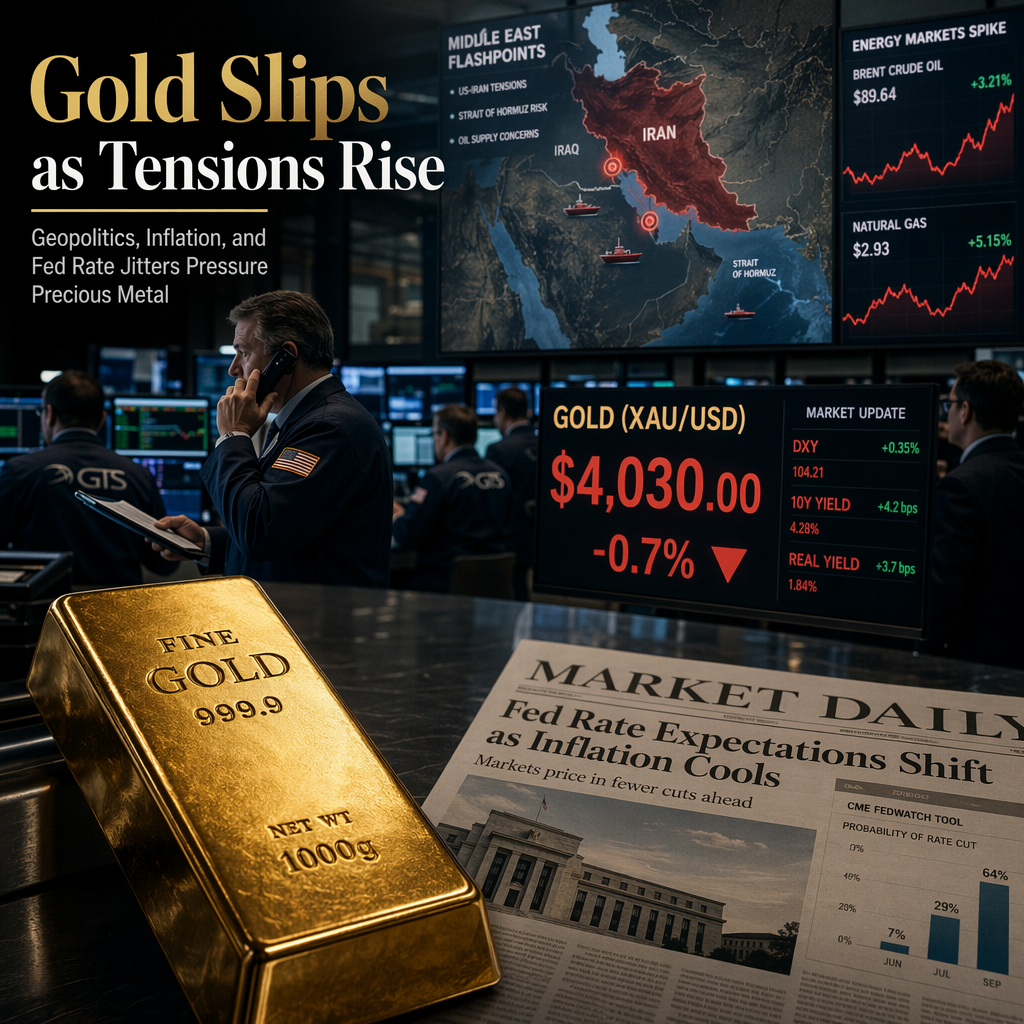
Gold prices (XAU/USD) declined by 0.7% to near $4,030 during the European trading session on Thursday, as the precious metal faced selling pressure due to persistent global inflation concerns and elevated energy prices following increased military aggression between the United States and Iran [1]. A drone crash into an oil tanker at Iraq's Basra terminal led to the suspension of all crude loading at Iraqi terminals, intensifying fears of reduced oil supply and further supporting higher energy prices [1].
The prospect of higher energy prices has de-anchored global inflation expectations, raising concerns about tighter monetary conditions from central banks. This environment typically weighs on non-yielding assets like gold, as higher interest rate hike expectations make such assets less attractive [1]. US President Donald Trump warned in a Fox News interview that he may authorize attacks on Iranian infrastructure next week if Iran does not return to negotiations, signaling potential for further escalation in the conflict [1].
Despite these pressures, the downside for gold may be limited by easing hawkish expectations for the Federal Reserve. Traders have reduced their expectations for a Fed interest rate hike in July, with the CME FedWatch tool showing odds dropping to 10.2% from 24.6% a week earlier, following cooler US consumer and producer inflation data for June [1].
From a technical perspective, XAU/USD remains bearish in the near term, trading below the 20-day exponential moving average (EMA) at $4,113.96, with a mid-range Relative Strength Index (RSI) around 40 indicating ongoing, though not exhausted, selling pressure. Key resistance is at the 20-day EMA, and a sustained move above this level would be needed to alleviate bearish momentum. On the downside, a break below the June 30 low of $3,941.76 could open the way for a slide toward the October 28 low of $3,886.62 [1].
CONCLUSION
Gold prices are under pressure due to geopolitical tensions and inflation concerns, but the downside may be cushioned by reduced expectations for further Fed rate hikes. The market remains cautious, with technical indicators pointing to persistent selling pressure unless key resistance levels are reclaimed.