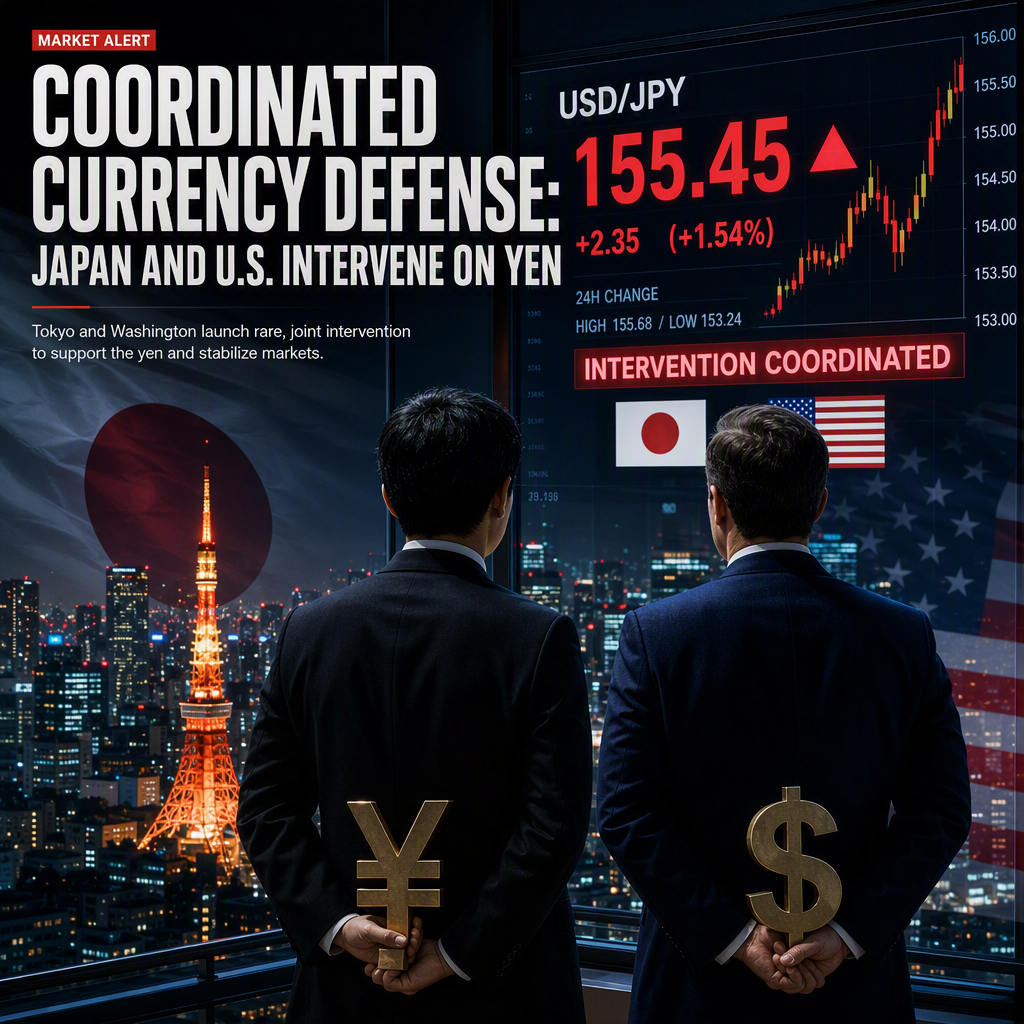
Japan and the United States conducted a coordinated yen-buying intervention on Friday, marking the first joint currency market action between the two countries in 15 years, according to statements from Japan's Finance Minister Satsuki Katayama and U.S. Treasury Secretary Scott Bessent [1][4][5]. The intervention was aimed at curbing what officials described as 'excessive volatility and disorderly movements' in the Japanese yen, which had recently fallen to its weakest level in roughly four decades, hitting 163.73 against the U.S. dollar on Thursday before strengthening to 157.57 on Friday [5].
Following the intervention, the Japanese yen attracted buyers, with the USD/JPY pair dropping to as low as 155.45 during early Asian trading hours on Monday, its lowest since May 6 [1]. At various points, the USD/JPY was reported at 155.55 and 156.35, reflecting a 1.15% and 0.62% decline on the day, respectively [2][3]. However, the yen later softened, with the USD/JPY recovering to 157.65 [4].
Finance Minister Katayama emphasized that Japanese authorities 'will not hesitate to carry out more foreign exchange (FX) intervention with Washington' and remain in close communication with U.S. counterparts [1][3][5]. U.S. Treasury Secretary Bessent echoed this stance, stating that the Treasury 'will stay vigilant and maintain close communication with counterparts at the Ministry of Finance (MoF) and the Bank of Japan (BoJ)' and would not hesitate to participate in further joint intervention [1][5].
Japan's Vice Finance Minister for International Affairs, Atsushi Mimura, described the joint intervention as potentially marking the peak of the U.S.-Japan currency partnership and noted that authorities would continue close cooperation with the BoJ [2]. The Japanese Finance Ministry also announced plans to utilize the Federal Reserve's FIMA repo facility for future interventions, clarifying that limits on the facility do not imply constraints on overall FX intervention [2][3][5].
Market analysts offered mixed views on the intervention's effectiveness. Robin Brooks of the Peterson Institute for International Economics suggested that the coordinated intervention could ultimately weaken confidence in the yen, depending on the mechanics of the operation [5].
U.S. President Donald Trump commented that the U.S. participated in the intervention as a gesture of support for Japan and global economic stability, describing it as a 'signal of friendship' [5].
CONCLUSION
The rare joint yen-buying intervention by Japan and the U.S. led to a sharp appreciation of the yen and signaled both countries' readiness for further action if needed. While officials stressed their commitment to stabilizing the currency, market analysts expressed uncertainty about the long-term impact. The intervention underscores heightened vigilance and cooperation between Tokyo and Washington in managing currency volatility.