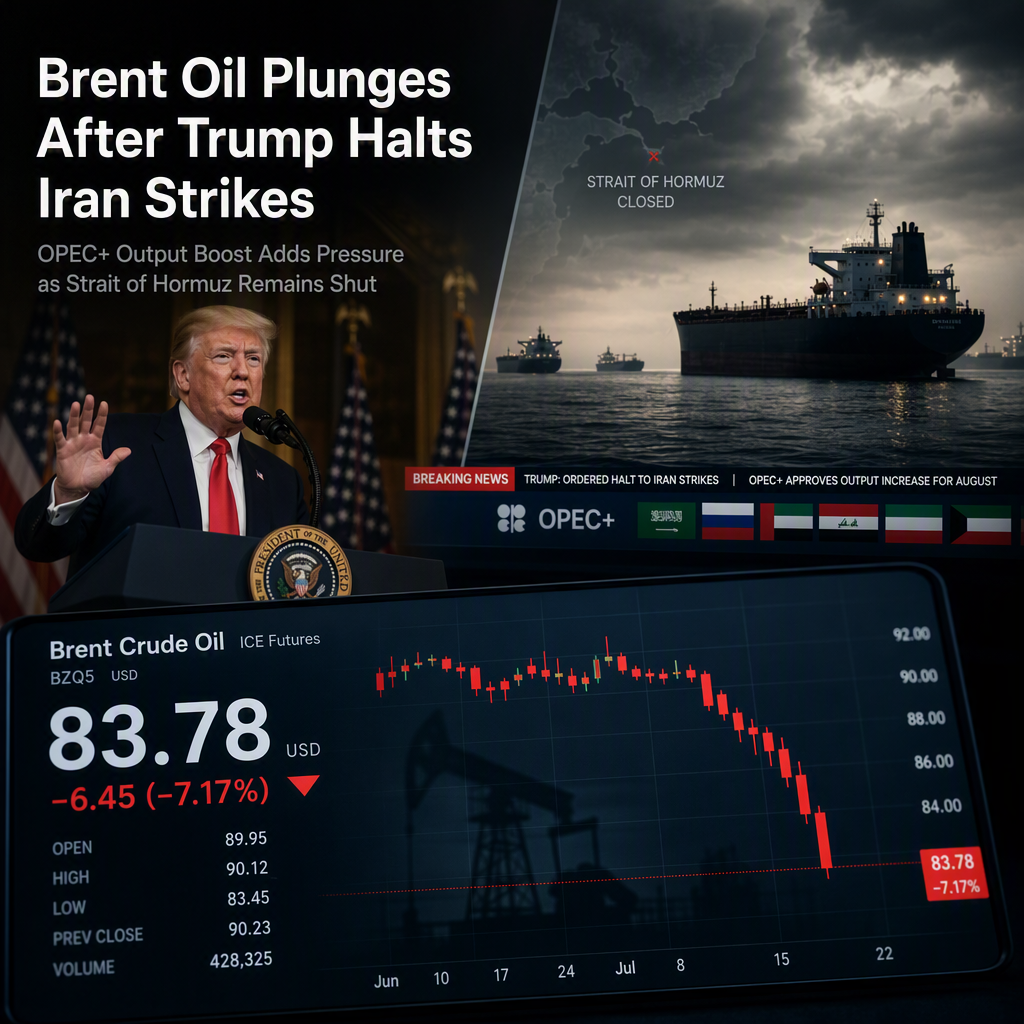
Brent oil prices experienced a sharp decline, opening over 7% lower to under USD84 during the Asian session. This significant drop followed President Donald Trump's announcement that the United States would hold off on new strikes against Iran, a decision made public over the weekend. Trump stated on social media that he agreed to cancel the attack 'subject to being able to rapidly make a DEAL,' urging all parties to 'get to work, everybody, and get it DONE.' Saudi Arabian Crown Prince Mohammed bin Salman reportedly encouraged Trump to refrain from further military action, while Iran and other Gulf nations indicated efforts toward reaching a deal [1].
On the supply side, OPEC+ approved a further increase of 188,000 barrels per day to collective output targets for September. This move completes the theoretical unwinding of the 1.65 million barrels per day in voluntary cuts made in April 2023 [1]. Despite this output increase, the Strait of Hormuz remains effectively closed, continuing to disrupt Persian Gulf oil exports. These ongoing disruptions are fueling inflation concerns, particularly across Asia and Africa [1].
The combination of Trump's decision to pause military action and the OPEC+ output increase has led to a notable market reaction, with Brent oil prices falling sharply. The closure of the Strait of Hormuz continues to be a critical factor, maintaining uncertainty in the market and sustaining concerns about supply disruptions and inflation [1].
CONCLUSION
Brent oil prices dropped significantly after President Trump announced a pause on new strikes against Iran, while OPEC+ moved to increase output. Despite these developments, the ongoing closure of the Strait of Hormuz keeps market uncertainty and inflation risks elevated. The market's sharp reaction underscores the sensitivity of oil prices to geopolitical and supply-side news.