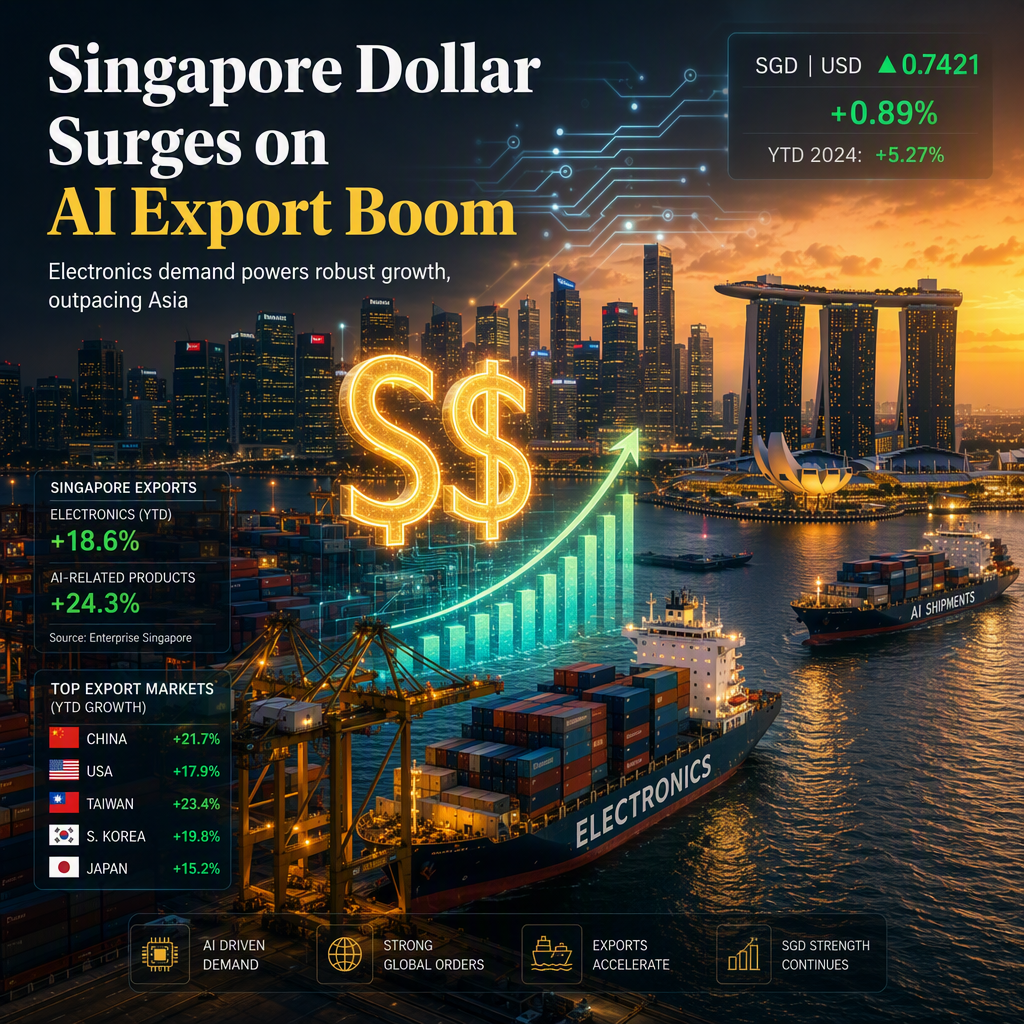
Commerzbank's Singapore-focused FX research highlights that Singapore's non-oil domestic exports (NODX) have shown robust growth, primarily driven by strong demand for electronics and AI-related products. In July, NODX increased by 24.2% year-on-year, slightly below the Bloomberg consensus of 26.5%, but still higher than June's 20.8% growth. Year-to-date, NODX is up 19.4%, surpassing the government's recently upgraded full-year forecast of 14-16%, which was previously set at 3-5% [1].
The growth in exports is overwhelmingly attributed to electronics, which offset continued weakness in non-electronic shipments. Non-electronic NODX contracted by 2.3% year-on-year, with significant declines in pharmaceuticals (down 57% year-on-year) and petrochemicals (down 23%). These declines are attributed to sector-specific and supply-chain pressures rather than recent US tariff measures. The US imposed a 12.5% tariff on about one-third of Singapore's domestic exports to the US following the Section 301 investigation on July 24, but key sectors such as pharmaceuticals, semiconductors, certain electronics, and energy products are currently exempt. However, ongoing uncertainty regarding US trade policy remains a downside risk for Singapore's broader export outlook [1].
Looking forward, the export outlook remains positive, with global AI infrastructure investment expected to continue supporting electronics exports. Notably, NODX to the US surged 63% year-on-year in July, while shipments to China, South Korea, and Japan rose by 38%, 53%, and 43% respectively, indicating broad-based technology-related external demand [1].
In the foreign exchange market, the USD/SGD pair fell 0.1% to 1.2780, continuing a downward trend since its July high of just under 1.3000. The Singapore Dollar is expected to remain supported by strong export growth and the Monetary Authority of Singapore's (MAS) decision to steepen the S$NEER appreciation path at both its May and July meetings. Year-to-date, the SGD has appreciated by 0.6% against the USD, outperforming the average Asian currency ex-Japan, which has declined by 1.9% [1].
CONCLUSION
Singapore's strong export performance, particularly in electronics and AI-related sectors, is underpinning the Singapore Dollar's outperformance against regional peers. While US trade policy uncertainty poses a risk, the outlook remains constructive due to broad-based technology demand and supportive monetary policy.