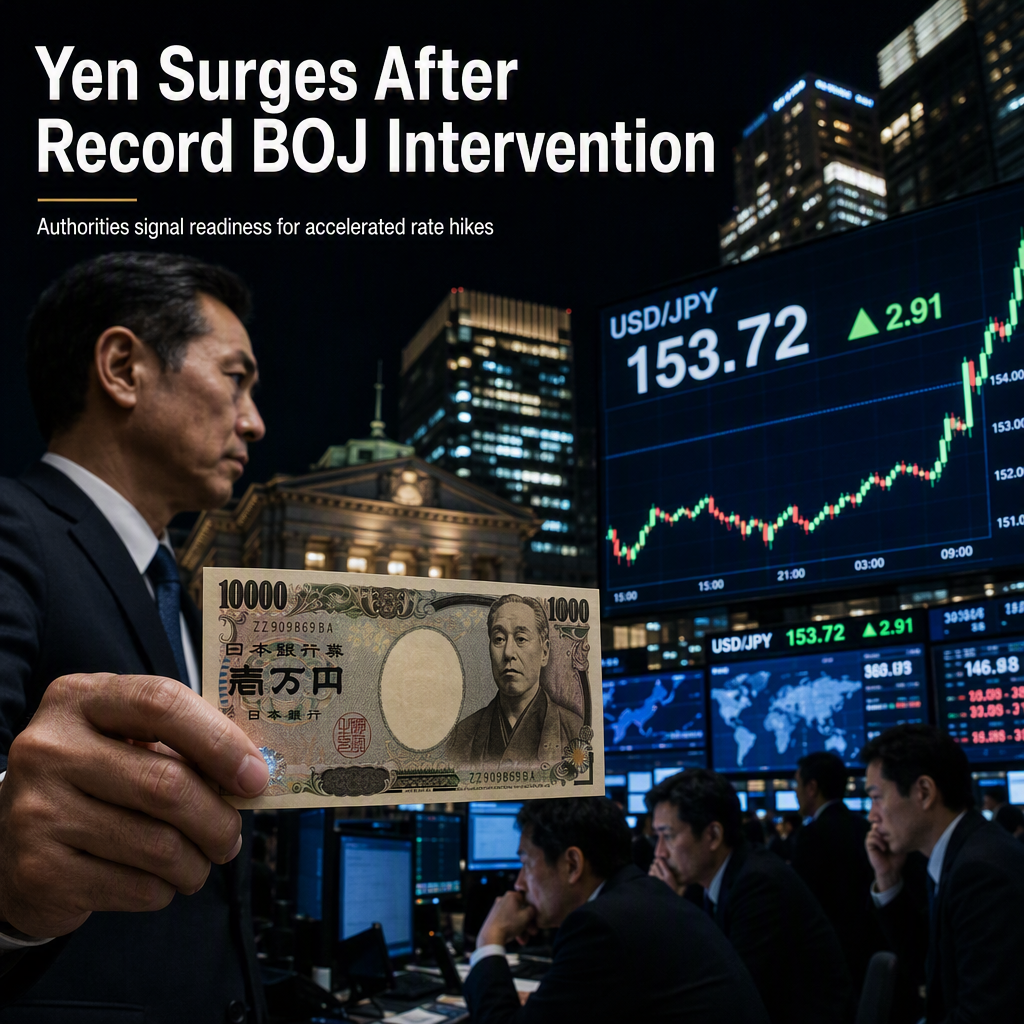
Japanese authorities intervened in the foreign exchange market on Thursday, buying yen and selling dollars in an effort to halt the yen's rapid depreciation and stabilize the currency after it had fallen to multi-decade lows against the U.S. dollar [1][3]. Preliminary money market data from the Bank of Japan suggests that the intervention may have totaled between 6 trillion and 7 trillion yen, equivalent to approximately $37.5 billion to $44 billion [1][3]. This action follows a previous record intervention of $73 billion in April-May [3]. The intervention led to a sharp 3% jump in the yen against the U.S. dollar during early New York trading, bringing the yen to its highest level since mid-May [1][3].
The U.S. Treasury Department communicated with currency market participants, instructing them to prepare for potential additional intervention, highlighting the seriousness with which authorities are addressing the yen's decline [1]. This possibility of further intervention has injected volatility into the foreign exchange market, with traders closely monitoring official statements and future actions [1][3]. However, after an initial surge to the 157 level against the dollar, the yen slipped back into the 160 range in Tokyo on Friday as importers and corporate customers bought dollars, eroding some of the yen's gains [2].
Bank of Japan Governor Kazuo Ueda signaled on Friday that the pace of rate hikes could accelerate, warning of "meaningful upside risks" to inflation due to rising wages, elevated oil prices, and a weak yen [4]. Ueda stated that if financial conditions are judged to be overly accommodative, the BOJ could "accelerate the pace of rate hikes" [4]. The BOJ's policy rate remains unchanged for now, but the central bank is closely monitoring yen movements, wage trends, energy prices, and global geopolitical risks as it evaluates its monetary policy stance [4].
Technical analysts noted that the yen's move above prior resistance levels signaled a potential trend reversal, though some caution that further sustained intervention may be necessary to maintain the currency's stability [1]. Market sentiment remains cautious, with expectations of continued volatility as authorities weigh additional measures [1].
CONCLUSION
Japanese authorities' large-scale intervention temporarily strengthened the yen, but gains were partially reversed as market participants resumed dollar buying. The BOJ has signaled readiness to accelerate rate hikes if inflation risks persist, keeping markets on alert for further policy action. Overall, the event has heightened volatility and underscored the sensitivity of currency markets to coordinated interventions and central bank signals.