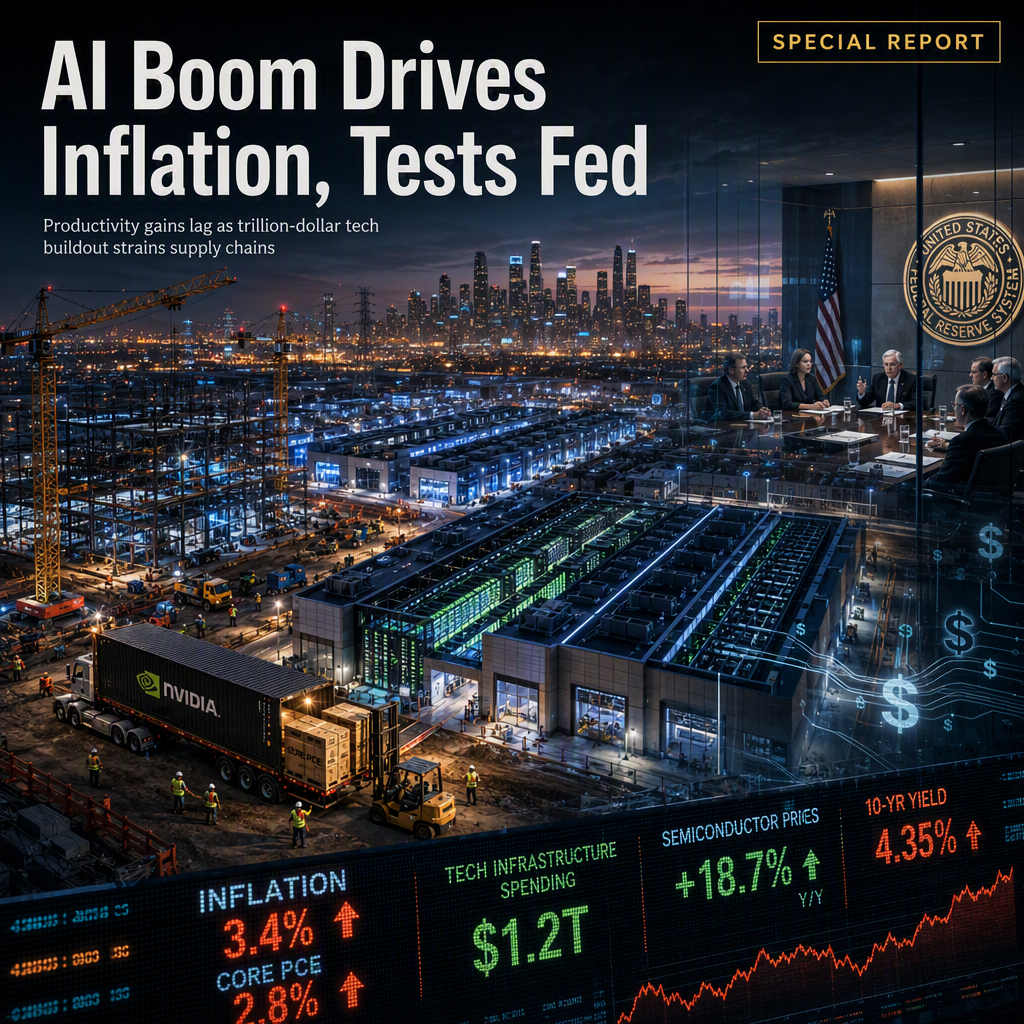
The rapid buildout of artificial intelligence (AI) infrastructure is complicating the Federal Reserve's efforts to manage inflation, as massive capital expenditures drive up costs in key sectors such as electricity, chips, software, and data-center capacity [1]. While Silicon Valley leaders including Elon Musk, OpenAI CEO Sam Altman, and SoftBank's Masayoshi Son have touted AI's potential to lower costs and boost productivity, these deflationary effects have yet to materialize in the broader economy [1]. Altman recently wrote that 'intelligence too cheap to meter is well within grasp,' and Son predicted a 40% drop in prices due to AI, but these outcomes remain unrealized as corporate adoption of AI technologies lags expectations [1].
Instead, the current wave of AI investment is contributing to near-term inflation, with little evidence of a sustained productivity boom. Goldman Sachs Research estimates that capital expenditure on AI buildout will reach $581 billion in the U.S. this year, and as much as $1 trillion globally, with U.S. spending alone accounting for 1.8% of GDP—a figure projected to rise to 2.8% by 2028 [1]. The tech industry's multi-trillion-dollar spending spree has also snarled supply chains, further exacerbating cost pressures [1].
A May survey by the Census Bureau found that only 17% to 20% of U.S. businesses reported using AI, with adoption rates significantly higher among large firms compared to small ones [1]. Ronnie Chatterji, chief economist for OpenAI, noted that for AI to impact the economy, it must be widely adopted by organizations that can realize its value—a process he acknowledged will take time before showing up in productivity statistics [1].
Peter Boockvar of One Point BFG Wealth Partners drew parallels to the internet-driven productivity boom, noting that even during that era, U.S. productivity gains averaged only 1.5% over 30 years, compared to a 2.5% average over 50 years [1]. This historical context tempers expectations that generative AI will deliver immediate or dramatic productivity enhancements [1].
The ongoing mismatch between high AI infrastructure costs and delayed productivity benefits presents a dilemma for Fed Chair Kevin Warsh and other officials, who must decide whether the inflationary pressures from AI spending warrant interest rate hikes [1].
CONCLUSION
The surge in AI infrastructure spending is currently driving inflation and complicating the Federal Reserve's policy decisions, as productivity gains from AI adoption remain elusive. While industry leaders remain optimistic about AI's long-term deflationary potential, the near-term market impact is characterized by rising costs and uneven adoption. The Fed faces a challenging environment as it weighs the timing and necessity of further interest rate actions.