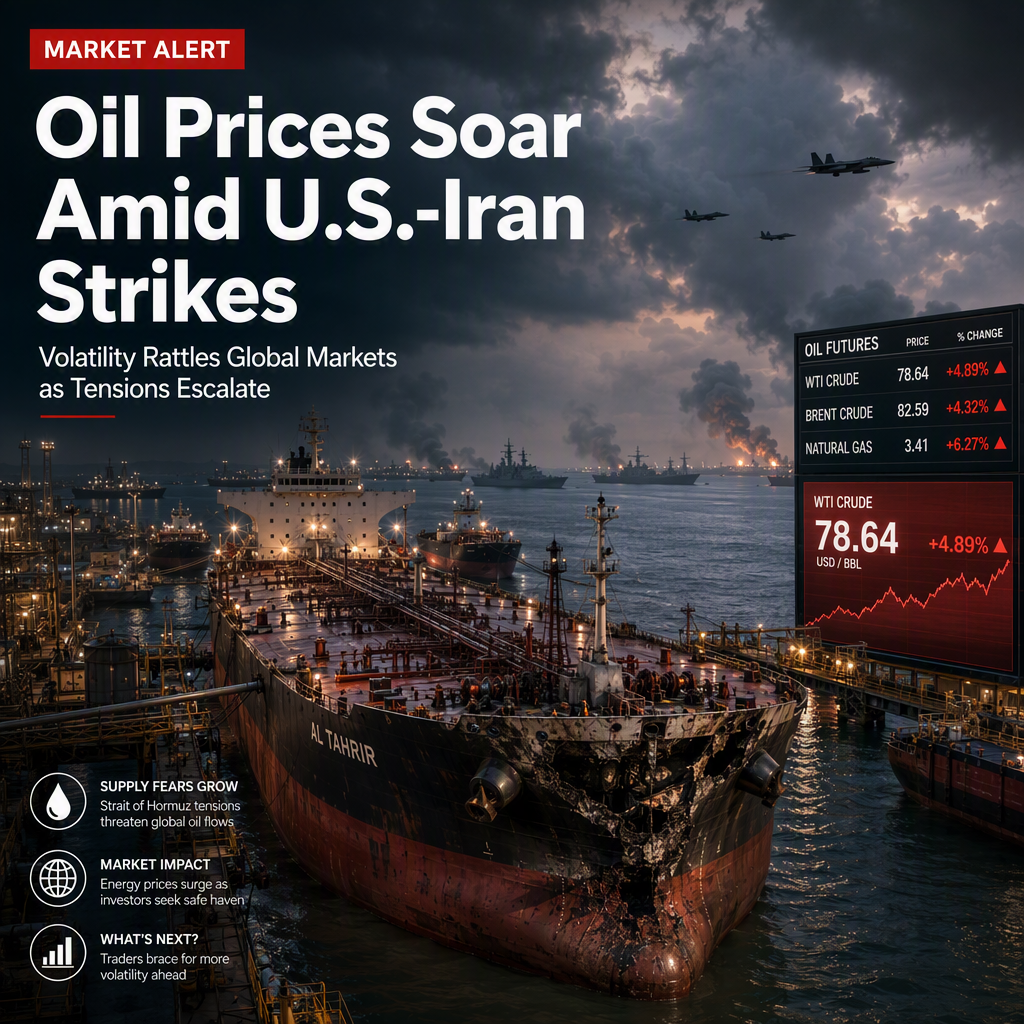
Oil prices surged to their highest levels since July 24 as escalating military tensions between the United States and Iran triggered renewed fears over global energy supply disruptions and broader market volatility. West Texas Intermediate (WTI) crude climbed to the mid-$90s, up 1.20% for the day, marking its third consecutive daily gain and the fifth positive session in the last six days [1]. International benchmark Brent crude futures rose 4.5% to $94.52 a barrel in Asia trading, while WTI futures gained about 5% to $90.03 per barrel, with Brent for November delivery later advancing over 2% to $96.59 and WTI for October up 1.73% at $91.78 [2][3][4].
The price rally followed a fresh round of U.S. strikes against Iranian targets, including air defense, communications, and radar sites, in retaliation for attempted attacks on commercial shipping in the Strait of Hormuz and on American service members [1][2][4]. President Donald Trump stated that the U.S. was "not trying to force Iran to the bargaining table" and asserted "almost total control" over the Strait of Hormuz, while describing Iran's economy as "totally collapsing" [2][4]. In response, Iran reportedly launched heavy ballistic missile and drone attacks on U.S.-linked targets in Jordan, the UAE, Kuwait, and Bahrain, with Jordan intercepting 10 of 13 missiles and no casualties reported [1][2][4]. A tanker was also struck by three unknown projectiles while transiting Hormuz, further underscoring the risks to commercial shipping [4].
The ongoing conflict has led to heightened volatility and risk premiums in energy markets. Analysts at TD Securities highlighted the fragility of existing arrangements around key energy chokepoints, noting that the renewed confrontation keeps the risk premium in energy markets firmly in focus [1]. Edward Rosenberg of Strategy Shares commented that "the longer the war with Iran goes on, oil prices will continue to stay elevated and volatile," with sanctions, stalled negotiations, and mixed signals from Iran contributing to day-to-day price swings [4]. Technical resistance for Brent is seen near $97, with support at $92, while WTI faces resistance at $91 and support at $89 [2][4].
The broader market reaction has been significant. Wall Street ended a third straight negative session, with the S&P 500 down 0.71% and the Nasdaq Composite declining more than 1% [3]. The surge in oil prices revived concerns about inflation, prompting a sell-off in global bonds and pushing U.S. Treasury yields to multi-decade highs. Fed Governor Michael Barr indicated support for a rate hike if inflation does not moderate, with markets now leaning toward a quarter-point hike this month and the benchmark rate at 3.50%-3.75% [3].
Negotiations between the U.S. and Iran over reopening the Strait of Hormuz have stalled, with both sides rejecting proposals to end the conflict that began when the U.S. and Israel attacked Iran on February 28 [4]. Market sentiment remains highly cautious, with traders closely monitoring developments for further escalation and potential supply disruptions.
CONCLUSION
The escalation of U.S.-Iran military strikes has driven oil prices to multi-month highs and injected significant volatility into global markets. With negotiations stalled and both sides signaling further confrontation, traders are bracing for continued price swings and elevated risk premiums in energy and financial markets. The situation remains fluid, with geopolitical developments in the Middle East expected to dictate near-term market direction.