
Several Democratic-led states are set to implement substantial minimum wage increases beginning January 1, 2027, further widening the gap between state minimum wages and the federal minimum of $7.25 an hour [1]. Washington will lead with a new minimum wage of $17.73 per hour, up 60 cents from its current rate of $17.13 [1]. Connecticut's minimum wage will rise from $16.94 to $17.48, and California's will increase from $16.90 to $17.40 [1]. New Jersey will see a 56-cent increase to $16.48 per hour for most workers, while Michigan is set for one of the largest jumps, moving from $13.73 to $15 per hour [1].
Republican-led states are also raising their minimum wages, though not to the same extent as the highest-paying blue states. Florida's minimum wage reached $15 per hour on September 30 and will remain at that level through the end of 2027, while Missouri is also at $15. Nebraska will increase its minimum wage from $15 to $15.26 on January 1 [1].
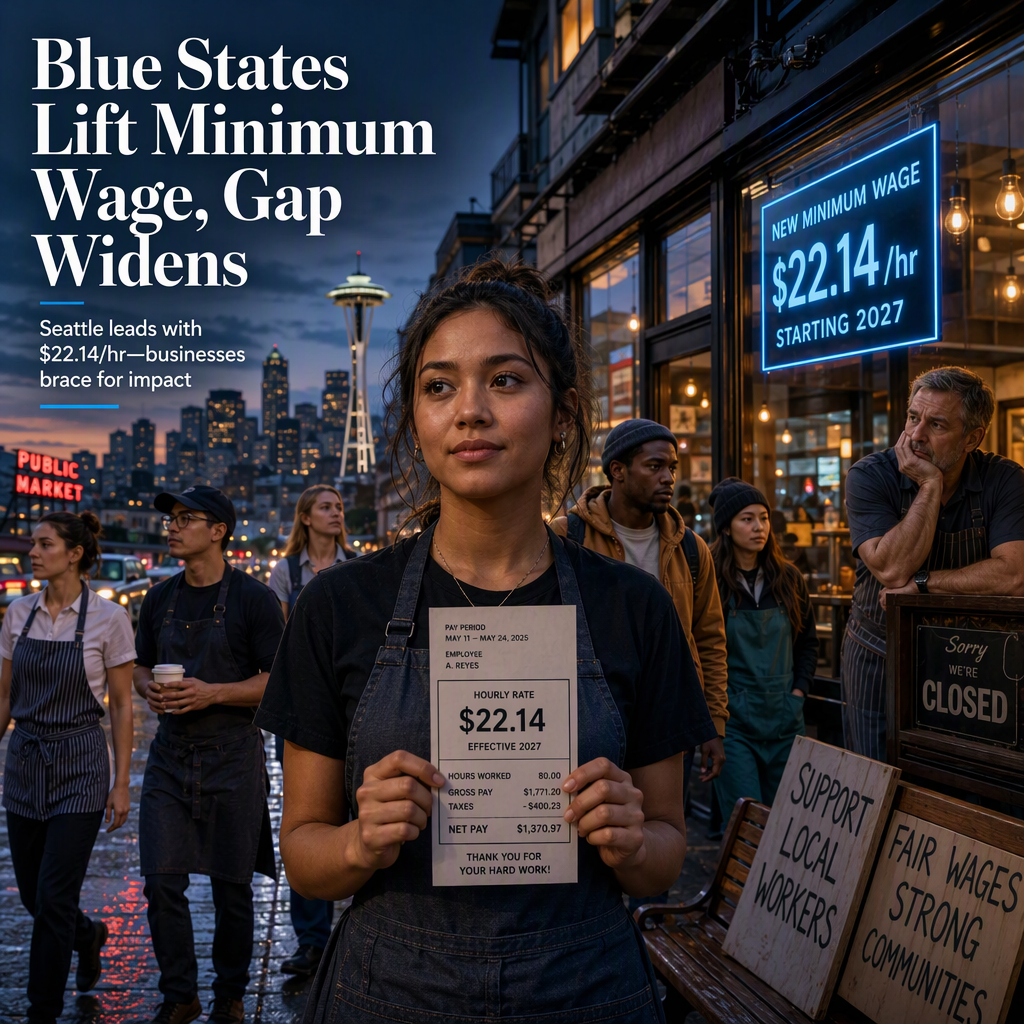
Seattle, Washington, will see its minimum wage rise even higher, reaching $22.14 per hour in 2027, nearly $4.50 above the new statewide rate [1]. The city's wage requirements have sparked debate, with some restaurant owners attributing business closures to rising labor costs among other financial pressures [1]. Beginning in 2025, all employers in Seattle, including small businesses, will be subject to the same inflation-adjusted minimum wage [1].
Washington's minimum wage is tied to inflation by state law, with annual recalculations based on changes in the CPI-W. The new rate is announced each September 30 and takes effect January 1 [1]. Conservative commentator Jason Rantz criticized the increases, stating, "Democrats appear to be doing everything they can to make the business climate in Washington more untenable," citing high labor costs, crime, and new taxes as challenges for businesses [1].
CONCLUSION
The upcoming minimum wage hikes in several blue states, particularly Washington, are set to significantly outpace the federal minimum, intensifying debates over business costs and economic competitiveness. While intended to keep wages in line with inflation, these increases have prompted concerns from some business owners and commentators about the broader impact on the local business climate.