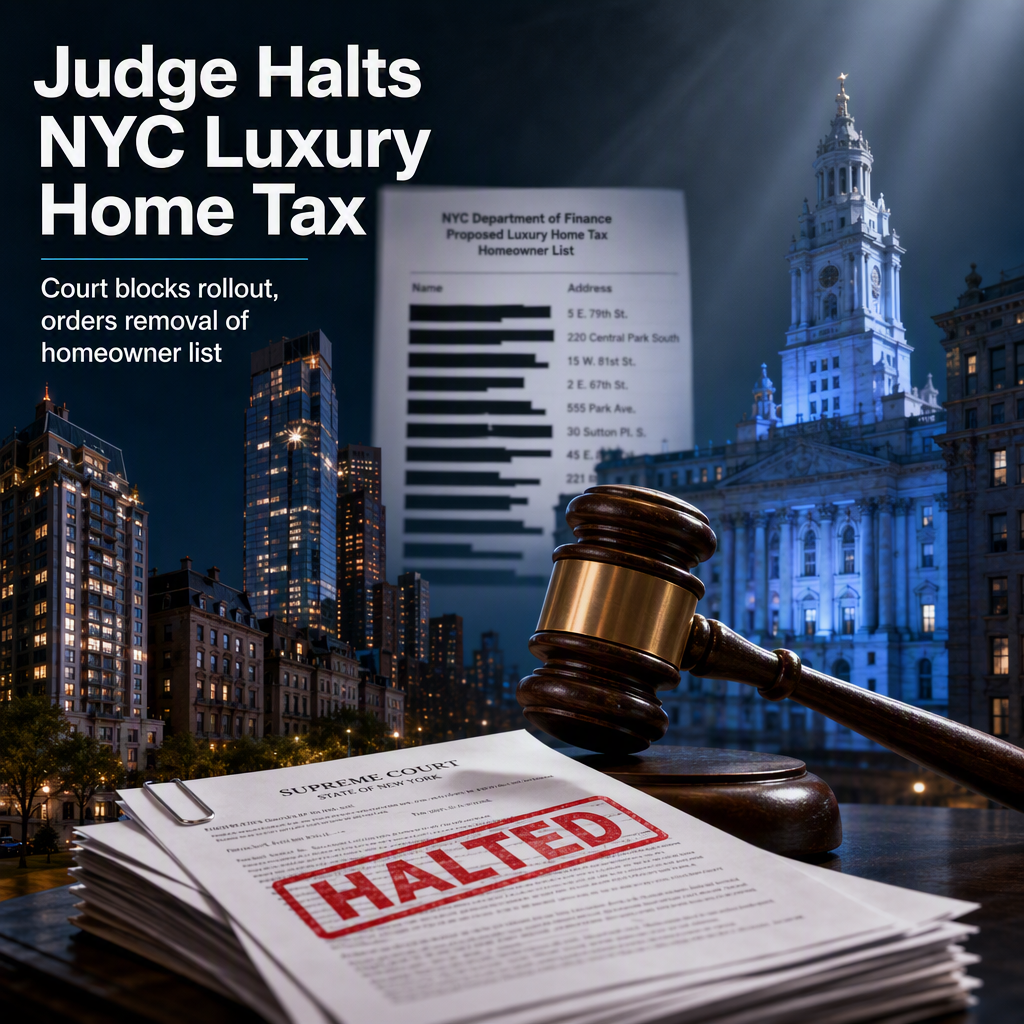
A New York judge has temporarily blocked Mayor Zohran Mamdani’s administration from proceeding with the rollout of a new tax targeting luxury second homes, following a lawsuit filed by three New York City homeowners. The court order, issued by Judge Wayne Ozzi, restrains the city from using a disputed property roll or mailed notices and prohibits enforcement of upcoming deadlines against homeowners affected by the rollout. The judge also ordered City Hall to take down a controversial list that exposed the names, addresses, and property values of more than 900,000 New York City homeowners [1].
Attorney Randy Mastro, representing the plaintiffs, criticized the Mamdani administration for what he described as a 'botched rollout' of the surcharge, which targets second homes valued at more than $5 million. Mastro argued that the city failed to first determine whether properties actually qualified as non-primary residences before subjecting homeowners to the surcharge process. Instead, the administration published a supplemental property roll covering a vast number of properties and sent notices that left many New Yorkers scrambling to prove their homes were their primary residences [1].
Mastro further contended that the city should bear the burden of proof and accused officials of not utilizing available information to make accurate determinations. He stated that the publication of homeowners’ personal information led to confusion and public backlash, describing the disclosure as effectively 'doxxing' homeowners. Outside the courthouse, Mastro called the ruling 'a very good day for all New York City homeowners,' emphasizing that thousands of residents who live in their own homes received letters suggesting they might be subject to the surcharge, which he argued should not have happened [1].
The lawsuit does not challenge the legality of the pied-à-terre surcharge itself but focuses on the implementation process by the Mamdani administration. The plaintiffs allege that the city incorrectly identified their primary residences as potentially subject to the surcharge, failed to conduct the required individualized initial determination before mailing notices, and improperly disclosed sensitive homeowner information [1].
CONCLUSION
The court’s decision represents a significant setback for the Mamdani administration’s luxury home tax rollout, highlighting procedural flaws and privacy concerns. The temporary restraining order halts enforcement and requires the city to revisit its process, signaling potential delays and further scrutiny before any surcharge can be implemented.