
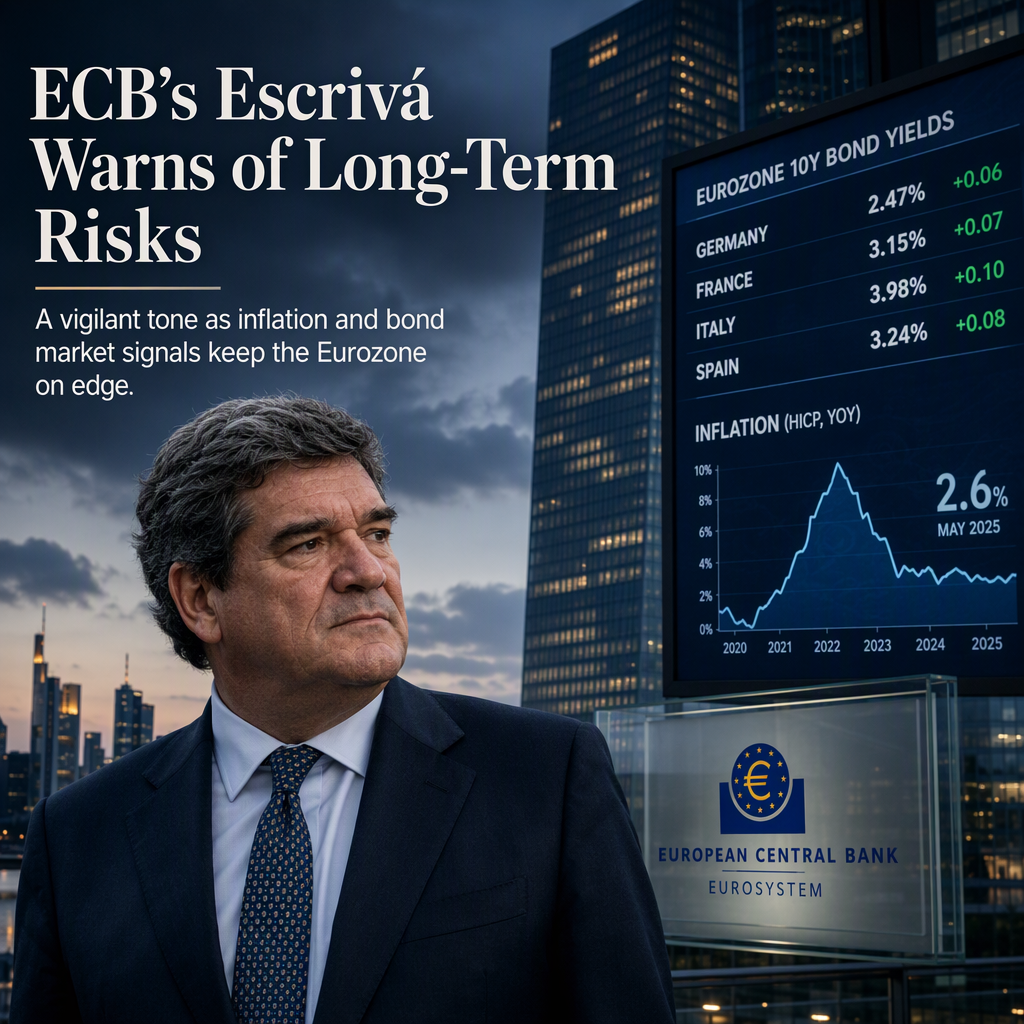
European Central Bank (ECB) member José Luis Escrivá stated on Tuesday that the ECB is 'still not in a restrictive territory,' indicating that current Eurozone monetary policy is not yet tight enough to curb inflation aggressively [1]. Escrivá highlighted concerns about the global upward trajectory of long-term rates, warning that this trend could add pressure to interest rates in the Eurozone [1]. He specifically noted, 'What I would start to worry about is the global upward trajectory of long-term rates,' and added, 'This can add pressure to interest rates' [1].
Escrivá's remarks reflected a balanced stance: while his assessment of current policy was mildly dovish, suggesting no immediate tightening, he also flagged medium-term risks. The persistence of high energy prices and the potential for second-round inflation effects were cited as ongoing worries, introducing a hawkish layer to his otherwise non-restrictive policy outlook [1]. The FXS Speechtracker scored Escrivá's speech at 6.2/10, slightly above the historic 6/10 baseline, indicating a modestly more cautious tone compared to previous ECB communications [1].
Market implications from Escrivá's comments include a warning signal for bond markets, as rising long-term yields could force the ECB to consider higher Euro interest rates in the future [1]. However, no immediate policy shift was signaled, and the overall message was one of vigilance regarding inflation risks, particularly those stemming from energy prices [1].
No forward-looking statements or analyst opinions were explicitly provided in the article, and there were no references to specific dates, numbers, or ticker symbols related to market reactions [1].
CONCLUSION
ECB's Escrivá delivered a balanced message, expressing short-term dovishness on current Euro policy while warning of medium-term inflation risks and long-term rate pressures. The market takeaway is a cautious outlook, with no immediate tightening but heightened vigilance on inflation and bond market dynamics. Investors should monitor future ECB communications for potential shifts in policy as long-term rate and energy price risks evolve.