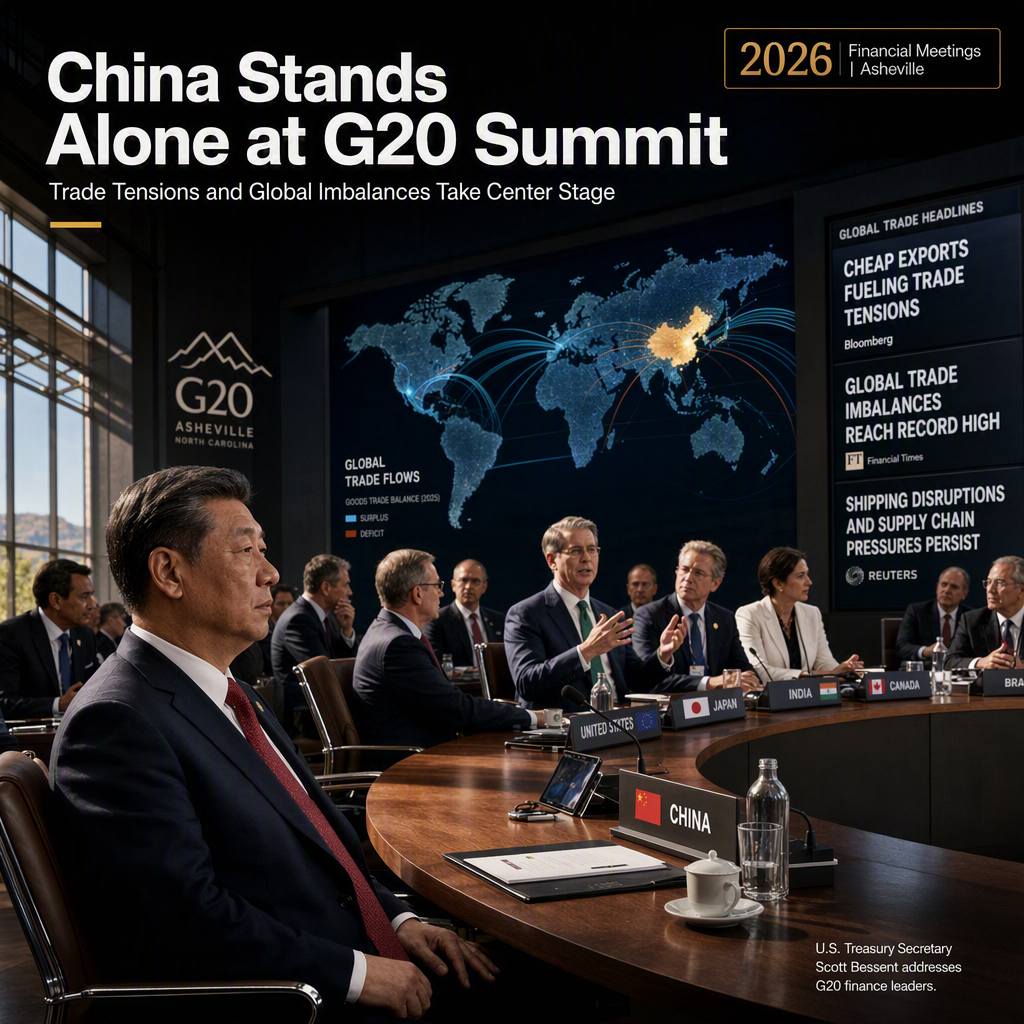
At the 2026 G20 Financial meetings held in Asheville, North Carolina, Treasury Secretary Scott Bessent announced that China was the only member of the Group of 20 to dissent from a joint statement condemning 'non-market based economies pushing out a never-ending stream of cheap exports' [1]. Bessent emphasized that China, described as 'the country with the world's largest and unsustainable current account surplus,' objected to several key paragraphs in the statement, including those urging countries to eliminate non-market policies and practices that exacerbate global imbalances [1]. The statement specifically called for countries with excessive and persistent external surpluses to remove distortions that constrain domestic consumption and result in an overreliance on exports for growth [1].
China also opposed paragraphs expressing concern about ongoing shipping disruptions in the Strait of Hormuz, a critical oil-shipping route currently blocked by Iran amid its conflict with the U.S. [1]. Additionally, China objected to sections praising the International Monetary Fund's surveillance of global imbalances and highlighting countries where a significant portion of external debt is owed to G20 members [1].
Bessent noted that the other 19 G20 members will take action in the 'days, weeks or months' to address what he described as an 'unsustainable equilibrium' in global trade, underscoring the urgency and scale of the issue [1]. He expressed disappointment at not being able to announce a unanimous joint communiqué but stressed that the agreement among the remaining members demonstrates the enormity of the problem [1].
The event comes as Bessent leads the Trump administration's 'Operation Economic Outcast,' a plan to choke off Iran's economy by threatening its business partners with secondary sanctions. This raises questions about whether the U.S. will target China, Iran's top trading partner and oil buyer, amid ongoing long-term trade talks and an upcoming visit by Chinese President Xi Jinping to the U.S. in late September [1]. Bessent remarked, 'With China on Iran, we have more in common than we have differences,' suggesting some potential for cooperation despite the current tensions [1].
CONCLUSION
China's dissent from the G20 statement highlights significant divisions among major economies regarding trade practices and global imbalances. The unified stance of the other G20 members signals potential for coordinated action, which could have substantial market implications. Ongoing U.S.-China trade talks and the upcoming visit by President Xi Jinping may further influence the trajectory of these issues.