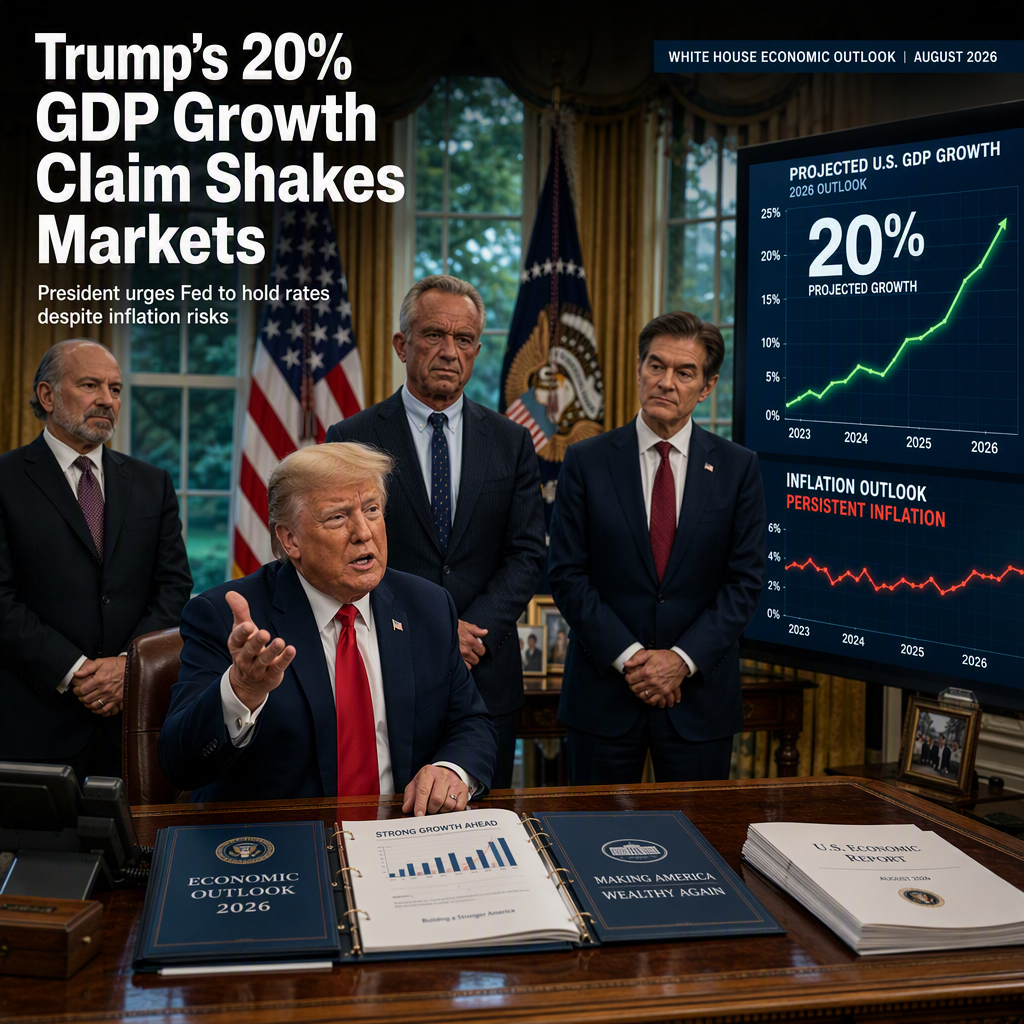
President Donald Trump stated that the U.S. economy could achieve GDP growth rates as high as 20%, referencing historical data to support his claim during an Oval Office event on August 31, 2026, where he was joined by U.S. Secretary of Commerce Howard Lutnick, U.S. Secretary of Health and Human Services Robert F. Kennedy Jr., and CMS Administrator Dr. Mehmet Oz [1]. Trump argued that even with such rapid growth, the Federal Reserve should not raise interest rates, asserting, "Success in growth does not cause inflation" [1].
Historically, U.S. GDP has grown at an annualized rate of 20% or more in only one quarter since 1947: the third quarter of 2020, when the economy rebounded at a 34.9% annualized rate following Covid-19 shutdowns. The next-highest postwar quarter was the first quarter of 1950, with a 16.7% annualized rate. No other quarter in the nearly eight-decade series has reached 20% [1].
Currently, the U.S. economy is growing at a much slower pace. Real GDP increased at a 1.5% annualized rate in the second quarter of 2026, down from 2.1% in the first quarter, according to the Bureau of Economic Analysis [1]. Inflation remains above the Federal Reserve’s 2% target, and the Fed held its benchmark rate steady at 3.5% to 3.75% in July, with three policymakers dissenting in favor of a quarter-point hike. Many Fed watchers expect the Federal Open Market Committee to raise rates at its next meeting in September [1].
Trump’s remarks come as he continues to advocate for lower borrowing costs, framing the potential for faster growth as a reason for the Fed to lower, rather than raise, interest rates, despite ongoing inflationary pressures [1].
CONCLUSION
President Trump's projection of 20% GDP growth is historically unprecedented outside of extraordinary circumstances, such as the post-Covid rebound. His call for the Federal Reserve to avoid raising rates contrasts with current inflation trends and market expectations for further tightening. The market is likely to view these comments as optimistic but not reflective of current economic realities.