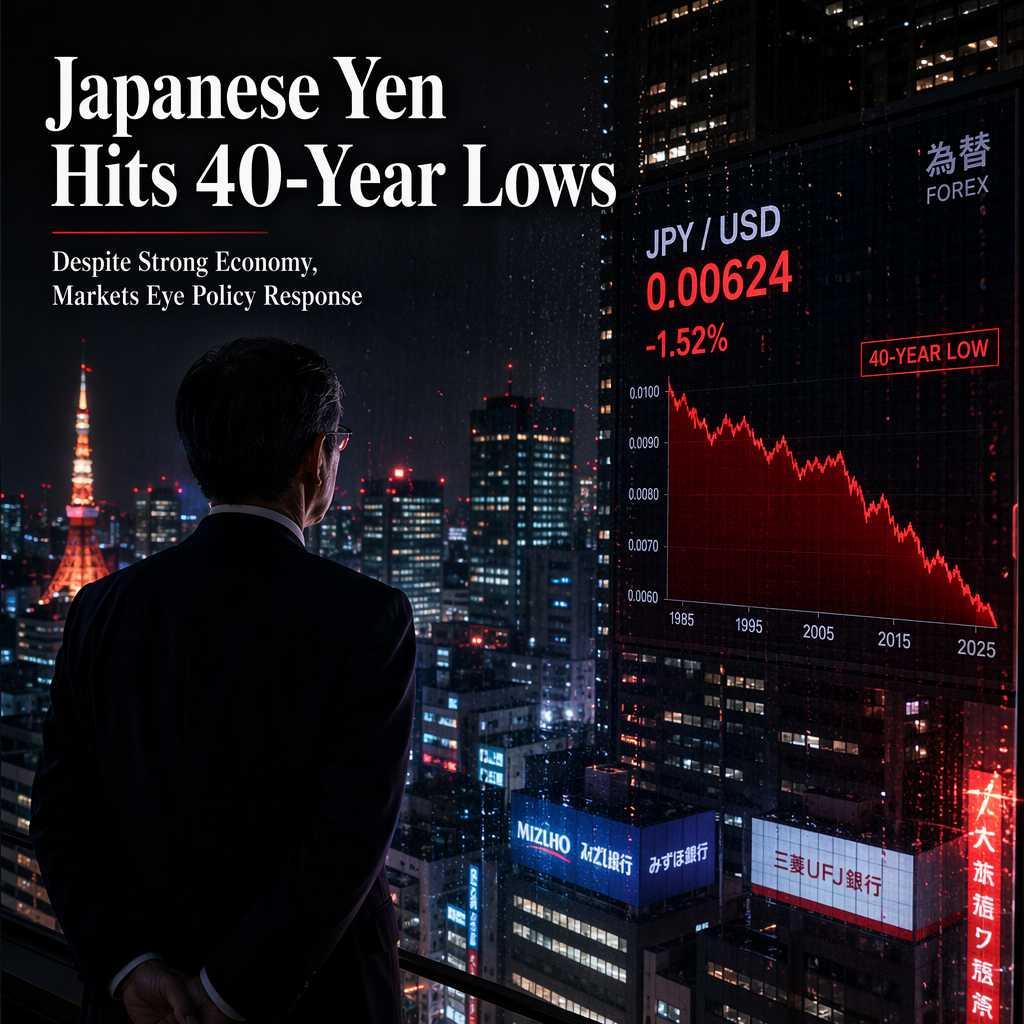
The Japanese Yen (JPY) is trading near its lowest levels since 1986 against the US Dollar, even as Japan's domestic economic indicators show strength, notably with a robust quarterly Tankan survey released by the Bank of Japan (BoJ) [1]. Despite this positive economic data, the Yen remains under pressure due to aggressive short positioning and its continued use as a primary funding currency for global carry trades [1].
Market participants are closely watching for potential intervention by Japan's Ministry of Finance (MoF), especially as the market enters a low-liquidity US holiday weekend. There is heightened speculation about whether the MoF will intervene in the foreign exchange market or allow the Yen to continue its gradual decline until the BoJ signals a more aggressive interest rate hiking cycle [1]. Macro strategists at Societe Generale highlight the dangerous buildup of speculative Yen shorts, drawing parallels to the volatile unwind seen in July 2024, and suggest that the threshold for official intervention has moved higher. However, they caution that any unexpected shifts in US Federal Reserve policy could trigger a sharp short-covering rally in the Yen [1].
Rabobank analysts argue that unilateral FX interventions by the Japanese authorities are likely to be only a temporary solution, and that a sustainable recovery in the Yen would require the BoJ to adopt a more hawkish stance on interest rates. They state that the BoJ may need to signal its willingness to accelerate rate hikes to break the market's reliance on the Yen as a funding currency for carry trades [1].
MUFG notes that the stronger-than-expected Tankan report supports the BoJ's recent rate hike in June and strengthens the case for further tightening. However, the recent softening of verbal intervention warnings from Japanese officials suggests that authorities may be willing to tolerate a slow, low-volatility depreciation of the Yen as long as broader bond and equity markets remain stable [1].
CONCLUSION
Despite strong domestic economic data, the Japanese Yen remains at multi-decade lows due to persistent bearish positioning and its role in carry trades. Market participants are watching for potential policy shifts or interventions, but analysts suggest that only a more aggressive BoJ rate hike path will provide lasting support for the Yen. For now, authorities appear to be tolerating the Yen's gradual decline.