
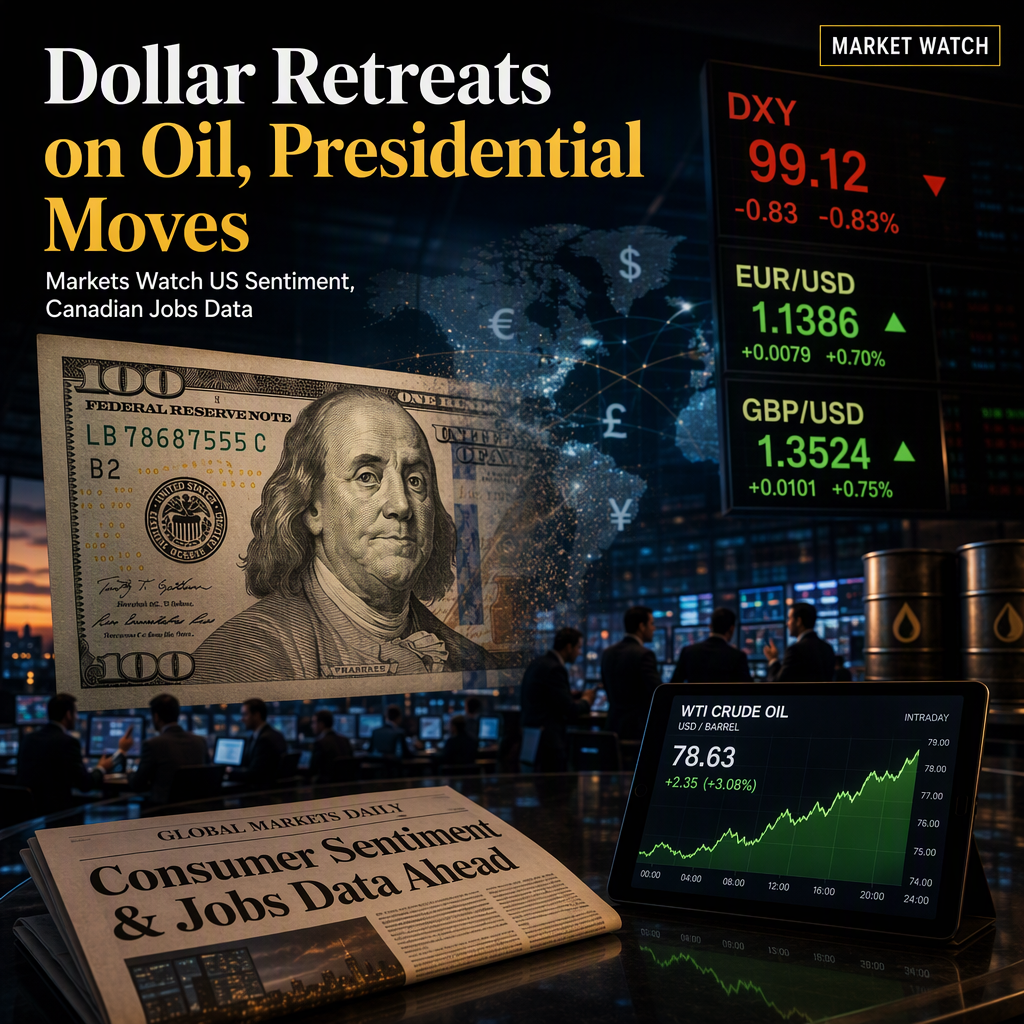
On Thursday, the US Dollar (USD) experienced a sudden bout of selling pressure, causing it to abandon recent highs. This move was attributed to comments from President Donald Trump and a subsequent pullback in crude oil prices, which weighed on the currency's performance [1]. The US Dollar Index (DXY) partially faded its previous advance, challenging the 102.00 region but remaining in the upper end of its recent range [1].
Major currency pairs responded to the USD's weakness. EUR/USD managed a mild rebound, moving above the 1.1200 level, while GBP/USD posted decent gains, advancing north of 1.3200 following the late decline in the Greenback [1]. USD/JPY reversed course, slipping to three-day lows near 157.70, and AUD/USD trimmed earlier losses, bouncing off lows near 0.6930 [1]. USD/CAD receded from recent peaks near 1.4300, stabilizing in the low 1.4200s as the Canadian Dollar appreciated markedly ahead of the country's labor market report [1].
In commodities, front-month WTI crude oil futures reversed Wednesday's pullback, climbing to weekly highs above $93.00 per barrel amid renewed supply concerns in the Middle East [1]. Gold attempted a modest bounce toward $4,150 per troy ounce but continued its weekly negative streak [1].
Looking ahead, markets are focused on the preliminary University of Michigan Consumer Sentiment report in the US and the Canadian labor market report, both expected to influence trading sentiment. Additionally, investors are watching for speeches from Fed's Collins and ECB's Cipollone and Schnabel, as well as upcoming economic data releases in the UK, Japan, and Australia [1].
CONCLUSION
The US Dollar's retreat, triggered by presidential comments and oil price movements, has led to notable shifts across major currency pairs and commodities. Market participants are now closely monitoring upcoming US consumer sentiment and Canadian jobs data for further direction.