
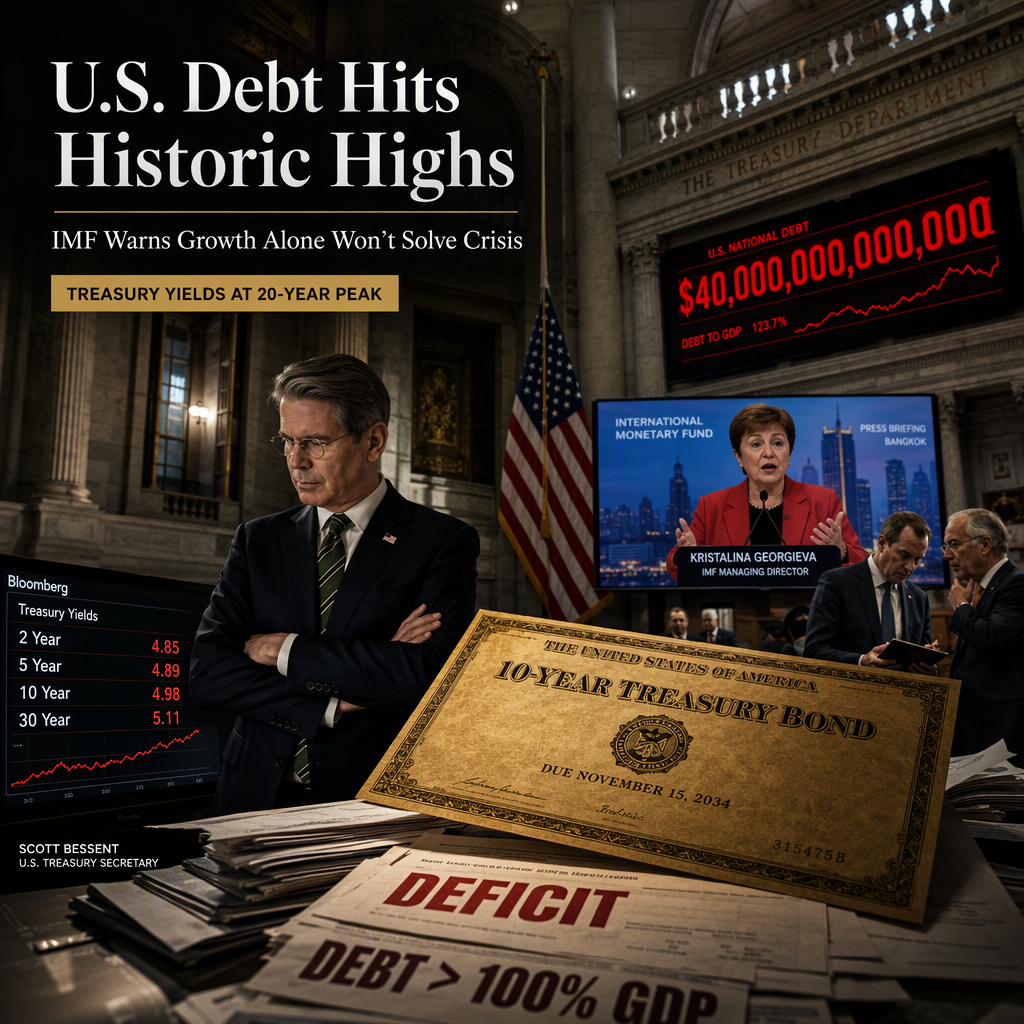
IMF Managing Director Kristalina Georgieva has publicly urged U.S. Treasury Secretary Scott Bessent to take concrete steps to reduce the federal deficit, cautioning that relying solely on economic growth will not be sufficient to address the country's mounting debt burden [1]. Speaking at the IMF-World Bank annual meetings in Bangkok, Georgieva emphasized, "Growth of course helps, but it cannot deliver fast enough the necessary adjustments," and called for additional fiscal measures [1].
Bessent and Trump administration officials have promoted robust economic growth—fueled by artificial intelligence expansion, reshoring manufacturing, and consumer tax cuts—as the primary strategy to improve the U.S. fiscal outlook. Bessent has argued that sustained growth above 3%, combined with spending restraint, could lower the debt ratio and bend the debt-to-GDP curve, stating last month, "With 3% growth, we grow our way out of this" [1]. However, Georgieva countered that the authorities are overly reliant on strong growth and that more direct fiscal action is needed [1].
The U.S. federal debt has now exceeded 100% of GDP, surpassing $40 trillion and approaching a record set after World War II [1]. The government has consistently spent more than it collects in taxes, with debt-financed spending accelerating sharply in recent years. Notable fiscal actions include Trump’s tax cuts and Covid relief packages in 2020, followed by Biden’s $1.9 trillion stimulus in 2021, which helped avert recession but contributed to persistent inflation [1].
The U.S. Treasury market has reacted strongly, with yields climbing to multidecade highs. Benchmark 10-year yields stood at around 5.2% on Wednesday, near their highest level since 2002, as investors anticipate that surging energy costs and heavy AI spending will keep borrowing costs elevated [1]. The budget deficit for the fiscal year ending September 30 is expected to exceed 6% of GDP, up from 5.8% in fiscal 2025, with the debt projected to rise by $7 billion each day according to Benn Steil, senior fellow at the Council on Foreign Relations [1].
CONCLUSION
The IMF's warning highlights growing concerns about the sustainability of U.S. fiscal policy, as debt and deficits reach historic levels. Market reactions, including soaring Treasury yields, underscore investor unease about the government's reliance on growth to manage its debt load. Without additional fiscal measures, the U.S. faces continued upward pressure on borrowing costs and persistent inflation risks.