
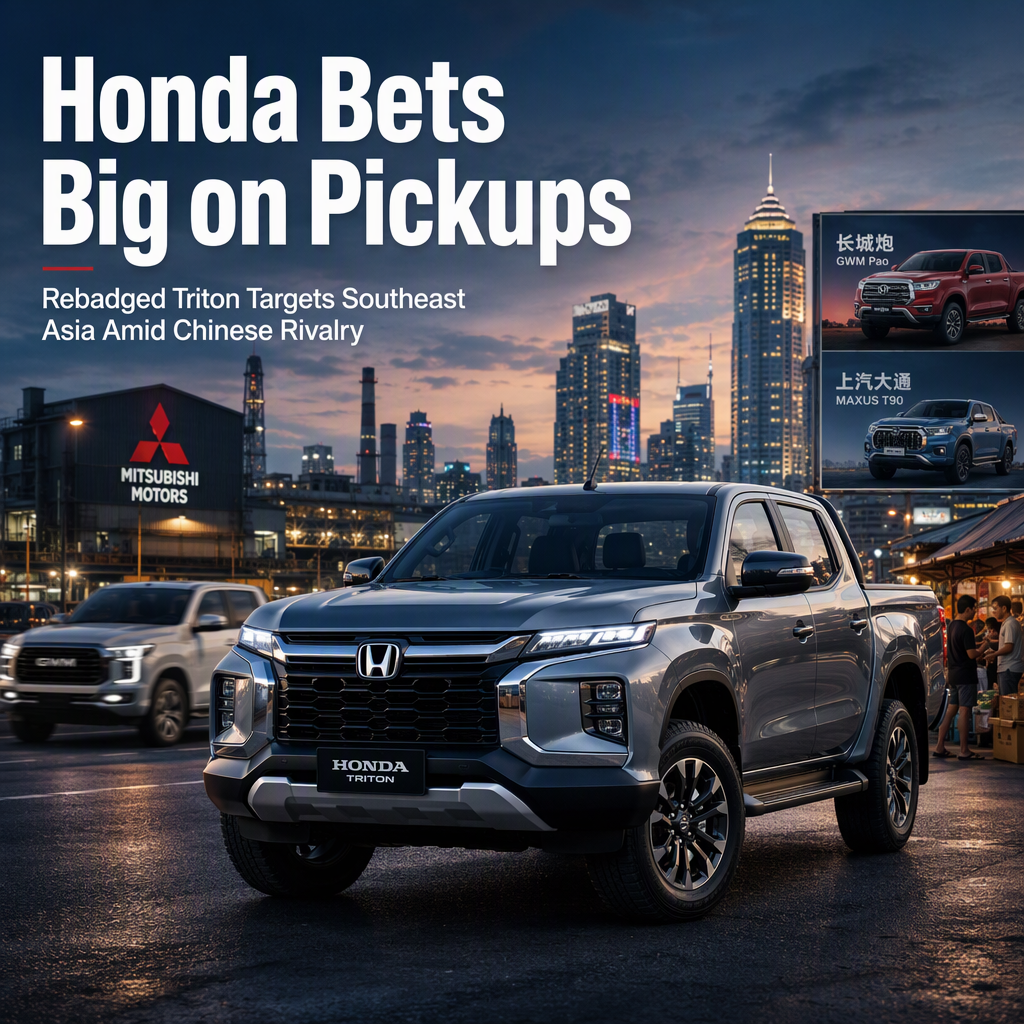
Honda Motor has announced plans to sell the Mitsubishi Triton pickup truck, manufactured in Thailand, under its own brand in Southeast Asia and other markets as early as 2028. This marks Honda's first rebadging arrangement in approximately thirty years, signaling a strategic response to intensifying competition from Chinese automakers in the region [1]. The Triton, a well-established model produced by Mitsubishi Motors, will be distributed with Honda branding, leveraging Mitsubishi's manufacturing capabilities in Thailand [1].
The collaboration aims to strengthen the position of Japanese automakers in Southeast Asia, a region where pickups are highly popular for both commercial and private use. The move comes as Chinese brands have rapidly gained market share, particularly in the pickup and commercial vehicle segments, prompting Japanese companies to seek new strategies to maintain their presence and defend against market erosion [1].
No specific financial terms, price levels, or technical specifications for the rebadged pickups have been disclosed at this time. However, industry analysts anticipate that Honda's entry into the pickup segment could intensify competition and potentially lead to price adjustments across the region [1]. Market sentiment is described as cautiously optimistic, with analysts suggesting that the rebadging strategy could boost Honda's sales in Southeast Asia, despite ongoing challenges from aggressive pricing and promotional efforts by Chinese competitors [1].
This initiative is part of a broader trend among Japanese automakers to collaborate and innovate in response to evolving market dynamics and increased competition from overseas rivals. Further details regarding pricing, technical specifications, and distribution are expected to be announced closer to the launch date [1].
CONCLUSION
Honda's decision to rebadge and sell the Mitsubishi Triton pickup in Southeast Asia represents a strategic effort to counter growing competition from Chinese automakers. While market sentiment is cautiously optimistic, the move is expected to intensify competition and could lead to price adjustments in the region. Key details such as pricing and specifications remain undisclosed, with further announcements anticipated as the 2028 launch approaches.